- 321 pages
- English
- PDF
- Available on iOS & Android
eBook - PDF
About this book
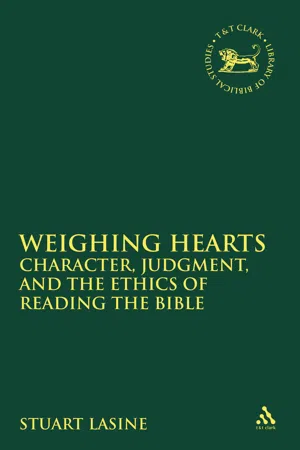
Issues involving 'character' have been the object of increasing interest and debate in recent years. Social psychologists attempt to determine the role of character as a cause of human behavior, moral philosophers explore the significance of character for understanding ethics and virtue, and literary scholars investigate the depiction of character in narrative. Weighing Hearts represents the first serious attempt to integrate all these approaches in order to gain a deeper and more precise understanding of how readers evaluate characters in biblical narrative. While the primary focus is on the Hebrew Bible, the author also includes several comparative analyses involving other ancient and modern literary works. Weighing Hearts also shows how biblical historians and redaction critics can make their analyses more precise and nuanced, by taking into account what psychology has learned about the consistency of character and the 'attribution errors' people make when evaluating others.
Information
Table of contents
- CONTENTS
- Preface
- Abbreviations
- Part I. METHODS, THEORIES, AND TEXTS
- Chapter 1. INTRODUCTION: SEEING WITH THE EYES OF EVALUATION
- 1. Judging Character: Methodology at the Intersection of Psychology, Literary Theory, and Moral Philosophy
- 2. Preview of Chapters 2–9
- Chapter 2. SEARCHING THE INNERMOST PARTS: CONSCIOUSNESS, SELF, AND MENTAL SPACE IN ANCIENT LITERATURE
- 1. “How different were the ancients?”
- 2. Methodological Problems Assessing Ancient Selves from Texts
- 3. Mental Space Ancient and Modern
- 4. Biblical Selves and Inner Space
- 5. Conclusion
- Chapter 3. WHEN SHOULD WE PSYCHOLOGIZE? EVALUATING CHARACTER IN REDACTED BIBLICAL TEXTS
- 1. Character and Situation in Job 1–2
- 2. Moses in Exodus 32 and Numbers 11
- 3. Elijah in 1 Kings 19 and Other Passages
- 4. David in 2 Samuel 12:15–23
- 5. Zedekiah in the Book of Jeremiah
- 6. Conclusion
- Part II. PROPHETS AND PERSONALITY
- Chapter 4. PROPHECY WITHOUT PERSONALITY: LIONIZED PROPHETS AND THE POWER OF LYING IN 1 KINGS 13 AND 20
- 1. Characters and Intentions
- 2. Der Gottesmann ohne Eigenschaften: Obedience and Vulnerability to Deceit
- 3. Lying, Success, and the Social Functions of Deceit
- 4. Moral and Theological Implications: Is Character Destiny?
- Chapter 5. PROPHECY, PERSONALITY, AND DEATH: PSYCHOLOGIZING ELIJAH
- 1. Describing Elijah’s Personality
- 2. 1 Kings 19:1–14
- 3. Narcissism and Death in 1 Kings 19
- 4. Narcissism, Death, and Immortality in the Elijah Narratives as a Whole
- Part III. CHARACTERIZING KINGS
- Chapter 6. REASSESSING THE CHARACTER OF CONDEMNED KINGS: NEW PERSPECTIVES ON JEROBOAM AND JEHORAM
- 1. Judging Jeroboam’s Character
- 2. Being Sane in Insane Places: Evaluating Jehoram’s Characterin Besieged Samaria
- Chapter 7. KINGS WICKED AND WEAK: THE CHARACTERIZATION OF AHAB IN COMPARATIVE PERSPECTIVE
- 1. Introduction: Flat Statements About Round Characters
- 2. Ahab and Periander as Wicked: Character, Situation, and Context
- 3. Ahab and Agamemnon as Weak Kings
- 4. Conclusion: Judging Ahab’s Character
- Part IV. CHARACTER AND THE ETHICS OF READING THE BIBLE
- Chapter 8. THE WITNESSING HEART: SELF-EVALUATION IN THE STORIES OF JOB AND KING DAVID
- 1. Self-evaluation and Self-betrayal in the Book of the Dead and the Book of Job
- 2. Varieties of Self-Evaluation in the Hebrew Bible
- 3. David’s Self-presentation as Soft and Weak in 2 Samuel 3
- Chapter 9. ART THOU THE MAN? JUDGING KING DAVID AND JUDGING OURSELVES
- 1. Counting Character and Weighing “Heaps” of Facticity
- 2. Identifying the Wicked and the “Negativity Bias”
- 3. Identifying the Sinner: Ambiguity, Attribution, and Cognitive Dissonance
- 4. It Is I to Whom It Is Speaking
- 5. Empathy, the Spell of Identication, and the Process of Character Evaluation
- 6. Judging King David and Ourselves
- 7. Judging Dickens’s David and Uriah
- 8. Judging Kafka’s Josef K. and King David
- 9. Conclusion
- Bibliography
- Index of Ancient Sources
- Index of Authors
Trusted by 375,005 students
Access to over 1.5 million titles for a fair monthly price.
Study more efficiently using our study tools.
Frequently asked questions
Yes, you can cancel anytime from the Subscription tab in your account settings on the Perlego website. Your subscription will stay active until the end of your current billing period. Learn how to cancel your subscription
No, books cannot be downloaded as external files, such as PDFs, for use outside of Perlego. However, you can download books within the Perlego app for offline reading on mobile or tablet. Learn how to download books offline
Perlego offers two plans: Essential and Complete
- Essential is ideal for learners and professionals who enjoy exploring a wide range of subjects. Access the Essential Library with 800,000+ trusted titles and best-sellers across business, personal growth, and the humanities. Includes unlimited reading time and Standard Read Aloud voice.
- Complete: Perfect for advanced learners and researchers needing full, unrestricted access. Unlock 1.5M+ books across hundreds of subjects, including academic and specialized titles. The Complete Plan also includes advanced features like Premium Read Aloud and Research Assistant.
We are an online textbook subscription service, where you can get access to an entire online library for less than the price of a single book per month. With over 1.5 million books across 990+ topics, we’ve got you covered! Learn about our mission
Look out for the read-aloud symbol on your next book to see if you can listen to it. The read-aloud tool reads text aloud for you, highlighting the text as it is being read. You can pause it, speed it up and slow it down. Learn more about Read Aloud
Yes! You can use the Perlego app on both iOS and Android devices to read anytime, anywhere — even offline. Perfect for commutes or when you’re on the go.
Please note we cannot support devices running on iOS 13 and Android 7 or earlier. Learn more about using the app
Please note we cannot support devices running on iOS 13 and Android 7 or earlier. Learn more about using the app
Yes, you can access Weighing Hearts by Stuart Lasine in PDF and/or ePUB format, as well as other popular books in Theology & Religion & Biblical Commentary. We have over 1.5 million books available in our catalogue for you to explore.