eBook - ePub
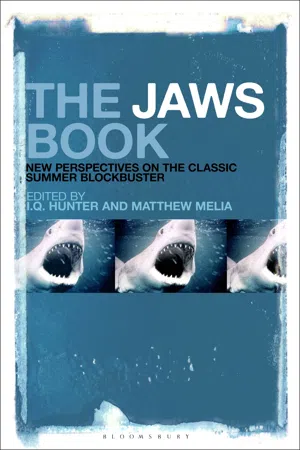
The Jaws Book
New Perspectives on the Classic Summer Blockbuster
- 288 pages
- English
- ePUB (mobile friendly)
- Available on iOS & Android
eBook - ePub
The Jaws Book
New Perspectives on the Classic Summer Blockbuster
About this book
After 45 years, Steven Spielberg's Jaws remains the definitive summer blockbuster, a cultural phenomenon with a fierce and dedicated fan base. The Jaws Book: New Perspectives on the Classic Summer Blockbuster is an exciting illustrated collection of new critical essays that offers the first detailed and comprehensive overview of the film's significant place in cinema history. Bringing together established and young scholars, the book includes contributions from leading international writers on popular cinema including Murray Pomerance, Peter Krämer, Sheldon Hall, Nigel Morris and Linda Ruth Williams, and covers such diverse topics as the film's release, reception and canonicity; its representation of masculinity and children; the use of landscape and the ocean; its status as a western; sequels and fan-edits; and its galvanizing impact on the horror film, action movie and contemporary Hollywood itself.
Trusted by 375,005 students
Access to over 1.5 million titles for a fair monthly price.
Study more efficiently using our study tools.
Information
Part One
Production, Reception and Style
1
‘She was the first’: The place of Jaws in American film history
Peter Krämer
The forty-fifth anniversary of the original release of Jaws in the United States is an appropriate occasion to consider its place in American film history and also to reflect on the paths we, as film scholars, have taken to arrive at our current thinking about this movie. So I want to take this opportunity for some personal and professional reflections before – sharklike, as it were – I get to the academic ‘meat’ of this essay.
Where was I in June 1975? The brief answer is: not in the cinema watching Jaws. This is not altogether surprising because I was still living in West Germany at the time, where the film was released only in September 1975, and even then I, being only 14 years old, was not allowed to see it because it was rated ‘16’. I am not sure whether I had even wanted to see Jaws. I vaguely remember that at some point in the mid-1970s I developed an aversion against the very idea of ‘big’ Hollywood movies, at least among current releases.
One of the first Film Studies books I read, and one of the reasons for my decision to study film at university, was a German translation of James Monaco’s How to Read a Film (first published in the United States in 1977). I was very pleased to find out a few years later that in 1979 Monaco had also published a book about contemporary Hollywood, American Film Now. It largely confirmed my distrust of Hollywood’s biggest hits. Monaco’s comprehensive study of the major Hollywood studios and the conglomerates they belonged to, of the ways films were made and marketed, of important aesthetic and generic trends as well as of key film-makers since the late 1960s set out to demystify American cinema: ‘The current governing myth has it that we are undergoing a Hollywood Renaissance – a rebirth. Yet, it seems to me, that – for the most part – American film in the seventies has a better reputation than it deserves.’1
In formulating his critique, Monaco referred to Jaws on several occasions2 and, referencing the name the crew had given to the film’s shark, went as far as characterizing what he perceived to be the main problem with contemporary Hollywood cinema as ‘the Bruce esthetic’:
The Bruce esthetic is visceral – mechanical rather than human. Films like Jaws that fit it are machines of entertainment, precisely calculated to achieve their effect – at the box office as well as inside the theater. Their model is the amusement-park rollercoaster. … Bruce movie machines have effectively driven out smaller, more idiosyncratic film projects of the sort that would rather interest an audience than viscerally excite it.3
As a film student, first in Germany and then in the UK, and as a film scholar I hardly read anything throughout the 1980s and early 1990s which did not critique contemporary Hollywood cinema along these or closely related lines. Then, in 1993, Thomas Schatz’s wonderfully succinct and incisive chapter on ‘The New Hollywood’ in Film Theory Goes to the Movies, an important collection on contemporary American cinema, expanded and deepened Monaco’s critique, using some of the same terminology, for example, when he wrote that across the 1970s, ‘we see films that are increasingly plot-driven, increasingly visceral, kinetic, and fast-paced’.4 Like Monaco, Schatz also referred to a ‘renaissance’ (or rather: a renaissance ‘of sorts’) in American cinema: ‘with the 1966 breakdown of Hollywood’s Production Code and the emergence in 1968 of the new ratings system … filmmakers were experimenting with more politically subversive, sexually explicit, and/or graphically violent material’.5 Schatz interpreted Hollywood’s ‘penchant for innovation in the late 1960s and early 1970s’ as a sign of ‘the studios’ uncertainty and growing desperation’ in the face of a series of catastrophic big-budget flops which had led to estimated overall losses in excess of half a billion dollars from 1969 to 1971.6
In Schatz’s account, Hollywood’s financial recovery was closely associated with a series of massive hit movies from The Godfather (1972) onwards, and it is this recovery and this hit series which is at the heart of what he called ‘The New Hollywood’, a term he used to characterize mainstream American cinema since the 1970s.7 Even more so than Monaco, Schatz focused on the importance of Jaws by declaring: ‘If any single film marked the arrival of the New Hollywood, it was Jaws.’8 It is important to emphasize here that, like Monaco, Schatz did not see Jaws as the beginning of a new era in Hollywood history, just as the most perfect incarnation of the New Hollywood. Indeed, he noted that, ‘[i]n many ways, the film simply confirmed or consolidated various existing industry trends and practices’, thus making sure that these trends and practices would dominate for decades to come.9
By the time I read Schatz’s essay, I had belatedly embarked on my own investigation of Hollywood’s biggest box office hits in the United States, inspired by the work of the German film historian Joseph Garncarz.10 Finally watching the big hits from the 1970s and 1980s which I had missed during their original release, I soon identified a pattern that I thought other scholars (including Monaco and Schatz) had not paid sufficient attention to. Most of the biggest hits from 1977 onwards were films which appeared to be addressed to, and successful with, an all-inclusive family audience, comprising cinema’s core audience of teenagers and young adults, as well as younger children and their parents. Because these films tended to take their characters (and their audiences) on fantastic adventures and also tended to focus on familial (or quasi-familial) relationships, I labelled them ‘family-adventure movies’. Interestingly, Jaws and many other big hits of the decade before 1977, notably The Exorcist (1973), did not fit into this category, mainly because they did not seem to be addressed to, and successful with, family audiences. I did not make much of this observation at the time, but it became the foundation of much of my later work on recent American film history.
I first presented the results of my research on American hit patterns at a conference entitled ‘Hollywood since the Fifties: A Post-Classical Cinema?’, organized by Steve Neale at the University of Kent in July 1995. I think I was not the only scholar who experienced this conference as a turning point in scholarship on contemporary Hollywood, because it brought together a wide range of approaches and was, by and large, much less judgemental than most previous academic work on the subject. The papers presented at that conference, including my paper on family-adventure movies, were published in 1998 in the edited collection Contemporary Hollywood Cinema.11 By this time, I had also published a long essay on the relationship between film and television in the United States, which not only went all the way back to the late nineteenth century but also aimed to identify an important shift in the media landscape between the 1970s and the 1980s.12
In addition, 1998 saw the publication, in The Oxford Guide to Film Studies, of an essay I had written a couple of years earlier about the long-running debates among film critics and scholars about the end of the ‘classical’ era in American film history and the beginning of a new era which, referring to the immediate post-war decades or to the period from the 1960s to the 1980s, had variously been labelled ‘the baroque’, ‘Hollywood in transition’, the ‘Hollywood Renaissance’, the ‘New Hollywood’ or ‘post-classical’ Hollywood.13 Apart from finding that journalistic and academic commentators as well as industry insiders had talked for almost five decades about the end of the studio system and of classical film-making, I noticed that, in addition to Monaco and Schatz, many other scholars had made strong and compelling claims about important aesthetic and industrial shifts across the 1960s and again in the 1970s. Both 1967, the year in which a Time cover stor...
Table of contents
- Cover
- Half-title Page
- Title Page
- Illustrations
- Foreword
- Acknowledgements
- Notes on Contributors
- Introduction
- Part One Production, Reception and Style
- Part Two Interpretation
- Part Three Beyond Jaws
- Index
- Copyright Page
Frequently asked questions
Yes, you can cancel anytime from the Subscription tab in your account settings on the Perlego website. Your subscription will stay active until the end of your current billing period. Learn how to cancel your subscription
No, books cannot be downloaded as external files, such as PDFs, for use outside of Perlego. However, you can download books within the Perlego app for offline reading on mobile or tablet. Learn how to download books offline
Perlego offers two plans: Essential and Complete
- Essential is ideal for learners and professionals who enjoy exploring a wide range of subjects. Access the Essential Library with 800,000+ trusted titles and best-sellers across business, personal growth, and the humanities. Includes unlimited reading time and Standard Read Aloud voice.
- Complete: Perfect for advanced learners and researchers needing full, unrestricted access. Unlock 1.5M+ books across hundreds of subjects, including academic and specialized titles. The Complete Plan also includes advanced features like Premium Read Aloud and Research Assistant.
We are an online textbook subscription service, where you can get access to an entire online library for less than the price of a single book per month. With over 1.5 million books across 990+ topics, we’ve got you covered! Learn about our mission
Look out for the read-aloud symbol on your next book to see if you can listen to it. The read-aloud tool reads text aloud for you, highlighting the text as it is being read. You can pause it, speed it up and slow it down. Learn more about Read Aloud
Yes! You can use the Perlego app on both iOS and Android devices to read anytime, anywhere — even offline. Perfect for commutes or when you’re on the go.
Please note we cannot support devices running on iOS 13 and Android 7 or earlier. Learn more about using the app
Please note we cannot support devices running on iOS 13 and Android 7 or earlier. Learn more about using the app
Yes, you can access The Jaws Book by I.Q. Hunter, Matthew Melia, I.Q. Hunter,Matthew Melia in PDF and/or ePUB format, as well as other popular books in Mezzi di comunicazione e arti performative & Film e video. We have over 1.5 million books available in our catalogue for you to explore.