Applying Deleuze's schizoanalytic techniques to film theory, Deleuze and the Gynesis of Horror demonstrates how an embodied approach to horror film analysis can help us understand how film affects its viewers and distinguish those films which reify static, hegemonic, "molar" beings from those which prompt fluid, nonbinary, "molecular" becomings. It does so by analyzing the politics of reproduction in contemporary films such as Ex Machina; Mary Shelley's Frankenstein; Mad Max: Fury Road; the Twilight saga; and the original Alien quadrilogy and its more recent prequels, Prometheus and Alien: Covenant.
Author Sunny Hawkins argues that films which promote a "monstrous philosophy" of qualitative, affirmative difference as difference-in-itself, and which tend to be more molecular than molar in their expressions, can help us trace a "line of flight" from the gender binary in the real world. Deleuze and the Gynesis of Horror demonstrates how the techniques of horror film – editing, sound and visual effects, lighting and colour, camera movement – work in tandem with a film's content to affect the viewer's body in ways that disrupt the sense of self as a whole, unified subject with a stable, monolithic identity and, in some cases, can serve to breakdown the binary between self/Other, as we come to realize that we are none of us static, categorizable beings but are, as Henri Bergson said, "living things constantly becoming."
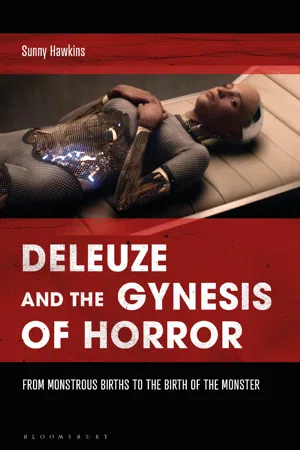
eBook - ePub
Deleuze and the Gynesis of Horror
From Monstrous Births to the Birth of the Monster
- 208 pages
- English
- ePUB (mobile friendly)
- Available on iOS & Android
eBook - ePub
Deleuze and the Gynesis of Horror
From Monstrous Births to the Birth of the Monster
About this book
Information
1
Mother, (m)Other
Gilles Deleuze (1925–95) was among the first philosophers of the twentieth century to take seriously what was at the time a relatively untheorized art: cinema. In fact, Deleuze insisted that film itself can be a philosophic medium, embodying the “transcendental empiricism” he argued for as a means of escape from the cultural, political, personal, and philosophical trap of an egoistic self.
This is not to say, however, that Deleuze saw film as representing philosophic thought. Rather, Deleuze viewed film as a mechanism via which viewers might experience the “self” not as a separate, divided, stable, subjective entity but as a self, uncategorizable by culturally determined norms and expectations inscribed onto human bodies by a culture that has deluded its members into believing our “selves” could ever be organized into identities or frozen into subjects. To Deleuze, the only reality was “virtuality,” the ceaseless becoming of a self-in-flux across time: a self always engaged in becoming different from itself. Such a virtual or potential self cannot be thought into being, for in the act of thinking-of-self we fix and freeze the self we are thinking of, thereby arresting the potentiality of becoming. Hence, our habituated ways of thinking—our (mis)perceptions or delusions of a self as The Self—in fact serve only to confine us into dualistic modes of being. According to Deleuze and his philosophic partner, the psychologist Felix Guattari, the “schizo”—the disordered mind able to exist without either boundaries between “self” and “other” or the fiction of reality and subjectivity to stabilize it—was the only “free” mind: free because the schizo had accepted reality as delusion and refused to participate in the great social delirium of granting to imagined, cultural fictions the status of generalizable, universal Truth.
For those readers unfamiliar with Deleuze and Guattari, a brief (and necessarily truncated) introduction to their philosophical partnership may clarify how Deleuze later applied their collaboratively devised “schizosophy” to his individual work on cinema. Deleuze and Guattari began their collaboration during the economic and political upheaval of late-1960s France, when French philosophy became overtly political in its attempts to demonstrate how identity, far from being the purview of an individual, is socially constructed and constrained, with the goal that such an understanding would ultimately free individuals from hegemonic restraints. Their first collaborative work Anti-Oedipus set out to dismantle Freudianism, in which neuroses and psychoses were produced by improper gender identification within the patriarchal nuclear family, as well as Marxism, in which neuroses and psychoses were created by inequitable, unjust socioeconomic conditions. In the first place, Deleuze and Guattari objected to Freud’s and Marx’s attempts to segregate the psychological/individual from the cultural/social realm; they argued instead for a synthetic theory capable of interrogating the interplay between the individual/social, wherein identity is constantly becoming—constantly produced as individuals assemble with social, cultural, political, educational, religious, economic, and other institutions. Moreover, Deleuze and Guattari proposed, in direct contravention of Freudian psychoanalysis, that there is no stable, static ego (or subject), for the self is, again, constantly becoming different from its-self. Even more importantly, they proposed that the “economy of desire” that produces these becomings is not motivated by lack, as it is in Freudianism, but is instead affirmative and creative: a desiring-production. The “social machine,” as Deleuze and Guattari call it, seeks to repress desiring-production, forming/forcing individuals into stable, static subjects submissive to the status quo—“good” citizens who go to work, spend money, obey laws, pay taxes, have children, and so on.
In the figure of “the schizo,” Deleuze and Guattari pointed to an individual unrestrained by social and cultural institutions (including the family), motivated not by conformity to sociocultural expectations but by the self-constituting desire to create an ever-evolving, autonomous self. Their second collaboration A Thousand Plateaus: Capitalism and Schizophrenia sought to present an affirmative philosophy of difference indebted to dynamic systems theory, in which material systems reach thresholds (or “plateaus”) that reduce or restrict their movements, constricting the “flow” of desiring-production—such as what happens to the individual when it confronts social, political, economic, or even linguistic structures that tend toward actuality, or systems meant to fix, freeze, and order individuals into (hegemonic) subjects. The schizo resists and ultimately rejects this fixing, freezing, and ordering, remaining an “open” system of desiring-production, or what Deleuze and Guattari called the Body without Organs (BwO); but, Deleuze and Guattari note, there are also systems that tend in the opposite direction from actuality, in which desiring-production is always progressing toward a virtual state that will never be realized or attained, never finished or frozen, leaving the individual open to those ceaseless assemblages and constant becomings.1
To say that Deleuze and Guattari turned philosophy on its head would be an understatement. Furthermore, their ideas, radical in themselves, were further radicalized by Deleuze’s later insistence that cinema was the modern era’s most excellent medium, or mechanism, for embodying the schizosophic principles he and Guattari identified. Yet, for all its radicality, Deleuze’s cinematic schizosophy was not the theoretical approach adopted once film came to be theorized in the mid- to late-twentieth century. Instead, film theorists, particularly those interested in gender, gravitated toward a theory Deleuze and Guattari vehemently and systematically rejected: Freudian psychoanalysis.
Before delving deeper into the maternal—the concept that animates the project of this book—let us step back, taking this time to examine in more detail both Deleuze’s cinematic philosophy as it has been applied by contemporary film theorists (especially those concerned with horror) and Deleuze and Guattari’s schizoid philosophy, which gives rise to schizoanalysis as a film theory in many ways counterposed to psychoanalytic film theory. Yet we must tread carefully, being sure not to draw another, and false, binary between psychoanalysis and schizoanalysis. Much about these theories can inform and enhance the other, even as schizoanalysis brings a more nuanced, inclusive, and embodied approach to film analysis that might point us toward a society no longer threatened by “the Other”—a society open to embracing difference as difference-in-itself.
Transcendental Empiricism: Deleuze’s Cinematic Philosophy
Schizoanalysis relies on dissolution of the ego, the film viewer’s loss of the sense of “self” as one loses track of whether one is “inside” or “outside” the film event. In Pure Immanence: Essays on A Life, Deleuze writes that our consciousness solidifies into dualisms (me/not me, inside/outside) “only when a subject is produced at the same time as its object, both being outside the field and appearing as ‘transcendents’. . . . [A]s long as consciousness traverses the transcendental field at an infinite speed everywhere diffused, nothing is able to reveal it” (2005: 26). In film, the viewer’s consciousness operates at this “infinite speed” as our brains work to process a deluge of stimulation delivered to and through our optic and auditory nerves. Film may therefore be one of those open or virtual systems that destabilizes the production of a fixed-and-frozen Self that could consciously perceive or conceive the images, sounds, movements, special effects, and edits of the film event as a stable, unified object capable of producing a cinematic or spectatorial subject.
Deleuze composed two works on the philosophy of cinema, Cinema 1 and Cinema 2, popularly known as his Cinema Books. Nevertheless, applying Deleuze’s theories is often easier said than done—which, as other schizophilosophers have noted, is one reason why Deleuze’s work has so long remained obscure outside his native France.2 Perhaps the most striking feature of schizoanalysis is that it foregoes the “model of the eye, which traditionally has been the most important model for perceiving, conceiving, imagining, and judging representation and difference (‘I see,’ ‘I think,’ ‘I imagine’ . . . all through the noble sense of sight, which presupposes an ‘I’ that transcends experience) for a model of the brain” wherein “the brain itself functions like the screen. It is here that we make assemblages and rhizomatic connections” (Pisters 2003: 7). In defining schizoanalysis, Anna Powell distinguishes its methods and aims from those of what will hereafter be referred to as cinepsychoanalysis. Her explanation also helps explain why the body is central to Deleuzian film philosophy, a point that will resonate throughout discussions of both horror and maternity in this book. In contrast to Freud’s ordered, three-part psyche (id, ego, and superego), and in explanation of how the schizoanalytic viewer differs from the psychoanalytic spectator in ways that challenge the idea of cinema as a monolithic cultural apparatus for producing cinematic subjects, Deleuze and Guattari, following Henri Bergson, propose that
there are two different selves, one of which is the external projection and social representation of the other. The internal operations of the self are reached by deep introspection, a process that leads us to grasp our inner states as living things constantly becoming. . . .[wherein] identity is in constant flux and process. Perception [of cinema] takes place on a direct, visceral level rather than at a subjective level. Cinema is an intensive sensory event of colour, light, and movement. If our subjectivity is not fixed, then our identity in the viewing experience is not a rigid template, but a fluid becoming. (Powell 2005: 19–20, 207)
Deleuze’s point, captured eloquently by Powell, was that the cinematic viewing experience has the power to change the viewer because film viewing is an embodied encounter experienced in and through the brain, not through the (allegedly transcendent) eye/I. Schizoanalysis maintains that, when highly affected by a film, as viewers we approach this transcendental (not “transcendent”) introspective experience in which sensation overtakes or replaces thought. Whereas cinepsychoanalysis has focused on detached, symbolic readings of film and analysis of spectatorial identification with characters, schizoanalysis focuses on “excessive forms of cinematography, mise-en-scéne, editing and sound . . . the pivotal tools of horror, used to arouse visual sensations and ‘horrify’ the viewer. Theories of representation and narrative structure neglect the primacy of corporeal affect” (Powell 2005: 2), that is, how a horror film affects the viewer’s body, as our hearts race, our stomachs clench, and our palms sweat. Yet it is this affectively corporeal experience of film viewing that may serve to dissolve our egos, even for a moment, creating space for viewers to become—an experience that cannot be undone even after the film ends and viewers begin to think as “I/eye” again.
In other words, the aim of schizoanalysis as both Anna Powell and Teresa Rizzo have applied it to film has been to theorize how films go about affecting our viewing bodies in ways that allow us to reach those “internal operations of the self,” freeing us to see ourselves not as fixed, stable identities—our external, social projections—but, as Bergson said, “as living things constantly becoming.” However, like Powell, I do not mean to discount the contributions made to film and gender studies by those cinepsychoanalysts who have “map[ped] social and political meaning onto the representations of fantasy,” nor can it be denied that “[f]ear and desire have subjective specificity and operate within a socially learned framework” (2005: 204). Nevertheless, like Powell, I argue that because the people, places, and things we see on film are rendered virtually, their “representational capacity” does not overtake the embodied effect of cinema as viewer s “are moved by, and move with, lighting, montage, and the camera’s motion in space and time” (2005: 201).
Again, without drawing a binary between schizoanalysis and cinepsychoanalysis, it nonetheless seems that cinepsychoanalysis, by focusing exclusively on film-as-representation, lacks the ability of schizoanalysis to illuminate cinema’s transformative potential, since it is through a film’s affective force, a force even stronger in horror than in other types of film,3 that film produces thought in a complex interaction between optic and auditory nerves and neurologic pathways, or as Deleuze put it, the brain is the screen. If we consider how our brains, interpreting information gained through our optic nerves, convince us that the images on film exist in spatial and temporal relation to one another, we may recall Deleuze writing of our “indefinite life” that has no “moments, close as they may be one to another, but only between-times, between-moments; . . . the immensity of an empty time where one sees the event yet to come and already happened” (2005: 29). Cinema for Deleuze, as a collection of images filmed at different times, in different spaces, then assembled to appear continuous, even seamless, was at its most philosophic when it revealed this time-image, the image of time as immanent; for it could be said that film is editing, since it is in editing, the literal between-times and between-moments, that cinematic time and space as we have come to know it becomes possible. In this instance, as in others, film provides the opportunity for viewers to reflect on “perception itself” (Powell 2005: 202). Such reflection may, and often does, continue after the film has ended, since “perception and reflection vibrate in us at different speeds. Ideally, Deleuze wants us to approach each film as a direct event, letting it work on us without preconceptions” (Powell 2005: 202)—the very “preconceptions” the eye/I of cinepsychoanalysis, steeped as it is in representation and identification, would weld us to. Yet approaching film as a “direct event,” rather than as a text onto which preconceived concepts can be mapped, requires a framework for analyzing the affective potential of film’s aesthetic and technological components, such as camera movement, light and color, editing techniques, and sound and visual effects. This is what schizoanalysis provides: a theory of film viewing that does not treat film as solely a representation of reality (as cinepsychoanalysis does) but instead as an embodied event with the expressive capacity to affect a viewer, whose “internal operations” can then be changed by and through the film event.
Schizoanalysis requires more than adopting a new set of tools for film analysis, however, for schizoanalysis operates from a paradigm radically different than the paradigm of psychoanalysis. In schizoanalysis, Freudian “[p]sychic interiority is replaced by an immanence in which desire is process and energy. Here, ideas are dynamic events or ‘lines of flight’ that can take us into ‘a fibrous web of directions’. . . . The term ‘rhizome’ (or lateral, multi-forked root system) suggests the nomadic movement of thought by the intensities of a self in process” (Powell 2005: 21–2). Rhizomatic thinking could not diverge more sharply from representational thinking, for rhizomatic thinking is non-hierarchic, non-dualistic, and non-chronologic (Pisters 2003: 6). Rhizomatic thinking instead remains open and multiplicitous and therefore, as this chapter will argue, able to think difference differently than i...
Table of contents
- Cover
- Half-Title
- Title
- Contents
- Acknowledgments
- Introduction
- 1 Mother, (m)Other
- 2 Mother (of) Monsters
- 3 Meet Your Makers
- 4 It’s a Monster (Baby)
- 5 The Post-human Family
- Notes
- References
- Films
- Index
- Copyright
Trusted by 375,005 students
Access to over 1.5 million titles for a fair monthly price.
Study more efficiently using our study tools.
Frequently asked questions
Yes, you can cancel anytime from the Subscription tab in your account settings on the Perlego website. Your subscription will stay active until the end of your current billing period. Learn how to cancel your subscription
No, books cannot be downloaded as external files, such as PDFs, for use outside of Perlego. However, you can download books within the Perlego app for offline reading on mobile or tablet. Learn how to download books offline
Perlego offers two plans: Essential and Complete
- Essential is ideal for learners and professionals who enjoy exploring a wide range of subjects. Access the Essential Library with 800,000+ trusted titles and best-sellers across business, personal growth, and the humanities. Includes unlimited reading time and Standard Read Aloud voice.
- Complete: Perfect for advanced learners and researchers needing full, unrestricted access. Unlock 1.5M+ books across hundreds of subjects, including academic and specialized titles. The Complete Plan also includes advanced features like Premium Read Aloud and Research Assistant.
We are an online textbook subscription service, where you can get access to an entire online library for less than the price of a single book per month. With over 1.5 million books across 990+ topics, we’ve got you covered! Learn about our mission
Look out for the read-aloud symbol on your next book to see if you can listen to it. The read-aloud tool reads text aloud for you, highlighting the text as it is being read. You can pause it, speed it up and slow it down. Learn more about Read Aloud
Yes! You can use the Perlego app on both iOS and Android devices to read anytime, anywhere — even offline. Perfect for commutes or when you’re on the go.
Please note we cannot support devices running on iOS 13 and Android 7 or earlier. Learn more about using the app
Please note we cannot support devices running on iOS 13 and Android 7 or earlier. Learn more about using the app
Yes, you can access Deleuze and the Gynesis of Horror by Sunny Hawkins,Sunny Romack in PDF and/or ePUB format, as well as other popular books in Media & Performing Arts & Film & Video. We have over 1.5 million books available in our catalogue for you to explore.