- 288 pages
- English
- ePUB (mobile friendly)
- Available on iOS & Android
eBook - ePub
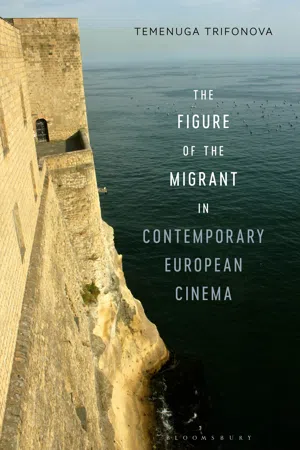
The Figure of the Migrant in Contemporary European Cinema
About this book
The Figure of the Migrant in Contemporary European Cinema explores contemporary debates around the concepts of 'Europe' and 'European identity' through an examination of recent European films dealing with various aspects of globalization (the refugee crisis, labour migration, the resurgence of nationalism and ethnic violence, neoliberalism, post-colonialism) with a particular attention to the figure of the migrant and the ways in which this figure challenges us to rethink Europe and its core Enlightenment values (citizenship, justice, ethics, liberty, tolerance, and hospitality) in a post-national context of ephemerality, volatility, and contingency that finds people desperately looking for firmer markers of identity. The book argues that a compelling case can be made for re-orienting the study of contemporary European cinema around the figure of the migrant viewed both as a symbolic figure (representing post-national citizenship, urbanization, the 'gap' between ethics and justice) and as a figure occupying an increasingly central place in European cinema in general rather than only in what is usually called 'migrant and diasporic cinema'. By drawing attention to the structural and affective affinities between the experience of migrants and non-migrants, Europeans and non-Europeans, Trifonova shows that it is becoming increasingly difficult to separate stories about migration from stories about life under neoliberalism in general
Information
1
The Migrant as a Symbolic Figure
The two principal approaches in contemporary scholarship on audiovisual representations of migration have been phenomenological approaches and autonomy-of-migration (AoM) approaches. While some of the films discussed in the present study underscore the autonomy and agency of the migrant, while others dramatize the frequently intangible ways in which migrant bodies are “governed” and “blocked,” both approaches share an awareness of the iconic nature of migration, acknowledging the central role cinema and television have played in shaping the public perception of migrants.
Phenomenological studies of migration highlight the various institutional practices and administrative mechanisms that continue to govern and regulate migrants and refugees beyond the physical border of the camp by drawing attention to the ways in which migrant bodies are “contained” or “blocked” not only in space but also psychologically and emotionally. In contrast to AoM’s emancipatory notion of “mobile subjects”, phenomenological approaches view migrants as “governed subjects” inasmuch as the government of freedom of movement does not only operate through sheer blockage—incarceration, detention, or encampment—but works, as well, “through mechanisms of spatial and temporal suspension of people’s lives beyond the regime of visibility sanctioned by such institutional technologies’ lifespans.”1 Underscoring the subjective and existential dimension of migration, which remains largely unexplored, Fiorenza Picozza employs the term “decelerated circulation” to describe the temporal and spatial regulation of migration through various practices of detention (including waiting, hiding, unexpected diversion) that profoundly affect migrants’ experience of time and of their own bodies.2 With their trajectories of movement continually disrupted and fragmented migrants experience their own self as a “self-in-transit,” always imagining their life elsewhere and elsewhen. Borrowing a term from R. D. Laing, Picozza describes the migrants’ sense of being doubly absent (physically from their home country and mentally and emotionally from the country they currently find themselves in), and of their lives as being forever postponed as “a schizoid experience of unembodiment.”3
Ipek Celik approaches the link between temporality and migration from a slightly different perspective. Instead of studying migration as a specific temporal experience constituted by absence, transitoriness, and unbelonging, and in contrast to earlier work on the spatial cartography of Otherness in European cinema and media, she analyzes the temporality assigned to migrants by the media, a temporality “of violent events followed by periods of incurable social crisis pregnant with the threat of impending rupture.”4 Citing numerous examples of media depictions of migrants and refugees in relation to emergency situations, Celik seeks to understand “how and why violence and temporality of crisis have become central to the articulation of ethnic and racial difference in today’s Europe.”5 More often than not, she claims, migrants are denied what Johannes Fabian, in Time and the Other (1983), calls “coevalness” by being represented either through “‘untimely’ acts such as ‘honor’ crimes that seem to emerge from a distant temporality, instead of being placed within the more general framework of domestic violence,”6 or by being assigned a catastrophic temporality of crisis.
Dismissing traditional, realist forms of representation as no longer capable of accounting for today’s “traveling cultures” (Clifford) and “global ethnoscapes” (Appadurai), visual anthropologist Steffen Kohn also calls for a phenomenological approach to the study of migration. According to Kohn, the increased mobility and interconnectedness of people, things, and places poses an epistemological problem for anthropology, which has traditionally been based on an obsolete “sedentarist metaphysics” that has allowed the anthropologist to “segregate himself and his world from the static, fixed and timeless world of the (primitive) cultural world he studied.”7 Not only would a phenomenological approach reveal “how global relations are necessarily inscribed in local lifeworlds”8 and analyze migration as a temporal experience (through Husserl’s theory of time-consciousness), but a more sensuous approach to ethnography would benefit the social analysis of power relations. Cinema offers an invaluable opportunity for the study of migration thanks to its phenomenological qualities “which inherit an important ethical potential9 as they bring us into an empathetic position toward the other and make abstract political processes become understandable in their effects on individuals and their lifeworld.”10 Drawing on Sobchack’s phenomenological theory of film, Kohn argues that certain cinematic techniques, specifically montage, are better suited to convey the complex spatial and temporal aspect of migration (e.g., by disorienting viewers so they can feel the sense of dislocation and deterritorialization experienced by migrants) thus helping us rethink contemporary culture from the perspective of mobility, movement, and interconnectedness rather than singularity, situatednness, belonging, and home. Insofar as transnational subjects like migrants, refugees, and travellers “experience global processes foremost in the form of absences,”11 cinema, which also works through absences, gaps, and ellipses, can transcend “the limitations of the micro perspective of situated observers and their subject-centered vision.”12
At the opposite end of the spectrum from phenomenological approaches are AoM approaches to migration. Emerging in reaction to the traditional view of migration as a mere response to socioeconomic factors and to the discourse of human rights with its patronizing conception of migrants as passive victims of globalization, AoM approaches (Nicholas de Genova, Catherine Wihtol de Wenden, Thomas Nail, Souad Osseiran, Stephan Scheel, Ranabir Samaddar) seek to restore agency to migrants by rethinking migration as a dynamic and autonomous way of reimagining/re-bordering Europe. Osseiran’s study of the ways in which Syrian refugees in Istanbul imagine migration into and within Europe is exemplary here. According to Osseiran, “Syrian refugees/migrants configure Europe and the EU not in terms of core and periphery, or centers and margins, but rather in more fragmentary ways that draw attention to some spaces and overlook others.”13 As they plan their migration route into and within Europe migrants bypass certain countries, where they do not want to, or cannot, stay permanently, viewing them merely as transit zones on the way to other countries. By “re-bordering” Europe via their discrepant and unpredictable movements migrants are “producing their own imagined ‘Europe,’” which, Osseiran insists, should be seen as a political act by political subjects or “mobile actors” with specific “mobility projects.”14 In a similar vein, examining the ways in which aspiring migrants “appropriate mobility to Europe via Schengen visas in the context of biometric border controls,”15 Stephan Scheel believes that the term “appropriation” “is better equipped than the inherently reactive concept of ‘resistance’ to account for the constitutive role that practices of subversion and dissent by the governed play in the transformation of regimes of government.”16 Adding to the critique of the dominant tendency to see refugees as mere objects of Western pity, Nicholas de Genova reminds us that “refugees never cease to also have aspirations and . . . they remain subjects who make more or less calculated strategic and tactical choices about how to reconfigure their lives and advance their life projects.”17 He urges us to see the migrant crisis as something positively exciting, “a remarkable site of unprecedented experimentation and improvisation, a transnational and intercontinental laboratory for the regimentation and subordination of human powers and freedoms in relation to the space of the planet.”18
Along similar lines, and distancing herself from studies that associate migration primarily with suffering, injustice, and death, Catherine Wihtol de Wenden credits migration with putting the individual back on the scene as an “agent” that influences international relations and defies the power of the State by appealing to supranational and non-state powers, especially through the appeal to human rights. This time, however, the individual dominating international relations is neither the individual embodying the State (the monarch), nor the individual representing the state (the national hero), but rather the ordinary person whose strength lies not in his power but in his number.19 Rejecting the pessimistic conclusions critics like Fukuyama and Bauman draw from neoliberalism’s commodification of citizenship and its celebration of individual over communal interests, de Wenden celebrates the migrant as anticipating a utopian world, in which the nation state will no longer be the principal actor, and which will be governed by new values, for example, the value of “vivre-ensemble.”20 It is thanks to the migrant, she believes, that a new human right—the right to migrate—has begun to constitute itself, finally correcting the asymmetry between the right to leave a country, including one’s own (guaranteed by the 1948 Universal Declaration of the Rights of Man) and the right to enter another country, not yet established as a right (a situation that is the inverse of that in the nineteenth century, when it was difficult to leave one’s country but relatively easy to enter another country).
In de Wenden’s analysis, the seemingly most powerless—refugees and minorities—emerge, paradoxically, as the most powerful in opposing the state by appealing to transnational non-state actors (e.g., human rights treaties and organizations). Rather than enumerate the seemingly infinite number of obstacles to mobility migrants/refugees face every day, de Wenden prefers to view such obstacles as motivating migrants to develop new, creative strategies of adaptation and multiple overlapping identities: for example, the same migrants can, in the course of their life, occupy a plurality of statuses, from sans-papiers, student, tourist, salaried work er, asylum seeker, family reunification applicant to qualified elite, a plurality of identities unthinkable in the past when the Soviet dissident was the main model of the “refugee.” The emphasis on the plurality of identities represented by the figure of the migrant is indicative of a tendency in recent scholarship to valorize, rather than bemoan, the migrant’s precarious (transitory, multiple and uncertain) status: here we might refer to Giorgia Ceriani-Sebregondi’s notion of “capital mobilitaire,”21 which construes mobility as “a strategy of adaptation”; Mehdi Alioua’s description of the transit migration of Subsaharrians in Morocco as an “adventure” through which migrants fashion themselves into “‘entrepreneurs’ ‘working on their mobility projects;’”22 Marie-Therese Tetu’s romantic description, in Clandestins au pays des papiers (2009), of the everyday life of sans-papiers as a modern “odyssey”; or even Laurent Berlant’s “cruel optimism,” which she also defines as “a strategy of adaptation,” though she does acknowledge that “strategy” to be ultimately self-destructive.
Heavily indebted to Paul Patton’s and Stephen Muecke’s adaptation of Deleuze and Guattari’s theories of nomadology—the idea of nomadic groups using “nomadic strategies” (mobility) in their political struggles23 —Thomas Nail’s The Figure of the Migrant (2015) uses the migrant to rethink political philosophy along the lines of what he calls “kinopolitics,” profiting from the double connotation of “kino” (referring both to movement/migration and cinema). There are unmistakable similarities between Nail’s conceptualization of “kinopolitics” as an analysis of “social flows” and Appadurai’s rethinking of Anderson’s (static and nation-based) “imagined communities” in terms of five types of “scapes,” though Appadurai’s concepts are derived from botany while Nail draws upon the fluid sciences (aerodynamics and hydrodynamics) and statistics. Nail’s central argument is that insofar as “flows” (of which migration is one instance) cannot be blocked or controlled but only slowed down or redirected, the migrant is always on the move; even when he is deported or deprived of social status his absence still shapes the society from which he has been expulsed. In short, the migrant is never a passive victim but an active force to describe which Nail coins a new term—“kinopower”—that invests movement with agency in opposition to the prevalent tendency to associate movement with powerlessness. Drawing on Bergson’s philosophy and on various strands of poststructuralism to reclaim the value of movement over stasis and recuperate displacement from a lack to “a positive capacity or trajectory,”24 Nail rewrites history from the point of view of what used to be seen as marginalized figures—nomads, barbarians, vagabonds, the proletariat, and migrants—who, far from being passive victims of social expulsion, are celebrated as the primary driving force of social and political history.
Nail’s reframing of migration in terms of autonomy is typical of AoM approaches, which, in seeking to correct the (pre)conception of migrants as victims, tend to swing to the opposite extreme of over-valorizing and/or misrepresenting what is often involuntary, even forced, movement as “voluntary” and “free.” But does changing the vocabulary we use to talk about migration—replacing “migration” with “mobility project” or “aspirations,” or “migrant/refugee” with “mobile actor”—endow migrants/refugees with real agency? The rhetoric of “excess” frequently employed by AoM approaches to underscore migration’s supposed autonomy and unpredictability—“escape, creativity, stubbornness, potentiality, uncontrollability, supplement, independence, surplus”25 —runs the risk of idealizing and romanticizing migration, as evidenced by the return of an old sociological figure—the flân...
Table of contents
- Cover
- Half-Title
- Title
- Contents
- Acknowledgments
- Introduction: The Figure of the Migrant as a Challenge to the Idea of “European Identity”
- 1 The Migrant as a Symbolic Figure
- 2 Rethinking European Identity and European Cinema in the Age of Mass Migration: Between Abjection and Impersonation
- 3 The Figure of the Migrant and Cinematic Ethics
- 4 Crossovers Between the Cinema of Migration and the Cinema of Precarity
- Bibliography
- Index
- Copyright
Trusted by 375,005 students
Access to over 1.5 million titles for a fair monthly price.
Study more efficiently using our study tools.
Frequently asked questions
Yes, you can cancel anytime from the Subscription tab in your account settings on the Perlego website. Your subscription will stay active until the end of your current billing period. Learn how to cancel your subscription
No, books cannot be downloaded as external files, such as PDFs, for use outside of Perlego. However, you can download books within the Perlego app for offline reading on mobile or tablet. Learn how to download books offline
Perlego offers two plans: Essential and Complete
- Essential is ideal for learners and professionals who enjoy exploring a wide range of subjects. Access the Essential Library with 800,000+ trusted titles and best-sellers across business, personal growth, and the humanities. Includes unlimited reading time and Standard Read Aloud voice.
- Complete: Perfect for advanced learners and researchers needing full, unrestricted access. Unlock 1.5M+ books across hundreds of subjects, including academic and specialized titles. The Complete Plan also includes advanced features like Premium Read Aloud and Research Assistant.
We are an online textbook subscription service, where you can get access to an entire online library for less than the price of a single book per month. With over 1.5 million books across 990+ topics, we’ve got you covered! Learn about our mission
Look out for the read-aloud symbol on your next book to see if you can listen to it. The read-aloud tool reads text aloud for you, highlighting the text as it is being read. You can pause it, speed it up and slow it down. Learn more about Read Aloud
Yes! You can use the Perlego app on both iOS and Android devices to read anytime, anywhere — even offline. Perfect for commutes or when you’re on the go.
Please note we cannot support devices running on iOS 13 and Android 7 or earlier. Learn more about using the app
Please note we cannot support devices running on iOS 13 and Android 7 or earlier. Learn more about using the app
Yes, you can access The Figure of the Migrant in Contemporary European Cinema by Temenuga Trifonova in PDF and/or ePUB format, as well as other popular books in Media & Performing Arts & Film & Video. We have over 1.5 million books available in our catalogue for you to explore.