The Metaphor of the Monster offers fresh perspectives and a variety of disciplinary approaches to the ever-broadening field of monster studies. The eclectic group of contributors to this volume represents areas of study not generally considered under the purview of monster studies, including world literature, classical studies, philosophy, ecocriticism, animal ethics, and gender studies.
Combining historical overviews with contemporary and global outlooks, this volume recontextualizes the monstrous entities that have always haunted the human imagination in the age of the Anthropocene. It also invites reflection on new forms of monstrosity in an era epitomized by an unprecedented deluge of (mis)information. Uniting researchers from varied academic backgrounds in a common effort to challenge the monstrous labels that have historically been imposed upon "the Other," this book endeavors above all to bring the monster out of the shadows and into the light of moral consideration.
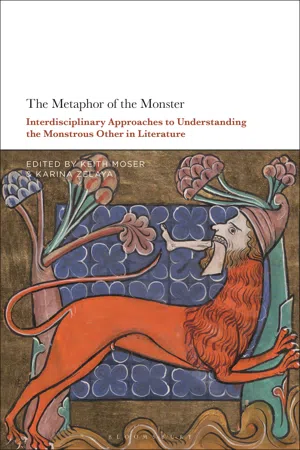
eBook - ePub
The Metaphor of the Monster
Interdisciplinary Approaches to Understanding the Monstrous Other in Literature
- 256 pages
- English
- ePUB (mobile friendly)
- Available on iOS & Android
eBook - ePub
The Metaphor of the Monster
Interdisciplinary Approaches to Understanding the Monstrous Other in Literature
About this book
Information
Part I
Ecological Perspectives
1
A Portrait of Fictional Characters as Darwinian Monsters
Dominique Lestel, translated by Keith Moser
The Darwinian theory of evolution appeared in the nineteenth century. It could be succinctly characterized as a theory of the victorious monster. The monster thus appeared as the archetype of the predator, but this particular predator was less of a predator that consumed an individual than a predator that consumed the species itself. In other words, it was a predator that replaced the current version of the species with the one to which he belongs. Darwinian theory focuses on populations challenged by permanent, random mutations that continually appear among those who are a part of it. Most of these transformations do not present any adaptive advantage, and they disappear as quickly as they appeared. On the other hand, some of them turn out to be very profitable and are quickly adopted by the species. Darwinism (and contemporary Neo-Darwinism) could therefore be characterized as a theory of monsters that win. Nearly all of these mutations disappear because they are unsuitable. The only ones that remain are those that reveal themselves to be advantageous because they allow organisms that carry them to hijack some of these environmental characteristics of the developing environments they face. From this point of view, Darwinism is a theory of lucky and stubborn monsters that end up occupying space at the expense of the less fortunate. Neo-Darwinism (Darwinism plus genetics) does not modify this conception of evolution. The most recent trends maintain this general framework, even if they modify it by introducing elements derived from complexity theory.1 The theory of evolution, or more precisely a theory of evolution, does it apply to other monsters in addition to biological monsters? Specifically, can it enable us to understand the phenomenon of fictional characters more fully by considering them to be semiotic, Darwinian monsters that strive to duplicate themselves in specific ecologies?
The Theory of Evolution as a Theory of Triumphant Monsters
An evolutionary approach to fictional characters can only be understood in the larger context of what evolution has become today. Cultural practices related to species management (whether it is in the form of domestication or what is designated in a somewhat strange manner as an expression of preserving wild spaces) have evolutionary repercussions that are difficult to deny. From the Neolithic era, humans have played an essential role in the process of species selection. They favor the development of certain monsters while ignoring others. Humans have thus assumed a rather odd place in the evolution of species:2 we are not only a monster that tries to sustain itself but also a monster that creates monsters that we allow to survive. A certain number of triumphant monsters presently owe their success to a feature, which has become increasingly important, that appeared rather late in natural history. “Attracting the attention of humans” is now a vital factor. This attraction manifests itself in a variety of different ways. For instance, it could take the shape of beauty, a certain type of touching vulnerability or interests that are more materially motivated including the production of meat or milk, the ability to run quickly in a race, or helping blind people find their way. Cultural organization has introduced corrective measures that are more or less efficient for managing emerging monsters without changing the mechanisms in the phenomenon of natural selection.3 Beginning with the Neolithic revolution, the situation started to transform radically. It is possible to largely reconstitute the noteworthy stages that increased the role of humans in the evolutionary process.
Stage 1: Domestication as the Practice of the Subjugated Monster
The Neolithic era substantially changed the rules of the game by introducing several innovations such as domestication. This stage could be described as an industry of hereditary monstrosity to the exclusive benefit of one given species. Domestication is less concerned with dominion over an animal than it is with reproduction. The hunter-gatherer from the Paleolithic appropriates available resources: the peasant transforms the heritability of his prey in order to adapt them to his desires or needs. From an evolutionary angle, he also ends up with rather peculiar living beings that are unable to survive without the assistance of their predator to whom they are made available. They are subjugated monsters. Their reproduction and management should be understood as a gigantic “jeu infini” (infinite game), to borrow an expression from the American historian James P. Carse, between one given species (Homo sapiens), several other selected species, and evolution.4 The “finite game” is a game that is about winning. The “infinite game” is a game that one must make last as long as possible. From an evolutionary vantage point, domestication is a phenomenon that has been an extraordinary success. Nonetheless, the phenomenon of domestication has turned out to be only the first stage of a general transformation of the living by humans.
Stage 2: Comparative Ecology of Monstrosity
These domestic monsters are so well adapted today that they are quantitatively much more triumphant than the majority of wild species of a comparable size. The success of the phenomenon of domestication is evident in several statistics. In 2018, there were approximately one billion cows (Statista 2018). There were more than a billion sheep ( answers.com 2018), 19 billion chickens in 2017 ( Quora 2018), and more than 769 billion pigs in 2017 (Statista 2018). A comparison with large wild mammals even further underscores this impressive number from available data. In 2014, there were between 450,000 to 700,000 African elephants, and around 40,000 Asian elephants ( reference.com 2018). There are between 50,000 and 100,000 whales. We could go on forever like this, but the following conclusion is obvious: the artificial monsters produced by livestock farming are much more abundant than most natural monsters of evolution. In the transformation of the planet brought about by humans, subjugated monsters have supplanted wild monsters. Some non-subservient species know how to play the same game admirably well, but they are rare. For example, it is impossible to quantify the number of rats that exist in the world, but there are already several billion of them, and they continue to proliferate blithely ( Worldatlas.com 2018). It comes as no surprise that the biological monsters that take advantage of the presence of humans get by the best. Humans are also doing quite well. In 2011, there were around seven billion of them. The collapse of biodiversity should be understood in this context as the inevitable sign that monsters exclusively descended from natural evolution are no longer welcome in the present world.
Stage 3: From Hybridization to Biotechnologies
It is very true that subjugated, biological monsters are more and more artificial. The technologies of monstrosity have generally been placed in the hands of farmers, but a certain number of mavericks have acquired exceptional expertise in this field that has led to remarkable success. Chinese goldfish, Japanese carp, or all of the animals that are regularly exhibited in these competitions come to mind. For several years, researchers have explained the challenges that underpin this practice that has been pushed to unheralded extremes. They have explored the unprecedented possibilities of mobilizing biotechnologies that have induced a logical split in relation to the hybridization techniques of traditional farming. With these techniques for manipulating the animal genome, it is not about influencing a reproductive program of monsters. Instead, it is a matter of directly fabricating monsters. In other words, it is a question of going from controlled hybridization manipulation to the mastery of the genome.
Stage 4: Butlerian Evolution
However, the role of humans in the evolutionary process does not stop at biological selection. According to the vast majority of experts, evolution is above all a biological theory, but there is no reason why it has to be restricted to such a space. The English writer Samuel Butler was the first person to apply the Darwinian theory of evolution to things. In 1863, he sent a letter to a New Zealand journal in which he explained that we are engaged in an evolutionary struggle with machines and they have already won the game.5 This idea is not merely comical. It destabilizes our vision of evolution itself. The biological theory of evolution no longer appeared to be a special case (even if it is still the most remarkable). What should be considered a general theory of evolution applies to all evolutionary agents, whether they are biological or not.6 The technologies for subverting living beings no longer even need to have biological connections.
Fictional Agents, Are They the Same?
The biologist Richard Dawkins gives credence to this idea of a Darwinism that focuses on artifacts suggesting that evolution is as much about “memes” (intellectual) as it is about “genes” (biological).7 Furthermore, the Darwinian theory of evolution is not a unique case, but rather Darwinism is a much more encompassing theory. Whereas genes spread out through the reproduction of organisms that incorporate them, memes branch out by being copied or imitated by active agents. Dawkins’s theory poses many problems, and what constitutes a “meme” is far from being the most trivial. Nevertheless, this theory has the advantage of envisioning the possibility that artificial, semiotic agents can be full actors in their own right in the evolutionary game by parasitizing biological organisms like the human brain.8 Dan Dennett and Douglas Hofstadter popularized the theory of memes while noticeably transforming it at the same time, since they made memes selfish predators who take over our brains like prey.9 Susan Blackmore revisits this interpretation in The Meme Machine (1996) while simultaneously rejecting the intentional point of view. The meme theory poses a lot of problems; thus, its popularity has declined in recent years. Privileging the copy and reproducibility compared to variability and duplication has uncontestably neutralized its impact.
Evolution of Artifacts
Yet, the question of an evolution of artifacts insistently remains. Beyond memes, there is the possibility of an evolution of artifacts in the broad sense of the term, an evolution that includes ideas, beliefs, and so on which merits discussion. A certain number of theorists have explored this direction. Without going into all of the details of their studies, here are a few examples: F. T. Cloak, Jr. who evokes the possibility of a “cultural ethology” starting from 1975, D. T. Campbell who thinks about scientific theories in an evolutionary perspective, and David Hull who affirms that scientific theories have an evolutionary dynamic based on selection organized around a conceptual inclusive fitness that refers to the recognition of the originality of the researcher. Additionally, Hull theorizes about a “demic” structure referring to the need for each researcher to cooperate with others while also trying to assert their own originality.10
Thinking about Fictional Monsters from an Evolutionary Perspective
It is in this context of an evolutionary approach to nonbiological entities that thinking about fictional characters by considering them to be “literary monsters” becomes interesting. Literature, art, and cinema unite through sophisticated practices involving fictional monstrosity. They put into place ecologies in which fictional monsters proliferate that differ distinctly from biological ecologies, even if these two ecologies belong to a common evolutionary process.11 Darwinism contends that an organism that is better adapted than another is one that reproduces itself more. Reproduction is the only criterion for success.12 A similar analysis is equally applicable to fictional monsters who fill stories and more generally to imaginary monsters—and consequently to literary monsters. Yet, is the agency of fictional characters not illusory? This is the question that Marjorie Taylor and her colleagues respond to negatively evoking what they cal...
Table of contents
- Cover
- Half-Title
- Title
- Contents
- Acknowledgments
- Introduction
- Part I Ecological Perspectives
- Part II Transgressive, Monstrous Gender and Corporality
- Part III Teaching Monstrosity in the (Post-)Modern World
- Part IV Monstrosity in World Literature
- Index
- Copyright
Trusted by 375,005 students
Access to over 1.5 million titles for a fair monthly price.
Study more efficiently using our study tools.
Frequently asked questions
Yes, you can cancel anytime from the Subscription tab in your account settings on the Perlego website. Your subscription will stay active until the end of your current billing period. Learn how to cancel your subscription
No, books cannot be downloaded as external files, such as PDFs, for use outside of Perlego. However, you can download books within the Perlego app for offline reading on mobile or tablet. Learn how to download books offline
Perlego offers two plans: Essential and Complete
- Essential is ideal for learners and professionals who enjoy exploring a wide range of subjects. Access the Essential Library with 800,000+ trusted titles and best-sellers across business, personal growth, and the humanities. Includes unlimited reading time and Standard Read Aloud voice.
- Complete: Perfect for advanced learners and researchers needing full, unrestricted access. Unlock 1.5M+ books across hundreds of subjects, including academic and specialized titles. The Complete Plan also includes advanced features like Premium Read Aloud and Research Assistant.
We are an online textbook subscription service, where you can get access to an entire online library for less than the price of a single book per month. With over 1.5 million books across 990+ topics, we’ve got you covered! Learn about our mission
Look out for the read-aloud symbol on your next book to see if you can listen to it. The read-aloud tool reads text aloud for you, highlighting the text as it is being read. You can pause it, speed it up and slow it down. Learn more about Read Aloud
Yes! You can use the Perlego app on both iOS and Android devices to read anytime, anywhere — even offline. Perfect for commutes or when you’re on the go.
Please note we cannot support devices running on iOS 13 and Android 7 or earlier. Learn more about using the app
Please note we cannot support devices running on iOS 13 and Android 7 or earlier. Learn more about using the app
Yes, you can access The Metaphor of the Monster by Keith Moser, Karina Zelaya, Keith Moser,Karina Zelaya in PDF and/or ePUB format, as well as other popular books in Literature & Gothic, Romance, & Horror Literary Criticism. We have over 1.5 million books available in our catalogue for you to explore.