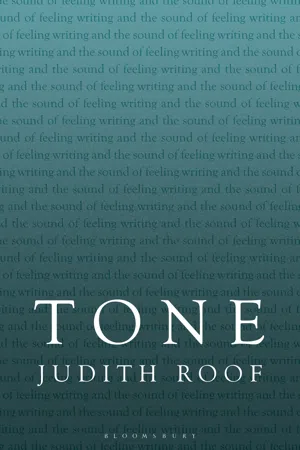
Tone is often decisive in whether we love or dislike a story, novel, or even critical essay. Yet literary critics rarely treat tone as a necessary or important element of literary style or critique. There are surprisingly few analyses of what tone is, how texts produce tone, or the ways tone--as an essential element of narration--contributes to character, story, mood, and voice.
Tone's 24 micro-chapters offer a playful, eclectic, and fast-paced guide into the creation of tone in a variety of modern and contemporary works of literature by such varied writers as Hemingway, Woolf, and Sedaris, as well as in criticism, advertising, and machine-authored texts. Judith Roof shows how tone is a crucial element in all writing, as it produces the illusion of a telling voice; creates a sense of character, personality, and attitude; inflects events recounted; anticipates certain directions and possibilities; and creates an ambiance that simultaneously produces, enables, and shapes narratives and characters. Tone gives us a lively and original way to rethink the practice of literary criticism.
- 288 pages
- English
- ePUB (mobile friendly)
- Available on iOS & Android
eBook - ePub
About this book
Trusted by 375,005 students
Access to over 1.5 million titles for a fair monthly price.
Study more efficiently using our study tools.
Information
1
Setting the Tone
While still a young man, John Courtney Boot had, as his publisher proclaimed, “achieved an assured and enviable position in contemporary letters.” His novels sold fifteen thousand copies in their first year and were read by people whose opinion John Boot respected. Between novels he kept his name sweet in intellectual circles with unprofitable but modish works on history and travel. His signed first editions sometimes changed hands at a shilling or two above their original price.1
These are the opening lines of the novel, Scoop (1937), by Evelyn Waugh.2 Many readers come to this novel with some preconceptions, depending on the circumstances of their reading. If they are familiar with other works by Waugh, they may have expectations about style, tone, and genre. If the novel were, say, an assignment for a class, they would most likely approach it from the vantages established by the topic and methods of the course. Perhaps readers commence the novel only with presumptions about the style prevalent during the literary period in which the novel was written and published. Certainly, they would have preconceptions based on the text’s place of origin and the nationality, the sex, social class, and so forth of its author (insofar as they might be familiar with these facts).
As readers commence their reading, the novel itself will offer cues to its consumption. Novels tell us how to read them. The novel’s genre, plot, setting, characters, narrative structure, style, mood, voice, and tone all help produce a figment of environment, the novel’s diegesis. Most readers are very good at discerning some of these features, as they constitute the routine of most English literature classes. Thus, such narrative elements as plot, character, and setting seem reassuringly apparent. But more difficult to apprehend and certainly to discuss is the personality—the feel—of the narration: the style, mood, voice, and tone of its telling. This more impressionistic quality is the sum effect of the ways the text’s constitutive linguistic elements—diction, grammar, the complexity of sentence structure—combine with cultural associations and connotations to produce more subtle feelings, impressions, and implications that constitute something like a text’s “aura.”3 This aura not only emanates the text’s vigor and personality but also comprises one aspect of its “meaning,” which the narrator of Joseph Conrad’s Heart of Darkness depicts as a quality that “was not inside like a kernel but outside, enveloping the tale which brought it out only as a glow brings out a haze, in the likeness of one of these misty halos that sometimes are made visible by the spectral illumination of moonshine.”4
All of these stylistic effluences—mood, voice, and tone—derive from and enlist one another. They are the sum effects of the more expansive category of style, which emerges as an effect of the idiosyncratic way texts deploy language. We generally link “mood” to the apprehension of a text’s “atmosphere.” Edgar Allen Poe’s horror stories, for example, might induce a “mood” of discomfort and apprehension as the combined effect of plot, character, setting, voice, and tone. Voice and tone, however, contribute to and derive from the ambiance of a novel’s diegesis, even as readers audiate both as effects of a text’s style. To audiate is to imagine hearing the sound—the quite literal “tone” of a “voice”—that appears to speak as an effect of the telling. This tone of voice is not the author (though often confused and/or conflated with an imaginary of the author) but an imaginary attribute of the text’s narrator, which is itself produced by the text as an effect of its telling.5 One curious tendency is almost certain: although Scoop is a product of British culture, American readers will audiate the telling in various American accents. And, although Americans may miss some cultural jokes and ironies, they almost always audiate the text’s various tones anyway.6 Tone, finally, is produced by the text and not by the specter of an originary author.
Among the more impressionistically gleaned aspects of narrative, tone is central to how we consume, feel, appreciate, define, and recall narratives. What is so difficult about defining tone? Rhetoricians, such as Wayne C. Booth, have offered much insight into the operations of “voice” (author, narrator, or both as these two figments persist in their conflation).7 But very few have, except most tersely, incidentally, or even dismissively, undertaken an exploration of how texts produce the phenomenon of tone. In concert with narrative’s co-constitutive qualities such as voice, tone enacts the illusion of a narratorial persona—the text produces the narrator—as the telling combines all of the elements of a recounting persona synergistically. How does narration produce tone, and how does tone, in turn, conduce the ambiance, attitude—the feel—of narration? How does tone engage synergistically with other textual elements? In what ways does tone extend texts beyond themselves, sustaining the audiation that merges text and reader?
So, to begin again, Scoop’s commencement:
While still a young man, John Courtney Boot had, as his publisher proclaimed, “achieved an assured and enviable position in contemporary letters.” His novels sold fifteen thousand copies in their first year and were read by people whose opinion John Boot respected. Between novels he kept his name sweet in intellectual circles with unprofitable but modish works on history and travel. His signed first editions sometimes changed hands at a shilling or two above their original price.8
How we read this novel will depend on many things, among which is our audiation of its tone, the combination of imagined attitude, feeling, distance, engagement, and investment as well as estimations of the text’s desired addressee. Tone offers clues to how to read the text and accept the narration’s depictions and judgments. It will signal how serious a text is and what its stance is about the characters and events it depicts. It instigates the reader’s identification with the narrator’s voice and attitude—its position vis-à-vis what it appears to narrate. Readers can reject tones (and entire books) based on audiations of tone as snide, narcissistic, nasty, supercilious, chiding, etc.
How do we discern the tone of a novel’s narration? If tone is a matter of audiation or estimating audiation, what parts of the text offer its aural cues? If we do audiate tone as an imaginary voice that emerges as if already produced, how do we know how it sounds? And what difference to the success of the text, the felicity of our reading experience, or the text’s artfulness does our perception of tone make?
Here is why it is difficult to find discussions about or definitions of literary tone: “While still a young man, John Courtney Boot had, as his publisher proclaimed, ‘achieved an assured and enviable position in contemporary letters.’”9
Let us begin with an easy hypothesis, easy in the sense that the evidence is right on the page. Tone is the combined product of apprehensions of diction and syntax as these interact with one another. The first sentence in the quotation above, presumably delivered in the present of the narration of the story, describes a character’s past accession to a certain reputation in the literary world, the characteristics of which appear in a subordinate clause the text attributes to another speaker it identifies only as “his publisher.” Structurally, the sentence begins with an adverbial clause that only implies but does not state its subject and verb (i.e., he was). The opening adverb is a temporal signifier (“while”) that refers to the life history of the clause’s “young man,” about whom at this point, we know nothing else. The sentence, thus, begins at an ambiguous, middling point in time that could potentially be either the present of youth or the time frame of a past action soon to be defined.
The opening adverb clause refers to an as yet unnamed “young man,” but provides the circumstance for the meaningful addition of the appositive—“John Courtney Boot”—that retroactively defines the subject of the opening clause. Just as the narrative begins in medias res, or more accurately in medium vitae, so the names that define the “young man” occur in the middle, this time of the sentence, posited between an adverbial clause and the subordinate clause that completes the sentence. The subordinate clause interposes another speaker between the opening narrator and the object narrated: an unnamed “publisher” who defines the “young man” as having gained a certain respect, at least in the eyes of others. Both the beginning and ending of the first sentence describe a character without the necessity of his appositive name. So far, one narrator frames another and between them is the object of interest. Ironically (if you are familiar with the novel), the role of the character/subject of this first sentence parallels the clauses that frame his appositive name, as he appears only at the beginning and end of the tale. And, as one might guess, he is no more than a middling writer.
The main verb of this first sentence is “had . . . achieved,” the past perfect tense defining the sentence’s subject character as perhaps no longer the young man he was when he gained the reputation the publisher’s quote provides (or produces or secures or contrives—is the publisher a reliable source in the end?). That the narrator gleans the subject “young man’s” achievement from another source brings this achievement into some small question insofar as the accomplishment of this “young man” supplies his defining characteristic from an unnamed source that is simultaneously a profession (one who ought to know) and biased (it is the young man’s own publisher). The “young man” had “achieved,” a verb that connotes striving, persisting, earning. “An assured and enviable position” is what the publisher declares he had gained, with “assured” suggesting something guaranteed and secure. But the sentence also suggests that this condition of being “assured,” itself an adjective derived from the past participle of a verb that also functions as passive voice, is enhanced by something other than the young man’s own work, perhaps by the quoted speaker himself. “Enviable” refers to the desirability of this author’s “assured” position, but also again might imply that this position is less John Courtney Boot’s accomplishment than the feelings of others, and perhaps also implies the potential presence of jealous and grudging competitors. These competitors would, the passage also implies, be that group of people interested in “contemporary letters,” the other “young” men who might vie with John Courtney Boot for such an “assured” position. Just as this opening sentence implies various possibilities the very notion of tonal implication already enwraps, so the discourse conveys a tone that enwraps the already enwrapped topic of the sentence. And to top it off, the verb “imply” itself derives etymologically from the Latin implicare, which means to entangle.
Nowhere does the publisher’s comment describe the young man’s actual work, talent, probity, or any other writerly accomplishment, limiting itself merely to his “position,” an attribute derived from the opinions of others. In addition, this opening sentence also deploys what appears to be the vocabulary that connotes literary culture, a stiffness (“enviable,” “assured”) at least partially undone by the object author’s name, but which imitates and perhaps even parodies the pomposity of an educated dialect.
So what tone does this combination of sentence grammar, diction, and vague suggestion of parody produce? Insofar as its language enacts a narrator who is describing this character, it produces a narrator who is vaguely dissociated from its subject, but who derives a hint of pleasure from its overly earnest deployment of and imitative play on literary discourse. The description progressively distances the opening voice from the sentence’s object of apparent interest. Just as the sentence appears to define the subject, the subject itself, John Courtney Boot, too, becomes the object of others’ impressions, remaining somewhat nebulous. Commencing with the more generic description “young man,” the sentence illuminates the description’s opaqueness only by the addition of an appositive, but then returns to its dissociative tactic by quoting another description supplied by another, perhaps less objective speaker. Beginning in the middle of things, this sense of dissociation and distance generates a species of impersonality or attempted objectivity in the introduction of a character, named in the very middle of things, who is in the middle of a literary career where he exists amidst the dual potential of security and envy. The first sentence, thus, enacts a tone that is itself middling—that is, neutral, matter-of-fact, but a bit off-the-cuff, beginning as it does in the middle of a life introduced in an adverbial clause—but with a vague detachment and potential lampooning that expands through the sentence.
The sentence’s enactment of slight detachment and equivocation produces a tone of vague but vaguely amused impersonality: but, at the same time and possibly as an effect of this tone, it also incites suspicion as well as an issue of interpretation that arises from the way the sentence avoids its nominal subject in seeming to introduce it. This ambivalence motivates a retroactive reconsideration of the connotations of the sentence’s diction. In this case, the ambiguity of “assured and enviable” rests on the noun “position,” which the adjectives modify. “Position,” which might have escaped as a simple description of vocation (when in fact it is a description of the “young” man’s reputation within a profession), becomes a question of which position the adjectives describe—a position as a respectable writer, or a position as one whose work is “assured” whether it deserves such security or not. This ambiguity produces a potentially different reading of “enviable” as the position of one who may or may not deserve such a secure career as a writer, but who, in having gained such a position, is enviable because of his security and not his talent.
The retrospective reconsideration instantiated by the slight shift from the naming of the author to the publisher’s description of the position the author had achieved, then, too, retrospectively refines the sense of the narrator whose tone is even a bit more distanced, dubious, and possibly caricatured than when it began the sentence. The narrator’s shift in distance in relation to its subject is simultaneously the effect of and perhaps the motive for including a quote from someone else not about the character but about his authorial reputation as the first description of the character. And in yet another retrospective reconsideration, this sense of the narrator’s tone both derives from and accounts for the choice to nest evasive description in a publisher’s quote—a mechanism that removes any estimation of John Courtney Boot’s talent from the direct aegis of the narrator, who in quoting another with a vested interest in the success of Boot’s career—can simultaneously offer an apparently neutral and middling introduction while at the same time casting a slightly humorous doubt not only about Boot but also about the publishing industry.
This analysis illustrates some of the ways that reading the sentence structure (plus a dash of diction) closely shows how elements of narration cooperate to produce tone. But I am not done yet. Right in the middle of all of this is the name—and what is, after all, in a name?—“John Courtney Boot.” A lot, but we need an additional element—the connotations offered by cultural associations. So to revise the definition: tone is the sum effect of diction, syntax, connotation, and cultural associations we might link to specific words, naming practices, and cultural patterns. Taking, then, these three elements into account, what does the introduction of the character’s three names contribute to the text’s enactment of tone? A simple “John Boot” seems quotidian, if a little comic, insofar as monosyllabic names with double o’s are often comic—Boot, Root, Smoot, Roof, Coot. The name “John” could not be more ordinary; “John” is a name that bespeaks the most average of all averages, the most normative of normativities, even evoking relief facilities. But the middle name—“Courtney”—takes the name beyond the unremarkable but vaguely comic into a higher-class realm, where parents give their children surnames for middle names, and where the names themselves connote the “court”—courtliness, courtesy, courtesan—sandwiched between (quite literally in the middle of yet again) the monosyllabic markers of silly mediocrity. The name “Courtney” has two derivations: it refers either to someone from the noble house of “Courtenay” in France or to someone sadly characterized by a court nez or “short nose.” Hence the name simultaneously connotes the stately and the silly, a history of landed gentry and joking insult. “Courtney” sets off “John Boot” from within, as the name itself occupies a middling grammatical space, by interrupting and settling between the commonplace monosyllabic signifiers of water closets and footwear, importing a soupçon of something else—Class? Education? Distinctiveness? Inadequate facial features? This is not just any “John Boot.” This is John Courtney Boot. And in this novel, the “Courtney” becomes a significant but absent and/or ignored signifier.
Just as the character’s n ame is ensconced between clauses, so the individuating middle moniker arrives sandwiched between two quotidian names, securing finally one vaguely exotic filling...
Table of contents
- Cover
- Half-Title
- Dedication
- Title
- Contents
- Preface: Key Tone
- Acknowledgments
- 1 Setting the Tone
- 2 Toning Up
- 3 Tone Jam
- 4 Intoning
- 5 Taking That Tone
- 6 Two Tone
- 7 Two Tones
- 8 Atonement: The Sound a Tree Makes When It Falls
- 9 Tone Down
- 10 Touch Tone
- 11 Tense Tone
- 12 Tone “R” Us
- 13 We-tone
- 14 The Tone “We” Tell
- 15 Tonal Dialogics
- 16 Inscribing Tone
- 17 Moebius Tone
- 18 Telling Tones
- 19 iTone
- 20 Toning Fork
- 21 Dissonant Tones
- 22 Toning Up/Toning Down
- 23 Tone-ads
- 24 Robo-tone
- Notes
- Bibliography
- Index
- Copyright
Frequently asked questions
Yes, you can cancel anytime from the Subscription tab in your account settings on the Perlego website. Your subscription will stay active until the end of your current billing period. Learn how to cancel your subscription
No, books cannot be downloaded as external files, such as PDFs, for use outside of Perlego. However, you can download books within the Perlego app for offline reading on mobile or tablet. Learn how to download books offline
Perlego offers two plans: Essential and Complete
- Essential is ideal for learners and professionals who enjoy exploring a wide range of subjects. Access the Essential Library with 800,000+ trusted titles and best-sellers across business, personal growth, and the humanities. Includes unlimited reading time and Standard Read Aloud voice.
- Complete: Perfect for advanced learners and researchers needing full, unrestricted access. Unlock 1.5M+ books across hundreds of subjects, including academic and specialized titles. The Complete Plan also includes advanced features like Premium Read Aloud and Research Assistant.
We are an online textbook subscription service, where you can get access to an entire online library for less than the price of a single book per month. With over 1.5 million books across 990+ topics, we’ve got you covered! Learn about our mission
Look out for the read-aloud symbol on your next book to see if you can listen to it. The read-aloud tool reads text aloud for you, highlighting the text as it is being read. You can pause it, speed it up and slow it down. Learn more about Read Aloud
Yes! You can use the Perlego app on both iOS and Android devices to read anytime, anywhere — even offline. Perfect for commutes or when you’re on the go.
Please note we cannot support devices running on iOS 13 and Android 7 or earlier. Learn more about using the app
Please note we cannot support devices running on iOS 13 and Android 7 or earlier. Learn more about using the app
Yes, you can access Tone by Judith Roof in PDF and/or ePUB format, as well as other popular books in Literature & Literary Criticism Theory. We have over 1.5 million books available in our catalogue for you to explore.