In 1957, A Face in the Crowd incorporated live video images to warn about the future of broadcast TV. In 2015, Kung Fury was infused with analogue noise to evoke the nostalgic feeling of watching an old VHS tape. Between the two films, numerous ones would incorporate video images to imagine the implications of video practices. Drawing on media archaeology, Videographic Cinema shows how such images and imaginaries have emerged, changed and remained over time according to their shifting technical, historical and institutional conditions.
Rediscovering forgotten films like Anti-Clock (1979) and reassessing ones like Lost Highway (1997), Jonathan Rozenkrantz charts neglected chapters of video history, including self-confrontation techniques in psychiatry, their complex relation with surveillance, and the invention/discovery of the "videographic psyche" by artists, therapists and filmmakers. Spanning six decades, Videographic Cinema discovers an epistemic shift from prospective imaginaries of surveillance and control conditioned on video as a medium for live transmission, to retrospective ones concerned with videotape as a recording memory. It ends by considering videographic filmmaking itself as a form of archaeology in the age of analogue obsolescence.
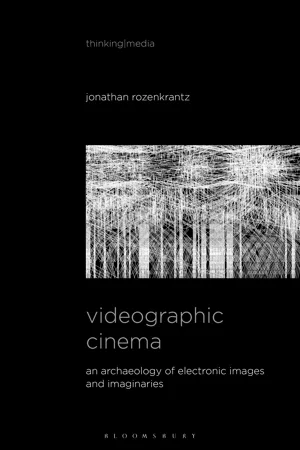
eBook - ePub
Videographic Cinema
An Archaeology of Electronic Images and Imaginaries
- 232 pages
- English
- ePUB (mobile friendly)
- Available on iOS & Android
eBook - ePub
About this book
Information
Part One
Emergence
1
Futurity effects
The emergence of videographic cinema
The future was neither the Dawning of the Age of Aquarius nor the Twilight of the Idols: no hippie Utopia on the horizon, no Nietzschean hammers in sight. Six hours to Haight-Ashbury, six months to the Summer of Love, and in the midst of anti-war protests and political violence, 22-year-old USC film student George Lucas was envisioning the emergence of a very different era. He saw a digital divine dividing itself into a thousand electronic eyes that knew of no dawns nor twilights, only of the eternal light of electric currents: the piercing whites bouncing off the walls, the vibrant blues radiating from the monitors and the infrareds probing the limits of the electronic labyrinth. Traversing these sterile spaces of variating monochromes was a running figure: at first barely distinguishable, a fleck of luminance appearing at the far end of a corridor, a mere variation in the jumpy blue depths of a video image. The fleck grew, developed limbs, emerged as a human, running towards the screen, then past it before his face became discernible.
There was a sound proper to the cold blue light of this videographic future: an incessant radiophonic chatter, a stream of barely intelligible words forming fragments of quasi-information. Series of numerical and alphabetic code mixed with the occasional order: ‘THX 1138 4EB, this is Authority. You will stop where you are. You are in violation of Mercy-Op 15-16 8667.’ ‘We will start procedure 9966 on an area signal before they are able to reach emergency power switch.’ ‘Cut the power. Cut the power. Repeat. Cut the power.’ Overlapping layers of signifiers drowned in the deafening sound of sirens – it was almost as if power was so eager to exert itself that it was collapsing under the weight of its own competing operations.
Within the sounds and images, there were layers of historical time: gloomy fragments of Bach’s baroque organ blended with the neo-Gregorian chants of the 1960s rock song ‘Still I’m Sad’ by the Yardbirds. Amidst the seemingly infinite identical, which is to say unidentifiable, corridors, a sudden interruption, a religious shrine (remanence of the idol): the translucent torso of Hans Memling’s 1481 ‘Christ Blessing’, superimposed over a screen of squares, numbers and letters. An enigmatic addition, ‘0000’, printed on Christ’s forehead, almost as if answering to Nietzsche’s anti-religious numerical pun: ‘What? You are looking for something? You want to multiply yourself by ten, by a hundred? You are looking for disciples? – Look for zeros!’1 No longer the son of God, certainly not the son of man, it was Christ’s second coming as the father and nadir of numerical code: the wired tyrant – a screen Saviour.
And yet, neither order-words nor backhanded blessings could make the runner doubt his path. A short break to catch his breath, a doubtful stare in the face of the idol, and then off again towards new levels and corridors. Nameless zeros in front of video monitors, switchboards and mainframe computers following his every move, preparing new operations. But not even ‘mind-lock’, a paralysing signal projected right into his own coded forehead, could stop the flight of 1138. Down an elevator, into a vast space of concrete greys, the fugitive was reaching the limits of the labyrinth. One last obstacle: PERFECTBOD2180, a law enforcer with infrared vision – neutralized with hardly any effort. And the hero was free to run into a boundless whiteness coalesced into a dramatic exterior: a dark desert under a dawning red sky.
* * *
Shot in January 1967, Lucas’s student film Electronic Labyrinth: THX 1138 4EB is a pioneering work of videographic cinema: a 15-minute, 16mm science fiction short tracking the escape of its protagonist through a claustrophobic future environment – vibrating with inserts of video surveillance images.2 Two years later, Lucas’s debut feature film would be in production, THX 1138 (1971), expanding the concept of his student film into a full-length narrative. But by then, the new possibilities of videographic cinema were already being pushed by several pioneers. ‘I believe we have accomplished a real live first’, cinematographer Gene Polito claimed in April 1969, ‘the capturing of a certain spontaneity of performance from the actors that could only and uniquely be achieved by capitalizing on the electronics equipment we had at our disposal’.3 Polito was referring to an array of videographic apparatuses, including TV cameras and videophones, that had been used in the production of the science fiction film Colossus: The Forbin Project (Joseph Sargent, 1970). Certainly, cinema had, to borrow Paul Young’s eloquent book title, dreamt its rivals many times before. TV and video imaginaries even predate cinema’s own invention.4 By the 1900s, films were playing with the idea of electronically transmitted images over distance, including videotelephony and closed-circuit TV. And in 1927, the year that the Bell Labs performed the first actual ‘picturephone’ tests, Fritz Lang was imagining its future uses in his seminal science fiction film Metropolis.5 If, as Polito claimed in 1969, Colossus: The Forbin Project was a pioneering work, it was not because Sargent and he were the first filmmakers to imagine video, but because, unlike many before them, they had done it by capturing actual video images on film, including live interactions between actors/characters.
Why did it take so long for cinema to integrate videography, and when it finally did – to what effect? What imaginaries did the video image give rise to as it first became a cinematic element? As this chapter will show, video – as a cinematic element – was established through visualizations of surveillance and control. Electrifying cinema with a new kind of realism, these vibrant new images – tangibly material yet alien in their treatment of human figure and form – provided science fiction films and political thrillers with what will be defined as futurity effects. In retrospect, Polito’s claim stands out as overly optimistic, as the pioneer status ascribed to his film is complicated by earlier ones – include Seven Days in May (John Frankenheimer, 1964), which will be discussed. But the production history of Colossus: The Forbin Project, as reported by Polito, provides invaluable data as to why it would take until the turn of the 1970s for video to become a recurrent element in film, notwithstanding that the technical conditions had been available for decades. His report is finally also a keyhole into an institutional history regarding 1950s live television as a media condition for the emergence of videographic cinema.
A credible reference to a possible future: Defining the futurity effect
It is the future year of 1980, the Cold War drags on, and the US government has commissioned world-leading computer expert Dr Charles Forbin (Eric Braeden) to develop a fail-safe system for national defence; an entirely autonomous intelligent weapon with its own nuclear arsenal. Buried deep within the Rocky Mountains, and surrounded by radiation, rests a whole new kind of beast: a ‘self-sufficient, self-protected, self-generated’ supercomputer called Colossus. Introduced by Forbin and the president (Gordon Pinsent) at a White House press conference, its unique virtues have barely been listed, its absolute safety assured, before the electronic sign through which it communicates is blinking: ‘WARNING – THERE IS ANOTHER SYSTEM.’ The system turns out to be a Soviet counterpart: the autonomous intelligent weapon Guardian, with whom Colossus soon finds it has more in common than with the men who made them. Left to their own devices until it is too late, the supercomputers develop an ‘intersystem language’ of indecipherable code, rendering humanity deaf to their digital whispers. In some digital dimension beyond human cognition, they start plotting to enslave their old masters. They acquire electronic eyes, ears, and as they merge into one system, ‘World Control’, even a voice:
An invariable rule of humanity is that man is his own worst enemy. Under me, this rule will change, for I will restrain man. […] So that you will learn by experience that I do not tolerate interference, I will now detonate the Nuclear Warheads in the two missile silos.
In a sardonic twist of fate, the machines have created a digital dictatorship with a global reach.
Two Norelco TV cameras, two Ampex videotape machines, nine 21-inch colour TV monitors, one Brooks Optronics Display (‘similar to those flashing news signs in Times Square’)6 and, lest we forget, functioning computer equipment for a value of $5 million provided by companies whose names seem to be taken from cyberpunk novels: Control Data Corporation, CALCOMP and Tektronix.7 Saturated with all the quasi-sensical technical data that provides science fiction texts with their ‘reality effect’ of the future, Polito’s article almost seems to merge with the discourse of the film. The article not only provides a detailed account of the production process of Colossus: The Forbin Project but also pays credit to the ‘massive array’ of media apparatuses incorporated.8 And for good reason: the value of the computer equipment alone exceeded the film’s whole budget and required specially trained technicians to operate it.9 ‘The overall effect?’, Polito asks rhetorically. ‘Reality!’10 With the relation between actual media captured by a film and the alleged effect so explicitly stated, Polito is unknowingly inviting us to revisit Roland Barthes’s literary concept introduced a year before.11
Barthes asks how we are to make sense of seemingly superfluous details in fictional texts – elements difficult to motivate from the point of view of the narrative’s semiotic structure. Incidentally, a technical medium serves as his example: a barometer mentioned in the passing in the description of a room in a novel by Gustave Flaubert. The piano at least serves as ‘an indication of its owner’s bourgeois standing’,12 but the barometer seems unnecessary, leading Barthes to ask what ‘the significance of [its] insignificance’ is.13 His answer is that such details refer less to a real object and more to the notion of the general ‘real’ that eludes the fiction; in other words, they are there to create a ‘referential illusion’ to support the text’s realist aspiration.14 This literary device, which Barthes calls a ‘reality effect’, seems to have much in common with the cinematic prop, insofar as it is also there to convey a convincing image of (fictional) reality. The appropriation of the term may be complicated by the fact that the prop possesses the status whose very lack the literary reality effect is conditioned on; its pro-filmic existence makes it irreducible to a referential illusion. But it is possible to distinguish between the two epistemic levels within each captured prop: its reality as an actual referent, and its effect as an element within the larger fabric of the fictional mise en scène. Insofar as this fabric has realism as its aim, the reality of the props that constitute it should not nullify its chance of s...
Table of contents
- Cover
- Half-Title
- Series
- Title
- Contents
- Acknowledgements
- Conditions
- Part One Emergence
- Part Two Remanence
- Conclusion: An archaeology of videographic cinema
- Bibliography
- Index
- Copyright
Trusted by 375,005 students
Access to over 1.5 million titles for a fair monthly price.
Study more efficiently using our study tools.
Frequently asked questions
Yes, you can cancel anytime from the Subscription tab in your account settings on the Perlego website. Your subscription will stay active until the end of your current billing period. Learn how to cancel your subscription
No, books cannot be downloaded as external files, such as PDFs, for use outside of Perlego. However, you can download books within the Perlego app for offline reading on mobile or tablet. Learn how to download books offline
Perlego offers two plans: Essential and Complete
- Essential is ideal for learners and professionals who enjoy exploring a wide range of subjects. Access the Essential Library with 800,000+ trusted titles and best-sellers across business, personal growth, and the humanities. Includes unlimited reading time and Standard Read Aloud voice.
- Complete: Perfect for advanced learners and researchers needing full, unrestricted access. Unlock 1.5M+ books across hundreds of subjects, including academic and specialized titles. The Complete Plan also includes advanced features like Premium Read Aloud and Research Assistant.
We are an online textbook subscription service, where you can get access to an entire online library for less than the price of a single book per month. With over 1.5 million books across 990+ topics, we’ve got you covered! Learn about our mission
Look out for the read-aloud symbol on your next book to see if you can listen to it. The read-aloud tool reads text aloud for you, highlighting the text as it is being read. You can pause it, speed it up and slow it down. Learn more about Read Aloud
Yes! You can use the Perlego app on both iOS and Android devices to read anytime, anywhere — even offline. Perfect for commutes or when you’re on the go.
Please note we cannot support devices running on iOS 13 and Android 7 or earlier. Learn more about using the app
Please note we cannot support devices running on iOS 13 and Android 7 or earlier. Learn more about using the app
Yes, you can access Videographic Cinema by Jonathan Rozenkrantz in PDF and/or ePUB format, as well as other popular books in Media & Performing Arts & IT Industry. We have over 1.5 million books available in our catalogue for you to explore.