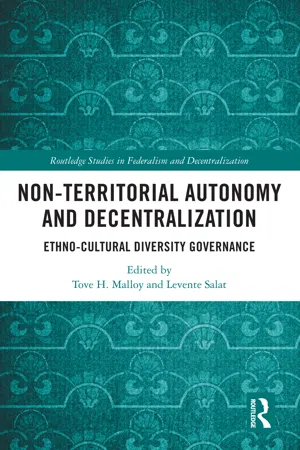
Non-Territorial Autonomy and Decentralization
eBook - ePub

Non-Territorial Autonomy and Decentralization

Ethno-Cultural Diversity Governance

  1. 274 pages
  2. English
  3. ePUB (mobile friendly)
  4. Available on iOS & Android
eBook - ePub

Non-Territorial Autonomy and Decentralization

Ethno-Cultural Diversity Governance

About this book

This volume describes and analyzes alternative and emerging models of non-territorial autonomy (NTA), particularly in relation to decentralization. The authors push the NTA debate in new directions by offering a re-conceptualization based on ethno-cultural bottom-up decentralized action that redefines autonomy into its true sense of autonomous action. Through description, critical analysis, and evaluation of several case studies, this book assesses the potential for new paradigms within decentralized systems.

The authors explore two approaches to political decentralization which add to the theoretical debate on NTA – network governance, which focuses on new dynamics in policy processes, and normative pluralism, which focuses on accommodating the distinctness of the groups through the subsidiarity principle with regard to their own affairs. The book explores the potential ramifications of ethno-cultural NTA institutions acting within the wider framework of state institutions and assesses the functions of these institutions as another dimension of decentralization and thus another 'layer' of democracy.

With contemporary examples from Europe, the Middle East, Asia and South Africa, as well as theoretical aspects of the conceptualization of autonomy, this book offers a truly global perspective. It will be of great interest to policy-makers in countries experiencing adverse developments due to the pressure on public management, as well as advanced students and scholars questioning the ability of the Westphalian system to address cultural diversity.

Frequently asked questions

Yes, you can cancel anytime from the Subscription tab in your account settings on the Perlego website. Your subscription will stay active until the end of your current billing period. Learn how to cancel your subscription.
No, books cannot be downloaded as external files, such as PDFs, for use outside of Perlego. However, you can download books within the Perlego app for offline reading on mobile or tablet. Learn more here.
Perlego offers two plans: Essential and Complete
  • Essential is ideal for learners and professionals who enjoy exploring a wide range of subjects. Access the Essential Library with 800,000+ trusted titles and best-sellers across business, personal growth, and the humanities. Includes unlimited reading time and Standard Read Aloud voice.
  • Complete: Perfect for advanced learners and researchers needing full, unrestricted access. Unlock 1.4M+ books across hundreds of subjects, including academic and specialized titles. The Complete Plan also includes advanced features like Premium Read Aloud and Research Assistant.
Both plans are available with monthly, semester, or annual billing cycles.
We are an online textbook subscription service, where you can get access to an entire online library for less than the price of a single book per month. With over 1 million books across 1000+ topics, we’ve got you covered! Learn more here.
Look out for the read-aloud symbol on your next book to see if you can listen to it. The read-aloud tool reads text aloud for you, highlighting the text as it is being read. You can pause it, speed it up and slow it down. Learn more here.
Yes! You can use the Perlego app on both iOS or Android devices to read anytime, anywhere — even offline. Perfect for commutes or when you’re on the go.
Please note we cannot support devices running on iOS 13 and Android 7 or earlier. Learn more about using the app.
Yes, you can access Non-Territorial Autonomy and Decentralization by Tove H. Malloy, Levente Salat, Tove H. Malloy,Levente Salat in PDF and/or ePUB format, as well as other popular books in Politics & International Relations & Politics. We have over one million books available in our catalogue for you to explore.

Table of contents

  1. Cover
  2. Half-Title
  3. Series
  4. Title
  5. Copyright
  6. Contents
  7. List of figures
  8. List of tables
  9. Notes on contributors
  10. Acknowledgements
  11. Abbreviations
  12. PART I Introduction
  13. PART II The state and pluralism
  14. PART III Network governance
  15. PART IV Normative pluralism
  16. PART V Conclusions
  17. Index