- 264 pages
- English
- ePUB (mobile friendly)
- Available on iOS & Android
eBook - ePub
About this book
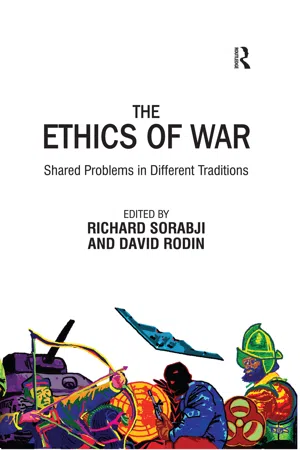
9/11 and the subsequent invasions of Afghanistan and Iraq have left many people baffled and concerned. This interdisciplinary study of the ethics of war provides an excellent orientation not only to present, but also to future conflicts. It looks both back at historical traditions of ethical thought and forward to contemporary and emerging issues. The Ethics of War traces how different cultures involved in present conflicts have addressed similar problems over the centuries. Distinguished authors reflect how the Graeco-Roman world, Byzantium, the Christian just war tradition, Islam, Judaism, Hinduism and the Geneva Conventions have addressed recurrent ethical problems of war. Cutting-edge essays by prominent modern theorists address vital contemporary issues including asymmetric war, preventive war, human rights and humanitarian intervention. Distinguished academics, ethical leaders, and public policy figures have collaborated in this innovative and accessible guide to ethical issues in war.
Information
PART I
TRADITIONS
Chapter 1
Just War from Ancient Origins to the Conquistadors Debate and its Modern Relevance
Richard Sorabji
The issues about war that face us today have been thought about for up to two-anda-half thousand years in all the cultures that are involved in the main present conflicts: Christianity, Judaism, Islam and India. So we need not think that we are facing them for the first time without guidance. What I want to spotlight above all is a sixteenth-century debate about the conquest by Spaniards of the American Indians, because by that time the Christian tradition on just war was considering in detail many of the issues that confront us today, and I think knowledge of that debate will give us tools to think with in our very different context. Some readers may wish to skip ahead to that debate. But first I want to trace its historical background, which started more than two thousand years earlier in Graeco-Roman antiquity, and then passed through Christianity. The role of the Christians Augustine around 400 CE and Thomas Aquinas in the thirteenth century is often mentioned. But I want to show that the issues were being discussed up to 700 years before Augustine in pagan antiquity, and that Augustine and Thomas represent important steps in a longer history, a history which begins to look closer to our concerns by the time it reaches the sixteenth century.
The two following chapters will extend the picture to the medieval Western crusaders and the idea of holy war, and to Grotius in the seventeenth century and modern legislation. We shall then pass to Jewish, Islamic and Indian approaches, because we need to be aware of how different parties think. Tools to think with are useful, even though people may come to different conclusions about our current predicaments.
Historical Background
First, a preliminary: the Christian tradition formulated a useful distinction between when it would be just to go to war (jus ad bellum), and how to conduct a war justly, whether it has been justly entered into or not (jus in bello). As the Introduction has explained, the first five criteria for justly engaging in war are fairly widely agreed:
- There should be a just cause.
- Attempts at peaceful resolution should have been exhausted.
- The war should be decided on by an appropriate authority, and it needs to be clear which that authority is.
- War will not make the situation even worse than it is already.
- There should be a reasonable prospect of achieving the aims of the war.
In Chapter 11, Anthony Coates recommends returning to a sixth ancient criterion, that of having the right attitude of benevolence. In Chapter 13, Michael Quinlan considers a particular criterion, that of commitment to obligations to the conquered after the war (post bellum). Other criteria are sometimes treated separately and sometimes subsumed under the above: for example, an obligation to declare war, and the requirement that war should be a matter of necessity, not of choice.
As regards the question of justice in the conduct of war (jus in bello), the Christian tradition did not develop so quickly perhaps as some other traditions. The Greeks and Romans, especially Cicero, already had plenty to say.1 From the eighth to twelfth centuries CE, there are discussions in Islam about not intentionally killing women or children, even the children of polytheists, about what to do if there are women and children in a fort you propose to attack, or if Muslims are used as human shields, about cheating, treachery and mutilation, and rejecting suicide or hopeless attacks.2 In the Jewish tradition, the sparing of fruit trees, already mentioned in Deuteronomy 20, is expanded by Maimonides in the twelfth century, so as to ban other destructive acts. And earlier than that there are rules about the treatment of women in war and about allowing civilians to escape from a siege.3 In the earliest Indian epic, the Mahābhārata, there are ethical constraints of chivalry which forbid or allow attack, partly on the basis of the role allotted to the individual by his dharma.4 The actual conduct of war was thus from early on the subject of ethical reflection in all these cultures at least as much as it was in Christianity. It is only with the Hague and Geneva legislation since the late nineteenth century that Western focus has switched from jus ad bellum to jus in bello.
Ancient Origins of the Ad Bellum Requirements
As regards the ad bellum constraints, the first requirement of just cause was already discussed by the Greek philosophers Plato and Aristotle in the fourth century bce, and by the Roman Cicero in the first century bce.5 The second requirement of attempts at peaceful resolution was, as Cicero says, embedded in the fetial code of ancient Rome.6 This code required that no war was just (bellum justum), unless 33 days’ notice had been given, with a warning or demand for restitution, and a formal declaration. As regards the sixth requirement of right attitude, relevant considerations, though not described as such, were already introduced by Aristotle when in Politics 7.7,1328a7–8 he criticised Plato Republic 5, 470C–D, as does Anthony Coates in Chapter 11 in this volume, saying that destroying the land and houses of non-Greeks is not appropriate. Only the unjust should be treated harshly, and closer kin more than the distant. Cicero criticises the razing of Corinth, bids us spare those who are not cruel, protect those who surrender, punish only the guilty and keep promises to the enemy. He further forbids selling back prisoners, destroying, or plundering: On Duties 1.35; 1.38; 1.39; 1.80.
Pacifist Interlude
Cicero was influenced by the Stoics, who, as we shall see, believed in the unity of all mankind. It may have been in this spirit that the Stoic Chrysippus and the Cynic Diogenes wrote their treatises On the Uselessness of Weapons.7
Christianity started with a pacifist tendency for quite different reasons.8 There was a tension between the Old Testament with its bloodthirsty wars and the New Testament with Christ’s injunction, if someone takes your coat, to offer your cloak also, and if struck on one cheek, to turn the other (Matthew 5:39–40, Luke 6:29). In the Old Testament, such advice is given only once, to young men in Lamentations 3:30. Such early Christians as Tertullian, the contemporary of Ulpian at the beginning of the third century CE, and Origen in the middle of that century held that Christians should not fight. Tertullian says that a Christian cannot forsake all for Christ if he is a soldier, and he takes the injunction to turn the other cheek as reinterpreting the ancient Judaic law of an eye for an eye and a tooth for a tooth.9 This means only that you should not take someone’s eye, because if you were to, he would take yours.10 Origen explains that war was necessary for the ancient Jews, but now would be forbidden them by Rome.11 Elsewhere, commenting on the particularly bloodthirsty wars of Joshua, he gives spiritual reinterpretations of the Old Testament wars.12 Vitoria still has to open On the Law of War by asking at Question 1, Article 1, whether a Christian may fight, and in Chapter 3 below, Grotius is shown as complaining in the seventeenth century of the opposite view.
Augustine’s Return to War and Just War
Augustine in the early fifth century made a huge difference. He too was pressed, in this case by the Manichaeans, on the discrepancy between Old and New Testaments. Augustine responded that Christians are allowed to fight, and the injunction to turn the other cheek is not against fighting, but only against having the wrong inward disposition. The need to turn the other cheek can only be revealed along with the revelation of the Kingdom of Heaven in the New Testament.13 This immediately introduces what came to be seen as a criterion for just war, namely the right inward disposition, whose importance is argued by Anthony Coates in Chapter 11. It is also applied to just punishment. Even if severe, the just executor of war or punishment must act with the benevolent intention of correcting those who have done wrong. This is the sort of context in which it is said that the just warrior must fight from necessity, not from choice, which some took up as an extra criterion. In this spirit, he will keep faith with the enemy, seek peace and teach him to seek peace.14 Talking of punishment, Augustine points out that St Paul thinks one person’s sin should cause grief (luctus) to all the Church, but the punishment must seek to save the sinner’s spirit (1 Cor. 5:2 and 5)15. The sinner in Paul 2 Thess. 3:14–15 is not to be treated as an enemy. Nor in 2 Cor. 2:6–11 is his punishment to be too great, or as Augustine interprets Paul, that would break the bond of peace and charity. This seemingly benevolent criterion has its dangerous side. For it has been pointed out that Sepúlveda was able to cite one of these same texts of Augustine, Letter 189, to cover up a move from an ‘ought’ to an ‘is’, and argue that the Spanish conquest is acceptable because it aims at peace and pities the conquered. Even Vitoria, it has been pointed out, concedes that the conquerors would have a just title to protect converts by arms, because they could plead friendship for the converts.16
As regards just conditions for entering on war, Augustine discusses what would later fall under the heading of just cause. And here, living in the period of ancient Greek and Roman philosophy, he drew on it. The aim of war is said, as in Cicero, and before that Plato and Aristotle, to be peace.17 In a striking passage, Augustine refers to the customary definitions of just war as avenging (ulcisci) injuries, and specifies in particular the refusal to return what was unjustly taken away or to punish transgressions. This echoes Cicero’s definition of just war – he coined the phrase – at Republic 3. 23, 34–5, according to which one first demands the return of goods, and then avenges (ulcisci) or repels the enemy. Unfortunately, in the same passage, Augustine opens the door to holy war by saying that a war is just if commanded by God.18 Elsewhere he says that it is legitimate to go to war for violation of the right of passage across territory, which is granted by the law (jus) of human society.19 Again, the law allows killing in defence of oneself or another, but there may be a stronger secret law which will punish the individual who so kills, and it would be wrong on the part of an official who had discretion.20 Elsewhere approval is given only to killing by a soldier or official in defence of others.21 The saying in Luke 14:23, ‘Compel them to come in’, justifies violence only against heretics.22
Augustine also discussed the right authority, recognising in a passage already discussed23 that it is not open to everyone to wage even a just war. The right authority is here treated as a separate requirement from the justice of the war. Augustine also expressed the idea, so ambiguously debated in Shakespeare’s Henry V, that the ruler has the authority to undertake war, and it is not for the ordinary soldier to decide on whether the war is just,24 a view which is also reflected in Vitoria25 and, as Chapter 3 in this volume shows, in Grotius.
The requirement that a just war must not do more harm than good is not formulated in general terms, but part...
Table of contents
- Cover
- Half Title
- Dedication
- Title Page
- Copyright Page
- Table of Contents
- List of Contributor
- Introduction
- Part I: Traditions
- Part II: Contemporary Problems
- Index
Trusted by 375,005 students
Access to over 1.5 million titles for a fair monthly price.
Study more efficiently using our study tools.
Frequently asked questions
Yes, you can cancel anytime from the Subscription tab in your account settings on the Perlego website. Your subscription will stay active until the end of your current billing period. Learn how to cancel your subscription
No, books cannot be downloaded as external files, such as PDFs, for use outside of Perlego. However, you can download books within the Perlego app for offline reading on mobile or tablet. Learn how to download books offline
Perlego offers two plans: Essential and Complete
- Essential is ideal for learners and professionals who enjoy exploring a wide range of subjects. Access the Essential Library with 800,000+ trusted titles and best-sellers across business, personal growth, and the humanities. Includes unlimited reading time and Standard Read Aloud voice.
- Complete: Perfect for advanced learners and researchers needing full, unrestricted access. Unlock 1.5M+ books across hundreds of subjects, including academic and specialized titles. The Complete Plan also includes advanced features like Premium Read Aloud and Research Assistant.
We are an online textbook subscription service, where you can get access to an entire online library for less than the price of a single book per month. With over 1.5 million books across 990+ topics, we’ve got you covered! Learn about our mission
Look out for the read-aloud symbol on your next book to see if you can listen to it. The read-aloud tool reads text aloud for you, highlighting the text as it is being read. You can pause it, speed it up and slow it down. Learn more about Read Aloud
Yes! You can use the Perlego app on both iOS and Android devices to read anytime, anywhere — even offline. Perfect for commutes or when you’re on the go.
Please note we cannot support devices running on iOS 13 and Android 7 or earlier. Learn more about using the app
Please note we cannot support devices running on iOS 13 and Android 7 or earlier. Learn more about using the app
Yes, you can access The Ethics of War by Richard Sorabji,David Rodin in PDF and/or ePUB format, as well as other popular books in Philosophy & Ethics & Moral Philosophy. We have over 1.5 million books available in our catalogue for you to explore.