Coordinating our use of the earth's natural resources is not easy. Resource users are many, their goals diverse, and their impacts on the environment often uncertain.
How we use those resources depends on the signals and incentives we receive, from either the market or our governments. These systems encourage certain uses of natural resources, but they are not perfect. We harm the environment not out of malice, but because we do not know the consequences of our actions, or the incentives for harm are too great to ignore.
Economics and the Environment argues that, by lowering the cost and improving the quality of the necessary signals and incentives, we can better reconcile our diverse interests in the environment. It introduces an economic way of thinking about environmental issues, without assuming a background in economics:
* how the economy and the environment interact
* how resource use is coordinated in ideal market and planned economies
* the barriers to ideal signalling and incentives in real markets and real government planning
* the economist's tools for dealing with natural resource issues
* the uncertainty and complexity of environmental issues: climate change, water rights, air pollution and overharvesting of common resources.
This second edition of Economics and the Environment is fully updated and includes new material on sustainability, valuation of environmental changes, the prospects for international cooperation under the Kyoto Protocol and the problems of defining and enforcing measures to protect biodiversity. It offers students in both economics and environmental studies programs a coherent framework for understanding our major environmental problems.
'Ian Wills succeeds in providing a fresh perspective . . . a very interesting and informative textbook.'
Economic Record
- 400 pages
- English
- ePUB (mobile friendly)
- Available on iOS & Android
eBook - ePub
About this book
I
SOCIAL COORDINATION, THE ECONOMY AND THE ENVIRONMENT
1 INTRODUCTION
1.1 What are environmental problems?
1.2 The reasons for coordination failures
1.3 Humans and Earth’s environment
1.4 The problem of setting boundaries
1.5 The environment and ethics: anthropocentric and non-anthropocentric perspectives
1.6 A brief outline
2 SCARCITY AND SYSTEMS OF SOCIAL COORDINATION
2.1 Scarcity and the need for social coordination
2.2 Property rights and other rules
2.3 Property rights and the preservation of Africa’s elephants
2.4 Costly and imprecise property rights: the case of Murray–Darling water
2.5 Alternative signalling and incentive systems
3 SOCIAL COORDINATION IN MARKET AND PLANNED ECONOMIES
3.1 Introduction
3.2 Social coordination tasks
3.3 Economists’ assumptions about behaviour
3.4 An ideal market
3.5 Market valuation
3.6 Can the market generate true values?
3.7 The gains from market exchange
3.8 Market incentives
3.9 Market valuation over time
3.10 Ideal planning
3.11 Valuation in planning
3.12 Incentives under planning
4 THE ECONOMY AND THE ENVIRONMENT
4.1 Economy–environment linkages
4.2 Types of natural resources
4.3 The sustainability issue: economic concepts
4.4 Other views of sustainability
4.5 Complex systems and sustainability
1
Introduction
The economic way of thinking about the environment begins with the recognition that environmental problems are people problems. They occur when some people are unhappy with other people’s use of the environment. Such failures of social coordination are unavoidable because people are generally self-interested and imperfectly informed about the environment and other people’s wishes. Thus the route to resolution of environmental problems lies through first understanding and then reducing these incentive and informational barriers. But the complexities of human–environment interactions, where people are both dependent on the environment and capable of changing it, mean that the task will be anything but easy.
1.1 What are environmental problems?
Bottles and cans discarded along the highway. Pulp and paper mill effluent polluting rivers. Chlorofluorocarbons (CFCs) from refrigeration and air-conditioning appliances breaking down Earth’s protective layer of stratospheric ozone. Illegal trapping and smuggling of Australia’s rare parrots. Clearing of Amazonian rainforest threatening the survival of plant and animal species. We readily recognise all of these as environmental problems, yet they are diverse in their physical or biological nature and geographic extent. We commonly distinguish them as solid waste problems or local or global pollution problems or illegal harvesting problems and so on, but what common elements do we recognise?
First, environmental problems involve nature—the natural world on Earth, including non-living physical features such as mountains, oceans and air, and all non-human, non-domesticated living things. Some readers will immediately protest that evolutionary biology teaches us that humanity is a part of nature. True. In this book the view of ‘nature’ and of ‘environmental problems’ is anthropocentric. This is unavoidable. The problems that concern us are those that matter to people, and humans do have the technological and behavioural capacities to change the environment. The ethics of human–environment relationships are briefly examined in Section 1.5.
Second, when we use the word ‘problem’ to describe something happening in the environment, we generally think that human actions create or affect the event so described. Environmental problems involve human impacts on the natural environment. Thus harmful natural events beyond human control, such as hailstorms or droughts or cyclones or volcanic eruptions, are not viewed as environmental problems here. They are part of our ever-changing natural environment. However, the way people respond to such natural calamities can cause environmental problems, for example the adverse effects of drought-mitigating irrigation on downstream soil salinity.
Equally important is the distinction between human actions in the past, which cannot be undone, and current human impacts on the environment. What we call ‘nature’ today is, in part, a result of human activity in the past, including English fields and hedgerows, and Australian landscapes and wildlife shaped by Aboriginal firesticks and, recently, agriculture and rabbits. Tim Flannery’s ecological history of the Australasian lands and people, The Future Eaters, provides a fascinating account of the shaping of Australian ‘nature’ by both Aborigines (Part Two) and Europeans (Part Three).1 Flannery points out the absurdity of the view that Australia contains ‘unmodified nature’ or ‘wilderness’ after 60 000 years of human occupation. He also highlights the extent to which people’s perceptions of ‘nature’ are determined by experience and culture, in particular the very different historical experiences and cultures of Aboriginal and other Australians.2 We cannot eliminate agriculture and rabbits; for better or worse, they are part of the current environment. Thus it is not sensible to see their existence in Australia as an environmental problem. On the other hand, the way we farm and the way we manage rabbits are things we can control now; features of the environment that we can do something about can be environmental problems.
Third, the notion that something is a ‘problem’ generally means that there is disagreement between individuals over appropriate actions. It is not sufficient to say that environmental problems occur when somebody damages the environment. What is ‘damage’, and is it a social problem? A farmer might apply fertiliser incorrectly, and thus reduce crop or pasture yield. A land developer may reduce eventual property sales returns by excessive subdivision. In each case, there is damage to the environment from the owner’s perspective, but not necessarily from that of outsiders. If no-one is hurt except the resource user, there cannot be a problem from a social point of view. On the other hand, if the farmer’s fertiliser applications damage stream quality for swimmers and fishers, or the developer’s tree clearing damages the views enjoyed by neighbours and passers-by, we do have a social problem, unless those harmed have agreed to bear the harm as a result of being compensated for damage suffered. Environmental problems involve a lack of consensus between the person harmed and the resource user.
Putting these ideas together, we can define environmental problems: Environmental problems occur when some people are unhappy with other people’s use of the natural environment, because it imposes harms on them or their property to which they have not consented.
This definition implies a distinction between harms, depending on whether or not there is prior consent to their imposition—in other words, whether or not they are legitimate. A red light legitimately ‘harms’ my progress at an intersection. As we will see in Chapter 2, legitimacy depends on prior community agreement about individuals’ rights to scarce resources, such as road space in the intersection. Scarce resources mean that harms to others are unavoidable; the issue is not whether such harms occur but whether they are the subject of prior community agreement.
Our definition is not meant to rule out problems involving only one resource user and one person harmed. The plural ‘people’ is preferable because important environmental problems almost always involve many resource users and/or damage sufferers. As is explained at length in Chapters 5 and 6, this is what we would expect; it is usually relatively easy, and hence relatively cheap, to reach consensus about use of natural resources when only two or very few parties are involved.
More importantly, as defined, environmental problems do not necessarily have solutions; that is, consensus between the resource user and persons harmed cannot necessarily be achieved at acceptable cost. Suppose that I am particularly unhappy at the sight of highway litter, but that other travellers are less concerned. If I have to sacrifice too much time and money to locate and rebuke litterers, or to organise fellow travellers to lobby government to detect and punish litterers, my continued unhappiness may be the best outcome for the community as a whole.
Each of the environmental problems listed above involves a lack of social coordination or consensus between resource users and those harmed. Highway litterers are unresponsive to the scenic concerns of subsequent travellers. Pulp and paper mill executives commonly pay little attention to downstream pollution, which has no effect on profits. The Chinese middle class, proud of their new CFC-using refrigerators, may be unaware of the scientific consensus that CFC emissions cause increased ultraviolet radiation in the higher latitudes. Bird smugglers pay attention to the policing and penalties that partially signal our concern about endangered birds, but the dollar signals from overseas collectors are stronger. Brazilian ranchers respond to the price of beef and government agricultural subsidies, not to the medicinal and genetic and carbon recycling values embodied in tropical forests. In each case social coordination is lacking; resource users are either unaware of or disregard the desires of other people.
1.2 The reasons for coordination failures
Why do people fail to coordinate with others in their use of the natural environment?3
- People are self-interested. People attend to their personal interests (which may include the welfare of others) ahead of the interests of others. Thus loggers will reveal more of what they know about the benefits of logging than about the damage it imposes on others, and environmentalists vice versa.
- Information about resource uses and values is dispersed and private. Foresters know more than other people about the productivity and value of forests for timber; biologists know more about the capability of forests to maintain rare flora and fauna and ecosystems under different management regimes; environmentalists and other citizens know more about the true sacrifices they would be prepared to make to preserve old-growth forests from logging. This information is costly for decision makers to acquire, especially if some parties choose to conceal or distort the truth to serve their own interests.
Any society must deal with these barriers to coordination if it is to persist and thrive. In Chapter 2 we review the ways in which societies coordinate people’s actions. Then we explore the reasons why coordination is not always possible, and the prospects for alleviating environmental problems by improved coordination between people. But first we need to understand human dependence on the environment.
1.3 Humans and Earth’s environment
Environmental problems exist because human beings are both dependent on the natural environment and capable of consciously changing it. Our dependence on the natural environment is, crudely, two-fold. First, the natural environment provides our life support system. We are sustained by a complex network of living organisms and non-living materials—the atmosphere, the oceans, minerals, organic matter and so on—which together maintain the flow of energy and the cycling of chemical elements necessary to life.4 Second, the natural environment affects our quality of life, in both material and aesthetic terms. We feel better off if timber and fish are abundant and therefore cheap, if the air smells fresh and if our view of the mountains is unobscured by smog.
Humanity’s global life support system is composed of four interacting subsystems—climate, the cycling of the chemical elements necessary to life, the water cycle and living organisms—whose major interactions are illustrated in Figure 1.1. Changes in the natural environment, whether naturally occurring or due to human action, involve one or more of these subsystems.
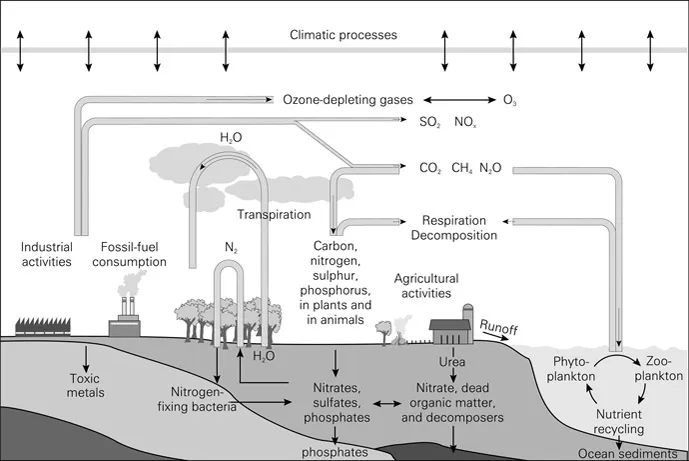
Figure 1.1 Interactions between the climate and major chemical flows
Source: W.C. Clark, ‘Managing Planet Earth’, Scientific American, Sept. 1989, p. 24.
The climate subsystem incorporates the atmospheric and oceanic processes that govern the global distribution of wind, rainfall and temperature. These processes are responsible, for example, for the major climatic changes associated with the El Niño effect in the southern Pacific and for any global temperature changes resulting from the accumulation of greenhouse gases.
The cycling of chemical elements involves the global circulation and processing of carbon, oxygen, nitrogen, phosphorus and sulphur. These elements are essential to life, and important in a wide variety of manufacturing processes. In compounds such as carbon dioxide, methane and nitrous oxide, they may have major effects on climate.
The water cycle involves evaporation, transpiration, precipitation and runoff. It circulates chemical elements between the land, the oceans, the atmosphere and living organisms. Water in the oceans plays a key role in determining the global climate.
Living organisms, and the ways they evolve, are dependent on the climate and the chemical and water cycles. At the same time, life other than humans is capable, usually over long time periods, of modifying the climate and circulation of chemical elements and water.5 Photosynthetic plants emit oxygen and water vapour, animals emit carbon dioxide and methane, and animal grazing can alter evaporation and runoff.
To understand how humans can be harmed by changes in the natural environment, and how human actions can cause such changes, we must have some understanding of the functioning and interactions of these four systems. However, many of the physical and biological interactions within and between climate, chemical cycling, water cycling and living organisms, and between these natural systems and human activities, are not well understood. For example, in the case of greenhouse gas emissio...
Table of contents
- Cover
- Title Page
- Dedication Page
- Copyright Page
- Contents
- Preface
- Acknowledgments
- Part I Social Coordination, the Economy and the Environment
- Part II Limitations of Market Signalling and Incentives
- Part III Decision-Making Tools
- Part IV Localised Environmental Problems
- Part V Global Environmental Problems
- Part VI Dealing with Uncertainty
- Notes
- Index
Trusted by 375,005 students
Access to over 1.5 million titles for a fair monthly price.
Study more efficiently using our study tools.
Frequently asked questions
Yes, you can cancel anytime from the Subscription tab in your account settings on the Perlego website. Your subscription will stay active until the end of your current billing period. Learn how to cancel your subscription
No, books cannot be downloaded as external files, such as PDFs, for use outside of Perlego. However, you can download books within the Perlego app for offline reading on mobile or tablet. Learn how to download books offline
Perlego offers two plans: Essential and Complete
- Essential is ideal for learners and professionals who enjoy exploring a wide range of subjects. Access the Essential Library with 800,000+ trusted titles and best-sellers across business, personal growth, and the humanities. Includes unlimited reading time and Standard Read Aloud voice.
- Complete: Perfect for advanced learners and researchers needing full, unrestricted access. Unlock 1.5M+ books across hundreds of subjects, including academic and specialized titles. The Complete Plan also includes advanced features like Premium Read Aloud and Research Assistant.
We are an online textbook subscription service, where you can get access to an entire online library for less than the price of a single book per month. With over 1.5 million books across 990+ topics, we’ve got you covered! Learn about our mission
Look out for the read-aloud symbol on your next book to see if you can listen to it. The read-aloud tool reads text aloud for you, highlighting the text as it is being read. You can pause it, speed it up and slow it down. Learn more about Read Aloud
Yes! You can use the Perlego app on both iOS and Android devices to read anytime, anywhere — even offline. Perfect for commutes or when you’re on the go.
Please note we cannot support devices running on iOS 13 and Android 7 or earlier. Learn more about using the app
Please note we cannot support devices running on iOS 13 and Android 7 or earlier. Learn more about using the app
Yes, you can access Economics and the Environment by Ian Wills in PDF and/or ePUB format, as well as other popular books in Economics & Business General. We have over 1.5 million books available in our catalogue for you to explore.