The Second World War was a dominant experience in Australian history. For the first time the country faced the threat of invasion. The economy and society were mobilised to an unprecedented degree, with 550 000 men and women, or one in twelve of a population of over 7 million, serving in the armed forces overseas. Social patterns and family life were disrupted. Politically, the war gave a new legitimacy to the Australian Labor Party which had been confined to the wilderness of the Opposition at the Federal level for most of the inter-war years. The powers of the Federal government increased and a new momentum for social reform was generated at the popular and governmental level. In the international sphere, the war fundamentally shook Australian confidence in the power on which it had relied for generations, Great Britain. It generated a sense of independence in Australian foreign policy and initiated a new, if halting and problematic, realignment towards the United States.
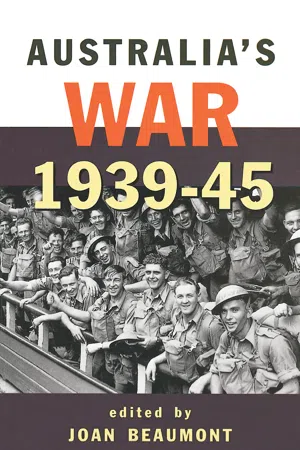
In this accessible book Joan Beaumont, Kate Darian-Smith, David Lee, David Lowe, Marnie Haig-Muir, Roy Hay and David Walker consider the range of Australia's experience of this conflict. In a single volume they draw together the many aspects of the war and distil the current state of historical scholarship.
Australia's War 1939-45 will be invaluable to tertiary students and of enormous interest to the reader concerned with the social, political and military history of Australia. A companion volume on the First World War is also available.
- 232 pages
- English
- ePUB (mobile friendly)
- Available on iOS & Android
eBook - ePub
Australia's War 1939-45
About this book
1 Australia's war: Europe and the Middle East
Joan Beaumont
There were less than twenty-two years—hardly a generation—between the end of the First World War and the start of the Second. With the keenest historical imagination it is difficult to recapture the emotions of Australians who listened to the radio broadcast on the night of Sunday, 3 September 1939, announcing the outbreak of war. War with Germany again. Women whose husbands, brothers and friends had died two decades earlier were now consumed with the fear that they would lose their sons; men who had been traumatised and maimed at Gallipoli, France or the Middle East faced the thought of their children engaged in combat, or the prospect that they themselves might have to serve again. It must have seemed intolerable: the peace bought at such a price in 1918 had proved ephemeral; the desperate efforts of British and French diplomats to avoid another European conflict had been frustrated.
Yet for all the anguish of confronting another war, Australians generally were willing to do this. Little more than an hour after the British Prime Minister, Neville Chamberlain, declared that Britain was at war with Germany, his Australian counterpart, Robert Menzies, went on radio to announce that it was his 'melancholy duty' to inform Australians that 'in consequence of a persistence by Germany in her invasion of Poland, Great Britain has declared war upon her and that, as a result, Australia is also at war,'1
Reasons for Australia's involvement in the war
The speed with which Menzies made this declaration was criticised later in the war. Such a vital matter, it was thought, should have been referred to the parliament, as it was in other British Dominions2 such as South Africa and Canada. Menzies, however, believed that it was necessary to take immediate action to reassure the British government of Australia's support. To him it was unthinkable that Australia should remain neutral in the war; not only because he had a deep attachment to Britain, but because, as a lawyer, he could not conceive of a situation where the King of the Commonwealth might be at war and peace with Germany at the same time.3
Whatever the later criticism, in September 1939 there was almost universal support for Menzies' position. When the Federal parliament did debate the question of war on 6 September, the leader of the Opposition Australian Labor Party (ALP), John Curtin, reluctantly agreed that there was 'no alternative but for this dreadful affliction to come to mankind'.4 No parliamentarian spoke against the war. Outside parliament the Communist Party, though it would soon emerge as an opponent of the war, was initially supportive. Having been schooled by Moscow for the past four years to cooperate with social democratic movements in the struggle against fascism and Nazism, it had yet to adjust to the dramatic volte-face of the Nazi-Soviet pact of 26 August 1939, which made Nazi Germany an ally of the Soviet Union.5 As for the public, so far as general moods can be assessed, there was a resigned acceptance of the war.
Why was Australia united about being at war, when the conflict was concerned with the challenge posed by Germany to the European international system established in the aftermath of the First World War, and with the containment of Nazism's ideologically driven expansion into Eastern Europe? The reasons provided by the official historian, Paul Hasluck, in 19526 still remain widely accepted.7 Australia entered the war because of a widespread political and emotional commitment to the British Commonwealth (as the Empire was now known). Across all major political parties there was a belief that Australia's interests, though distinctive within the Asia-Pacific region, were inextricably linked to those of Britain. Not only would a British defeat in Europe, it was thought, expose Australia ultimately to pressure from Germany but it would destroy the system of imperial defence on which Australia relied for security against Japan.8
The key to imperial defence strategy in the Asia-Pacific region was British naval power: in particular, the ability of the Royal Navy to place a battlefleet at Singapore in the event of Japan choosing to move south.9 All of Australian defence planning in the interwar years had been centred on this commitment, though the army leadership believed that Australia should also develop the capacity to meet a threat of invasion. By the late 1930s, as the diplomatic situation in Europe and Asia deteriorated, it had become increasingly obvious that Britain might not, in fact, be able to provide a fleet at Singapore. The ALP advocated the development of Australian air and submarine forces,10 but, since the defence budget had been starved in the Depression years and Britain's own demand for munitions made it difficult for Australia to place orders when it increased defence spending in 1938-39, the Australian government had little option but to continue with the logic of imperial defence. The 'chronic lack of self-reliance' in successive governments' defence policy, to quote David Horner,11 had left Australia facing the demands of war with its defence forces woefully ill-equipped.12
Australia's reliance on imperial defence was reinforced by an economic dependence on Britain; in the interwar years Britain was Australia's largest trading partner and largest overseas investor. There was also an emotional identification on the part of many within the Australian population with British culture. The First World War had generated a strong sense of Australian national identity and character, but for all the power of the Anzac legend, Australian nationalism was still subsumed into a wider imperial nationalism in which there was little perceived conflict between being 'British' and being 'Australian'. For the majority of Australians, Britain was still 'the mother country'. British literature and history dominated the school curricula. Going 'home' was an event to be celebrated in the social calendars of Australian newspapers. Of course, such sentiments were not universal within Australian society. As in 1914, there were dissenting voices, particularly on the left of politics. But the dominance of the non-Labor forces in federal politics in the interwar years had made 'loyalty' to the Empire a test of political reliability and had muted alternative constructions of Australian nationalism.
Finally, Australia entered the conflict against Germany because of a concern for international morality. Germany's aggression against its neighbours posed a more general threat to the principles of international law that were fundamental to the stability of the international system on which the survival of small nations depended. As the Labor Senator Collings said in the parliamentary debate on 6 September, 'resistance to force and armed aggression is inevitable if attacks on free and independent peoples are to be averted'.13 This, as Hasluck observed, was the one theme common to speeches from all political parties.14
The commitment to imperial defence
Australia, then, entered the Second World War, as it had the First, with a remarkable degree of consensus; but this was a consensus about the need to be at war, not about the role Australia should play in the conflict. The second issue proved to be much more contentious.
Popular mythology has it that Menzies followed up his automatic declaration of war with an immediate offer of troops to serve overseas at Britain's behest. Supposedly, as an Anglophile, he slipped unthinkingly into the mentality of 1914, when an expeditionary force of 20 000 men was promised to Britain even before the war had begun. Such an interpretation, however, is erroneous, as the research of many historians has shown.
In reality, the Australian government, like the ALP and the leaders of the armed services, were far more cautious in September 1939. They were deeply concerned about Australia's own security position and feared that Japan, already engaged in an aggressive war in China, would capitalise on Britain's and France's preoccupation in Europe to expand its influence in Asia. The dilemma confronting the Menzies government after it declared war was whether it should retain Australian forces at home or whether it should give practical aid to Britain by committing Australian naval, air and land forces overseas.
In the event, the government decided, in an incremental fashion and with considerable misgivings, to do the latter. On 8 September the British Admiralty asked that Australian naval vessels be released for service outside Australian waters. Since it had always been agreed in imperial defence planning that the Royal Australian Navy (RAN) would operate in time of war as an integral part of the Royal Navy, the Australian government, after some deliberation, decided that the Hobart (one of the RAN's six cruisers) and five destroyers should leave Australia. Their original destination, when they sailed on 13-14 October, was Singapore, a station of direct interest to Australia's security, but at the request of the British the vessels were soon diverted to the Mediterranean. On 7 November the cabinet agreed to place all the RAN's vessels under the strategic control of the Admiralty. Australia, however, retained the right to determine which of them should leave Australian waters, and in view of the uncertainty about Japan and the menace of German raiders, in December the cruiser Perth returned to Australian waters, while the Sydney joined the East Indies station.
These commitments of the RAN were not especially contentious. Far more controversial, especially in retrospect, were the decisions made by the Australian government in October 1939 about the Royal Australian Air Force (RAAF). When war broke out, an RAAF squadron already in Britain was transferred to the Coastal Command of the Royal Air Force (RAF). The Australian Minister for Air, J. V. Fairbairn, recommended that Australia should follow this up by providing an air 'expeditionary force' which would operate as a discrete group within the RAF in Britain. Menzies, however, preferred the scheme advocated by the Australian High Commissioner in London, Stanley Bruce. This proposed that Australia, and other Dominions, would train air crew for service in the RAF at their own expense, in Australia, Canada and Southern Rhodesia. The Empire Air Training Scheme, as it became known, was an unequivocal expression of Australia's commitment to imperial defence—and one which, as we shall see below, had the effect of limiting the RAAF's ability to play a role in the Pacific later in the war. Australia's enthusiastic embracing of the scheme was testimony to the emotional appeal to Menzies, Bruce and the Australian Cabinet of the notion that 'when the Lion roars, the Cubs will answer the call'.15
The appeal of imperial defence was resisted only a little longer in the case of Australia's land forces. At the outbreak of war Australia had a small per...
Table of contents
- Cover
- Half Title
- Title Page
- Copyright Page
- Contents
- Tables and Figures
- Maps
- Acknowledgments
- Abbreviations
- Contributors
- Chronology of the war
- Introduction
- 1 Australia's war: Europe and the Middle East
- 2 Australia's war: Asia and the Pacific
- 3 War and Australian society
- 4 Politics and government
- 5 The economy at war
- 6 The writers' war
- 7 Australia in the world
- Select bibliography
- Index
Trusted by 375,005 students
Access to over 1.5 million titles for a fair monthly price.
Study more efficiently using our study tools.
Frequently asked questions
Yes, you can cancel anytime from the Subscription tab in your account settings on the Perlego website. Your subscription will stay active until the end of your current billing period. Learn how to cancel your subscription
No, books cannot be downloaded as external files, such as PDFs, for use outside of Perlego. However, you can download books within the Perlego app for offline reading on mobile or tablet. Learn how to download books offline
Perlego offers two plans: Essential and Complete
- Essential is ideal for learners and professionals who enjoy exploring a wide range of subjects. Access the Essential Library with 800,000+ trusted titles and best-sellers across business, personal growth, and the humanities. Includes unlimited reading time and Standard Read Aloud voice.
- Complete: Perfect for advanced learners and researchers needing full, unrestricted access. Unlock 1.5M+ books across hundreds of subjects, including academic and specialized titles. The Complete Plan also includes advanced features like Premium Read Aloud and Research Assistant.
We are an online textbook subscription service, where you can get access to an entire online library for less than the price of a single book per month. With over 1.5 million books across 990+ topics, we’ve got you covered! Learn about our mission
Look out for the read-aloud symbol on your next book to see if you can listen to it. The read-aloud tool reads text aloud for you, highlighting the text as it is being read. You can pause it, speed it up and slow it down. Learn more about Read Aloud
Yes! You can use the Perlego app on both iOS and Android devices to read anytime, anywhere — even offline. Perfect for commutes or when you’re on the go.
Please note we cannot support devices running on iOS 13 and Android 7 or earlier. Learn more about using the app
Please note we cannot support devices running on iOS 13 and Android 7 or earlier. Learn more about using the app
Yes, you can access Australia's War 1939-45 by Joan Beaumont in PDF and/or ePUB format, as well as other popular books in History & Australian & Oceanian History. We have over 1.5 million books available in our catalogue for you to explore.