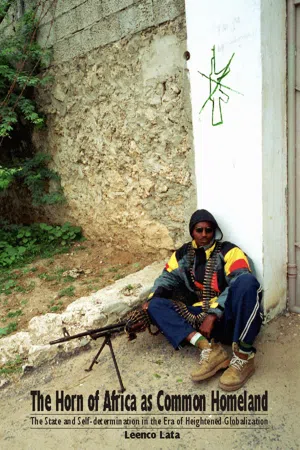
The Horn of Africa as Common Homeland
eBook - PDF

The Horn of Africa as Common Homeland

The State and Self-Determination in the Era of Heightened Globalization

  1. 232 pages
  2. English
  3. PDF
  4. Available on iOS & Android
eBook - PDF

The Horn of Africa as Common Homeland

The State and Self-Determination in the Era of Heightened Globalization

About this book

Contemporary states are generally presumed to be founded on the elements of nation, people, territory, and sovereignty. In the Horn of Africa however, the attempts to find a neat congruence among these elements created more problems than they solved. Leenco Lata demonstrates that conflicts within and between states tend to connect seamlessly in the region. When these conflicts are seen in the context of pressures on the state in an era of heightened globalization, it becomes obvious that the Horn needs to adopt multidimensional self-determination.

In Structuring the Horn of Africa as a Common Homeland, Leenco Lata discusses the history of conflicts within and between Ethiopia, Eritrea, Somalia, and the Sudan, and investigates local and global contributory factors. He assesses the effectiveness of the nation-state model to forge a positive relationship between these governments and the people.

Part 1 summarizes the history of self-determination and the state from the French Revolution to the post-Cold War period. Part 2 shows how the states of the Horn of Africa emerged in a highly interactive way, and how these developments continue to reverberate throughout the region, underscoring the necessity of simultaneous regional integration and the decentralization of power as an approach to conflict resolution.

Motivated by a search for practical answers rather than a strict adherence to any particular theory, this significant work by a political activist provides a thorough analysis of the regions complicated and conflicting goals.

Frequently asked questions

Yes, you can cancel anytime from the Subscription tab in your account settings on the Perlego website. Your subscription will stay active until the end of your current billing period. Learn how to cancel your subscription.
No, books cannot be downloaded as external files, such as PDFs, for use outside of Perlego. However, you can download books within the Perlego app for offline reading on mobile or tablet. Learn more here.
Perlego offers two plans: Essential and Complete
  • Essential is ideal for learners and professionals who enjoy exploring a wide range of subjects. Access the Essential Library with 800,000+ trusted titles and best-sellers across business, personal growth, and the humanities. Includes unlimited reading time and Standard Read Aloud voice.
  • Complete: Perfect for advanced learners and researchers needing full, unrestricted access. Unlock 1.4M+ books across hundreds of subjects, including academic and specialized titles. The Complete Plan also includes advanced features like Premium Read Aloud and Research Assistant.
Both plans are available with monthly, semester, or annual billing cycles.
We are an online textbook subscription service, where you can get access to an entire online library for less than the price of a single book per month. With over 1 million books across 1000+ topics, we’ve got you covered! Learn more here.
Look out for the read-aloud symbol on your next book to see if you can listen to it. The read-aloud tool reads text aloud for you, highlighting the text as it is being read. You can pause it, speed it up and slow it down. Learn more here.
Yes! You can use the Perlego app on both iOS or Android devices to read anytime, anywhere — even offline. Perfect for commutes or when you’re on the go.
Please note we cannot support devices running on iOS 13 and Android 7 or earlier. Learn more about using the app.
Yes, you can access The Horn of Africa as Common Homeland by Leenco Lata in PDF and/or ePUB format, as well as other popular books in History & African History. We have over one million books available in our catalogue for you to explore.

Information

Table of contents

  1. Table of Contents
  2. List of Figures and Maps
  3. Acknowledgements
  4. Introduction
  5. Part I: Self-Determination in History
  6. Part II: Resonance of Conflicts in the Horn of Africa
  7. References
  8. Index