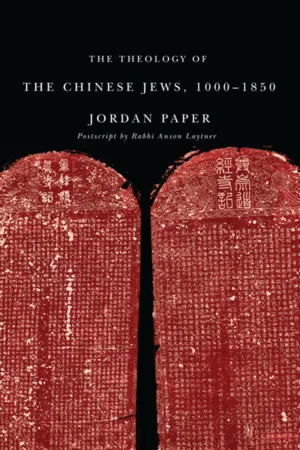
The Theology of the Chinese Jews, 1000–1850
eBook - PDF

The Theology of the Chinese Jews, 1000–1850

  1. 175 pages
  2. English
  3. PDF
  4. Available on iOS & Android
eBook - PDF

The Theology of the Chinese Jews, 1000–1850

About this book

A thousand years ago, the Chinese government invited merchants from one of the Chinese port synagogue communities to the capital, Kaifeng. The merchants settled there and the community prospered. Over centuries, with government support, the Kaifeng Jews built and rebuilt their synagogue, which became perhaps the world's largest. Some studied for the rabbinate; others prepared for civil service examinations, leading to a disproportionate number of Jewish government officials. While continuing orthodox Jewish practices they added rituals honouring their parents and the patriarchs, in keeping with Chinese custom. However, by the mid-eighteenth century—cut off from Judaism elsewhere for two centuries, their synagogue destroyed by a flood, their community impoverished and dispersed by a civil war that devastated Kaifeng—their Judaism became defunct.

The Theology of the Chinese Jews traces the history of Jews in China and explores how their theology's focus on love, rather than on the fear of a non-anthropomorphic God, may speak to contemporary liberal Jews. Equally relevant to contemporary Jews is that the Chinese Jews remained fully Jewish while harmonizing with the family-centred religion of China. In an illuminating postscript, Rabbi Anson Laytner underscores the point that Jewish culture can thrive in an open society, "without hostility, by absorbing the best of the dominant culture and making it one's own."

Frequently asked questions

Yes, you can cancel anytime from the Subscription tab in your account settings on the Perlego website. Your subscription will stay active until the end of your current billing period. Learn how to cancel your subscription.
At the moment all of our mobile-responsive ePub books are available to download via the app. Most of our PDFs are also available to download and we're working on making the final remaining ones downloadable now. Learn more here.
Perlego offers two plans: Essential and Complete
  • Essential is ideal for learners and professionals who enjoy exploring a wide range of subjects. Access the Essential Library with 800,000+ trusted titles and best-sellers across business, personal growth, and the humanities. Includes unlimited reading time and Standard Read Aloud voice.
  • Complete: Perfect for advanced learners and researchers needing full, unrestricted access. Unlock 1.4M+ books across hundreds of subjects, including academic and specialized titles. The Complete Plan also includes advanced features like Premium Read Aloud and Research Assistant.
Both plans are available with monthly, semester, or annual billing cycles.
We are an online textbook subscription service, where you can get access to an entire online library for less than the price of a single book per month. With over 1 million books across 1000+ topics, we’ve got you covered! Learn more here.
Look out for the read-aloud symbol on your next book to see if you can listen to it. The read-aloud tool reads text aloud for you, highlighting the text as it is being read. You can pause it, speed it up and slow it down. Learn more here.
Yes! You can use the Perlego app on both iOS or Android devices to read anytime, anywhere — even offline. Perfect for commutes or when you’re on the go.
Please note we cannot support devices running on iOS 13 and Android 7 or earlier. Learn more about using the app.
Yes, you can access The Theology of the Chinese Jews, 1000–1850 by Jordan Paper in PDF and/or ePUB format, as well as other popular books in Theology & Religion & History of Religion. We have over one million books available in our catalogue for you to explore.

Table of contents

  1. Cover
  2. Contents
  3. Prologue
  4. Acknowledgements
  5. 1 Introduction: The Four Questions
  6. 2 From Whence They Came to Where They Went
  7. 3 Life in China: Tenth to Nineteenth Centuries
  8. 4 Brief History of Buddhism and the Abrahamic Traditions in China
  9. 5 The Sinification of Judaism
  10. 6 A Speculative Theology of the Chinese Jews
  11. Epilogue
  12. Postscript: What Western Jews Can Learn from the Kaifeng Jews
  13. Appendix: Chinese Logographs for Terms and Translations in Chapter 6
  14. Notes
  15. References