- 254 pages
- English
- ePUB (mobile friendly)
- Available on iOS & Android
eBook - ePub
About this book
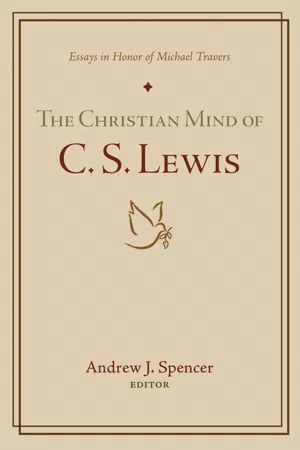
C. S. Lewis embodied the Christian mind because he saw the world as a coherent unity. His writing consistently pursued the good, the true, and the beautiful. He used nonfiction to point out the reasonableness of Christianity and used his fiction to create compelling illustrations that make faith in Christ an obvious and attractive conclusion.
This book explores the Christian mind of C. S. Lewis across the spectrum of the genres he worked in. With contributors from diverse disciplines and interests, the volume illuminates the many facets of Lewis's work. The Christian Mind of C. S. Lewis assists readers to read Lewis better and also to read other works better. The overarching goal is, just as Lewis would have desired, to help people see Christ more clearly in the world and to be more like Christ.
Information
Topic
Theology & ReligionSubtopic
Christian Theology1
The Christian Mind of C. S. Lewis
There is something about the character of C. S. Lewis that encourages happiness in fellowship and renewal of spirit. Some people read trendy novels for their popularity, but many of those who read Lewis do so in order to read other books better. Lewis’s books provide a more compelling attraction than mere popularity. Lewis is read widely for many reasons, but those who read him deeply and frequently do so to meet with a mind that has encountered Christ.
It would be difficult to quantify Lewis’s popularity. In some circles he is more popular than he ought to be, especially when his books are perceived as the final destination for studying literature. Though Lewis’s work is excellent, there is little question he would be surprised at the focus he receives in some Christian circles. Lewis’s work certainly deserves high praise, but those who have read him well recognize he is helpful in teaching readers how to think so they can read other literature better. He is pointing toward something beyond himself.
It is the Christian mind of C. S. Lewis that should be so very interesting. That mind is revealed on the pages of his various works. The books, essays, and poems that he wrote have profound interest to many because they direct the reader’s attention to something deeper, richer, and truer than anything seen or heard in this life.
Lewis is a less polarizing figure than many other Christian writers of enduring popularity, though Lewis did hold many strong opinions. John Calvin, Martin Luther, Origen, Augustine of Hippo, and others are more doctrinally significant to the history of the church because of their theological contributions, but their work tends to be much more divisive. For example, some groups love John Calvin, while others despise him. He is enduringly popular in some circles and was highly prolific, but his appeal is much narrower than Lewis’s. In fact, one of the intriguing aspects of Lewis’s enduring popularity is that he seems to appeal to Christians of nearly all theological traditions. It is not unheard of for even secularists to find Lewis’s work attractive, though I am not certain how long one can resist the siren call of the gospel in Lewis’s imaginative and expository works. Nevertheless, Lewis is read by a broad coalition of scholars, clergy, and laypeople.
Many recent treatments of the life and work of C. S. Lewis begin with speculation about his enduring popularity. Alister McGrath begins his book, The Intellectual World of C. S. Lewis, by offering three reasons why Lewis remains popular: (1) the continued value of his apologetic work; (2) his religious appeal; and (3) his use of imagination in defense of the faith.1 Michael Travers agreed with McGrath, but added his own considerations, writing:
In addition to these reasons, there is an underlying reason for Lewis’s ongoing importance: he wrote about things of first importance, timeless truths that he thought we needed to hear. In his writings, Lewis taps into the essential human condition in such a way that we catch glimpses of truths we had forgotten or perhaps suppressed, especially in our modern, Post-Enlightenment culture. One of these truths is that everyone is on a journey, hoping for heaven, even when we do not know it or refuse to admit it.2
Travers reflects on something most people interested in Lewis sense, but have a difficult time expressing: our interest in C. S. Lewis is partially driven by the mind of the person who wrote so beautifully about such important things. Many of us are interested in Lewis because he exemplified the Christian mind in what he wrote.
It is highly likely that Lewis would have winced at this reason for ongoing interest in his work. After all, this is the man who repeatedly rejected the notion that literature should be interpreted through the biography of the author, especially in his dialogue with E. M. Tillyard in The Personal Heresy.3 And yet, it is unquestionable that the ongoing interest in Lewis is driven nearly as much by the world’s fascination with something about the man as by enjoyment of his writing. The perpetual stream of biographies about Lewis is evidence of the world’s interest in Lewis’s personal history.4 But the Christian mind is both personal and super-personal. It is embodied by individuals, like C. S. Lewis, but it is also transcendently super-personal because it relies on a common relationship to the great mind of the creator God.
Lewis embodies the Christian mind because he brings the world together into a cohesive unity. He was one of several people who seemed to embody the Christian mind in his time. Others on this list include T. S. Eliot, Dorothy L. Sayers, and other Christian humanists from the early twentieth century.5 We might also include luminaries like Augustine of Hippo, Thomas Aquinas, and Abraham Kuyper on this list. These are people who, despite diverse theological backgrounds, seem to have seen the unity in the universe and meaningfully engaged with the Mind that first imagined the created order. This comes through in the pages of their books, which seem to be alive in such a way that enlivens the mind of the reader. The common thread running through all of their work is the vibrant life of the Christian mind.
This volume of essays, written in honor of Michael Travers, centers on the theme of the Christian mind of C. S. Lewis. The essays collected here explore some of the contours of Lewis’s own intellectual history. More significantly, they try to show where Lewis is pointing and how he directs readers’ attention to the things toward which he points.
It is impossible to write about Lewis without dealing with his biography, since his life and work were so inextricably linked. However, the biographical content in this volume is used to show where Lewis stood. As Christian authors seeking to point others to the same truths Lewis saw, we are attempting to see how he got to the place from which he pointed. The essays in this volume consider both topics, often simultaneously, in an effort to explore the Christian mind of C. S. Lewis and help others come closer to approximating the Christian mind in their own lives.
The Christian Mind
In his 1963 book, Harry Blamires flatly states, “There is no longer a Christian mind.”6 Such a grim diagnosis might seem to undermine the premise of this volume and raise contentious questions about the future of the church. However, Blamires went on to qualify his statement, writing, “There is still, of course, a Christian ethic, a Christian practice, and a Christian spirituality.”7 In context, Blamires is offering two specific criticisms of Christianity writ large. First, most Christians fail to integrate their faith with all areas of knowledge. Due to this failure, many do not think primarily as citizens of the kingdom of God, but instead function mainly as citizens of their nation, their time, and their cultural context. They may claim their identity is primarily in Christ, but that is not always visible in the way they live their lives, speak to others, spend their money, and engage in political activism. To see that his diagnosis is largely correct, one need only observe the drift of self-identified Christians toward blind acceptance of sexual revisionism, of reductionistic materialism in science and economics, and of the prevale...
Table of contents
- Title Page
- List of Contributors
- Acknowledgements
- 1: The Christian Mind of C. S. Lewis
- 2: Invitation to Glory
- 3: “The Intolerable Compliment”
- 4: C. S. Lewis, Architecton
- 5: Psalm 19, Revelation, and the Integration of Faith, Learning, and Life
- 6: The Fox and the Fool
- 7: Reality and Pre-Evangelism in the Christian Minds of C. S. Lewis and Francis Schaeffer
- 8: Disinterested Love in The Screwtape Letters and The Great Divorce
- 9: An “Inner Ring” or an Open Fellowship?
- 10: Ethics among Men without Chests
- 11: Lewis on Lament
- 12: “As Ever in My Great Task-Master’s Eye”
- 13: The Christian Mind of Michael Travers
Trusted by 375,005 students
Access to over 1.5 million titles for a fair monthly price.
Study more efficiently using our study tools.
Frequently asked questions
Yes, you can cancel anytime from the Subscription tab in your account settings on the Perlego website. Your subscription will stay active until the end of your current billing period. Learn how to cancel your subscription
No, books cannot be downloaded as external files, such as PDFs, for use outside of Perlego. However, you can download books within the Perlego app for offline reading on mobile or tablet. Learn how to download books offline
Perlego offers two plans: Essential and Complete
- Essential is ideal for learners and professionals who enjoy exploring a wide range of subjects. Access the Essential Library with 800,000+ trusted titles and best-sellers across business, personal growth, and the humanities. Includes unlimited reading time and Standard Read Aloud voice.
- Complete: Perfect for advanced learners and researchers needing full, unrestricted access. Unlock 1.5M+ books across hundreds of subjects, including academic and specialized titles. The Complete Plan also includes advanced features like Premium Read Aloud and Research Assistant.
We are an online textbook subscription service, where you can get access to an entire online library for less than the price of a single book per month. With over 1.5 million books across 990+ topics, we’ve got you covered! Learn about our mission
Look out for the read-aloud symbol on your next book to see if you can listen to it. The read-aloud tool reads text aloud for you, highlighting the text as it is being read. You can pause it, speed it up and slow it down. Learn more about Read Aloud
Yes! You can use the Perlego app on both iOS and Android devices to read anytime, anywhere — even offline. Perfect for commutes or when you’re on the go.
Please note we cannot support devices running on iOS 13 and Android 7 or earlier. Learn more about using the app
Please note we cannot support devices running on iOS 13 and Android 7 or earlier. Learn more about using the app
Yes, you can access The Christian Mind of C. S. Lewis by Andrew J. Spencer in PDF and/or ePUB format, as well as other popular books in Theology & Religion & Christian Theology. We have over 1.5 million books available in our catalogue for you to explore.