eBook - ePub
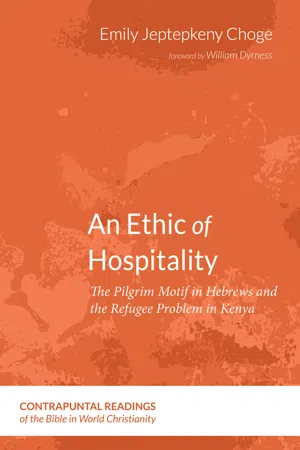
An Ethic of Hospitality
The Pilgrim Motif in Hebrews and the Refugee Problem in Kenya
- 266 pages
- English
- ePUB (mobile friendly)
- Available on iOS & Android
eBook - ePub
An Ethic of Hospitality
The Pilgrim Motif in Hebrews and the Refugee Problem in Kenya
About this book
In our increasingly xenophobic world, countries are turning away refugees and immigrants. Based on the situation in Kenya, this book offers a countercultural ethic of hospitality and welcome to the stranger, an ethic fraught with dangers and yet filled with great opportunities for transforming our world. Drawing on the scriptural pilgrim motif and specifically on the book of Hebrews, this study paints a picture of refugees not only as needy strangers to be herded into camps, but as brothers and sisters who bring with them treasures and talents that can enrich our understanding of our Christian identity and mission as pilgrims in the world. The hospitality practice seen in Hebrews offers hope and promise not only for refugees themselves but also for the pilgrim church. Like the ancient heroes of faith portrayed in Hebrews, we too live as pilgrims and aliens who await with hope the city whose architect and founder is God. Refugees in fact teach us how to live our pilgrim identity: they become teachers not only for the church in Kenya but also for the body of Christ worldwide.
Information
Topic
Theology & ReligionSubtopic
Biblical Studies5
The Pilgrim Motif in
the Book of Hebrews
These all died in faith, not having received the promises, but having seen them afar off, and were persuaded of them, and embraced them, and confessed that they were strangers and pilgrims on the earth. (Heb 11:13, KJV)
Introduction
The pilgrim293 motif is central to the Christian life.294 It plays a key role in the identity and the life of the people of God in both the Old and the New Testament. The pioneers of the faith Abraham, Isaac, Jacob, and their wives lived as “strangers and pilgrims” even in the land of Canaan, the land of promise. The book of Hebrews tells us that they were looking for the “city that has foundations, whose architect and builder is God” (Heb 11:10).295 In the Old Testament, the Israelite journey to and from Egypt, and later to exile in Babylon, continues this theme in the life of the people of God. We also note this kind of existence in the life of Jesus as “he set his face to go to Jerusalem,” he had “nowhere to lay his head.”296 The life of the early Christians is also one of movement as is depicted by the life of the apostle Paul, who made several missionary journeys to establish churches around the region of the Mediterranean sea, and later in Rome. It is important to note that in both the Old and the New Testament the emphasis is placed on the practice of hospitality or love for the aliens and strangers, as an appropriate response to pilgrim existence.297 The idea is that people who understand what it means to be a stranger should treat strangers better than those who do not. This was expected of the people of God in the Old Testament, but no less for those in the early church and in the present.298
The book of Hebrews focuses on the pilgrim motif and also on the response of hospitality to those who are experiencing various kinds of trials, especially Christians living in a hostile environment. My work in this chapter will be to examine how the author of Hebrews uses the pilgrim motif to speak to the situation of the early listeners.299 The key questions will be: Why does the author use this motif? How does the use of this motif communicate something about the life of the early listeners? What ethical values, principles and practices does the author of Hebrews promote in order for one to persevere in the pilgrimage? Are these values, principles and practices applicable to the church today? My thesis is that the use of the pilgrim motif sets the tone for radical faith and hope in the face of adverse circumstances. That kind of hope should characterize the body of Christ anywhere in the world, but more specifically in Africa where wars, famines and diseases have caused huge displacements of peoples who live scattered in various lands as refugees, aliens and strangers. Most importantly, Hebrews provides us with the key principle of pilgrimage, namely, the necessity of entering into God’s presence, the true goal of all pilgrimage. Therefore, this is not a theoretical or an abstract reflection but an urgent call to Christians everywhere to reflect on our true identity as “pilgrims and strangers” and on how this will change the way we live and view the world.
In order to do this work, I first look briefly at how the pilgrim motif is portrayed in and lived out in the life of the people of God in ancient Israel, at the time of Jesus, and in the early church. Then I will examine what various authors say about the use of the pilgrim motif in Hebrews. This will set the stage for examining what Hebrews says about this theme, as I do both a comprehensive overview of the whole book, as well as an exegetical analysis of a key passage, Hebrews 11:13–16. I will then discuss the ethical implications that result from the pilgrim motif with a view to applying them to the church in Africa, more specifically the church in Kenya. In the final analysis, I hope that these principles and practices can be carried on by the church worldwide because this calling for Christian to live as “pilgrims and aliens” is for the whole body of Christ regardless of time and place.
Background: The Pilgrim Motif in Ancient Israel
The central understanding of the people of God both in the old and the new covenant is that of a people always on the move. They are those who have set their eyes on the city “whose maker and founder is God” (Heb 11:10, 16). Here on earth, they have no fixed residence. They live as resident aliens, strangers and foreigners, or pilgrims on a journey to the heavenly city. This identity that embodies movement was brought into place with the calling of the father of faith, Abraham, who was told to move out of the land of the Chaldeans to the land that God would show him. At first, we think that the land that he was to inhabit is the land of Canaan, but Hebrews reinterprets this by saying; “By faith he stayed for a time in that land he had been promised, as in a foreign land, living in tents, as did Isaac and Jacob, who were heirs with him of the same promise. For he looked for a city that has foundations, whose architect and builder is God” (Heb 11:9–10). This shows that from t...
Table of contents
- Title Page
- Foreword
- Acknowledgments
- Introduction
- Abbreviations
- A Hospitality Ethic of Pilgrims for Kenyan Refugees
- The Refugee Situation in the Horn of Africa
- Responses to the Refugee Problem
- Kenya: A Refugee-hosting Country
- The Pilgrim Motif in the Book of Hebrews
- The Role of the Church in Kenya and the Refugee Problem
- Recommendations and Conclusion
- Definition of Key Terms
- Interview Questions
- Letter to the Refugees
- Bibliography
Trusted by 375,005 students
Access to over 1.5 million titles for a fair monthly price.
Study more efficiently using our study tools.
Frequently asked questions
Yes, you can cancel anytime from the Subscription tab in your account settings on the Perlego website. Your subscription will stay active until the end of your current billing period. Learn how to cancel your subscription
No, books cannot be downloaded as external files, such as PDFs, for use outside of Perlego. However, you can download books within the Perlego app for offline reading on mobile or tablet. Learn how to download books offline
Perlego offers two plans: Essential and Complete
- Essential is ideal for learners and professionals who enjoy exploring a wide range of subjects. Access the Essential Library with 800,000+ trusted titles and best-sellers across business, personal growth, and the humanities. Includes unlimited reading time and Standard Read Aloud voice.
- Complete: Perfect for advanced learners and researchers needing full, unrestricted access. Unlock 1.5M+ books across hundreds of subjects, including academic and specialized titles. The Complete Plan also includes advanced features like Premium Read Aloud and Research Assistant.
We are an online textbook subscription service, where you can get access to an entire online library for less than the price of a single book per month. With over 1.5 million books across 990+ topics, we’ve got you covered! Learn about our mission
Look out for the read-aloud symbol on your next book to see if you can listen to it. The read-aloud tool reads text aloud for you, highlighting the text as it is being read. You can pause it, speed it up and slow it down. Learn more about Read Aloud
Yes! You can use the Perlego app on both iOS and Android devices to read anytime, anywhere — even offline. Perfect for commutes or when you’re on the go.
Please note we cannot support devices running on iOS 13 and Android 7 or earlier. Learn more about using the app
Please note we cannot support devices running on iOS 13 and Android 7 or earlier. Learn more about using the app
Yes, you can access An Ethic of Hospitality by Emily Jeptepkeny Choge in PDF and/or ePUB format, as well as other popular books in Theology & Religion & Biblical Studies. We have over 1.5 million books available in our catalogue for you to explore.