eBook - ePub
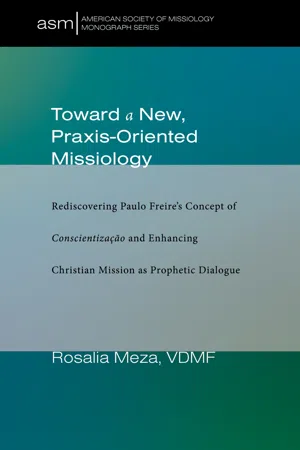
Toward a New, Praxis-Oriented Missiology
Rediscovering Paulo Freire’s Concept of Conscientizacao and Enhancing Christian Mission as Prophetic Dialogue
- 158 pages
- English
- ePUB (mobile friendly)
- Available on iOS & Android
eBook - ePub
Toward a New, Praxis-Oriented Missiology
Rediscovering Paulo Freire’s Concept of Conscientizacao and Enhancing Christian Mission as Prophetic Dialogue
About this book
The new and different frontiers and factors discussed in missiology are reshaping the meaning of mission. Christian mission today is searching for new directions to approach the postmodern, postcolonial, and ecumenical paradigms. This book argues that mission is the process of embodying the content and praxis of the gospel, not the transmission of knowledge that keeps an established structure and culture alive (often justified by a specific ecclesiological model). Thus, mission initiates a transformative process of faith, which leads to personal and social transformation.
This work brings into dialogue Stephen Bevans's notion of mission as prophetic dialogue and Paulo Freire's concept of conscientizacao. The aim is not to discover a method to do mission but to rescue the process that leads to transformation, allowing one to encounter the other where they are while respecting the uniqueness of every person, culture, church, and society. Prophetic dialogue enriched by conscientizacao (and vice versa) can open new perspectives within missiology and provide a new approach to mission praxis. This approach is then analyzed through the experiential and transformative elements of the Verbum Dei charism applied in ministry, demonstrating the effectiveness of prophetic dialogue and conscientizacao in the Verbum Dei Missionary Fraternity mission praxis.
Information
Topic
Theology & ReligionSubtopic
Christian Ministry1
Understanding of Mission as Prophetic Dialogue
Mission is not primarily an activity of the church, but an attribute of God.
—David J. Bosch, Transforming Mission
This chapter will discuss the concept of mission as prophetic dialogue by following its development from the joint work of Stephen Bevans and Roger Schroeder to Bevans’s own individual work. In order to show how Bevans developed this concept, the chapter will present the context within which his notion of mission as prophetic dialogue unfolded and then break up the concept into two terms: mission as dialogue and mission as prophecy. Subsequently, the chapter will introduce Bevans’s concept of prophetic dialogue as contextual theology and its relevance to engage mission contextually. Lastly, the chapter will demonstrate the relevance of understanding mission as prophetic dialogue in twenty-first-century missiological discourse.
To better contextualize Bevans’s work, this chapter will begin by offering a brief presentation on how the church’s understanding of mission has shifted since the Second Vatican Council, which opened under the pontificate of Pope John XXIII on October 11, 1962, and closed under Pope Paul VI on the Feast of the Immaculate Conception on December 8, 1965.
The Church and Mission since the Second Vatican Council
Looking at the current discourse in missiology, there are new and different frontiers and factors that are reshaping the understanding of mission and evangelization. Christian mission is faced with issues, and it is invited to grow in directions that are opening up new paradigms of theology and ministry. Therefore, the work of mission and evangelization is moving in new directions.1 Our task is to be good listeners to our contexts and to the needs of the world so that we allow a narrative of communion and inclusion to emerge in the church and continue collaborating in the missio Dei (mission of God).2
Vietnamese American theologian Peter C. Phan observed that mission is “not an innocent word.”3 In the name of mission, harm has been done to peoples and cultures throughout the world. The words “mission” and “missionaries” often carries a negative connotation of violence, imposition, destruction of cultures, and colonialism. Nevertheless, thanks to the Second Vatican Council and subsequent theological reflections by theologians, missiologists, ecclesiologists, and other interdisciplinary experts, such a perspective has been challenged. We can no longer think of mission, for example, as the only way of saving souls. We now say that salvation is possible outside explicit faith in Jesus Christ.4 We cannot conceive of mission as going from the West to the rest of the world. Nor do we generally employ military language such as “conquering the world for Christ.”5 Our theology of mission has significantly changed and now takes more into account the changes in the social, political, religious, and theological context.6 Moreover, we have recognized perhaps for the first time that our church today is incredibly diverse.7 No longer can the church’s catholicity mean a simple universality nor the church’s unity mean a simple uniformity.8 Christian mission today is in search of new directions to approach our diversity within postmodern and ecumenical paradigms.9 When talking about mission, we enter into a complexity of ideological, spiritual, and theological understandings which depend on individual perspectives, experience, religious background, and formation and education.
Regardless of the variety and new openness within missiological discourse, there is a common understanding about the need to be sensitive to philosophical, cultural, social, political, spiritual, and contextual movements of the present time, or as the Second Vatican Council puts it, “to read the signs of the times.”10 Therefore, mission is now conceived as a conscious dedication, preparation, and commitment to incarnate the gospel in every culture not only individually but in specific societies. An open attitude (thus, one open to dialogue) must characterize the interior mind-set of the persons undertaking holistically the endeavor of mission.11
Nevertheless, along with this new understanding of mission that emerged after the Second Vatican Council, the self-understanding of the church also changed. We can see this reflected in some church documents. Among those from the Second Vatican Council, Lumen Gentium (Dogmatic Constitution on the Church) emphasized the church and the renewal of its mission in the world. Lumen Gentium described the church as the mystical body of Christ and the people of God. Additionally, the theological basis of Ad Gentes (Decree on the Church’s Missionary Activity) established mission as the very essence of the church’s life. As the “universal sacrament of salvation,” the church participates in mission in order that “all things can be restored in Christ.”12 Also, Sacrosanctum Concilium (Constitution on the Sacred Liturgy) offered liturgical reform, such as the possibility of legitimate variations and adaptations to different cultures for the sake a clearer possibility for evangelization. Moreover, Nostra Aetate (Declaration on the Relation of the Church to Non-Christian Religions) recognized that other religions “often reflect a ray of that Truth” and attempted to rethink how to approach non-Christians in ways that were not threatening to them but were engaging them in dialogue and friendship—so anticipating the communion of the reign of God.13
Along with this vision of renewal, some regional developments in Latin America and Asia deeply affected the theology of mission of the Catholic Church. In 1968, the Latin American Episcopal Conference met at Medellín, Colombia. There the bishops dealt with the fundamental need to relate the church’s life a...
Table of contents
- Title Page
- Illustrations
- Acknowledgments
- Abbreviations
- Introduction
- Chapter 1: Understanding of Mission as Prophetic Dialogue
- Chapter 2: Paulo Freire’s Concept of Conscientização: A Commitment to Process
- Chapter 3: Conscientização Enhances Prophetic Dialogue and Vice Versa
- Chapter 4: Contribution to the Praxis and Field of Missiology in Light of Contemporary Verbum Dei Missionary Fraternity Vision and Ministry
- Conclusion
- Bibliography
Trusted by 375,005 students
Access to over 1.5 million titles for a fair monthly price.
Study more efficiently using our study tools.
Frequently asked questions
Yes, you can cancel anytime from the Subscription tab in your account settings on the Perlego website. Your subscription will stay active until the end of your current billing period. Learn how to cancel your subscription
No, books cannot be downloaded as external files, such as PDFs, for use outside of Perlego. However, you can download books within the Perlego app for offline reading on mobile or tablet. Learn how to download books offline
Perlego offers two plans: Essential and Complete
- Essential is ideal for learners and professionals who enjoy exploring a wide range of subjects. Access the Essential Library with 800,000+ trusted titles and best-sellers across business, personal growth, and the humanities. Includes unlimited reading time and Standard Read Aloud voice.
- Complete: Perfect for advanced learners and researchers needing full, unrestricted access. Unlock 1.5M+ books across hundreds of subjects, including academic and specialized titles. The Complete Plan also includes advanced features like Premium Read Aloud and Research Assistant.
We are an online textbook subscription service, where you can get access to an entire online library for less than the price of a single book per month. With over 1.5 million books across 990+ topics, we’ve got you covered! Learn about our mission
Look out for the read-aloud symbol on your next book to see if you can listen to it. The read-aloud tool reads text aloud for you, highlighting the text as it is being read. You can pause it, speed it up and slow it down. Learn more about Read Aloud
Yes! You can use the Perlego app on both iOS and Android devices to read anytime, anywhere — even offline. Perfect for commutes or when you’re on the go.
Please note we cannot support devices running on iOS 13 and Android 7 or earlier. Learn more about using the app
Please note we cannot support devices running on iOS 13 and Android 7 or earlier. Learn more about using the app
Yes, you can access Toward a New, Praxis-Oriented Missiology by Rosalia Meza in PDF and/or ePUB format, as well as other popular books in Theology & Religion & Christian Ministry. We have over 1.5 million books available in our catalogue for you to explore.