- 138 pages
- English
- ePUB (mobile friendly)
- Available on iOS & Android
eBook - ePub
About this book
In this clear, practical, and brief commentary, Anthony Thiselton brings to bear his intimate knowledge of Paul's theology, the ancient city of Colossae, and Paul's epistle to the church of that city. The commentary offers a new translation from the Greek, and explorations of an exegetical as well as a pastoral and practical nature on all passages of the book. Each section concludes with questions for further reflection.
Information
Topic
Theology & ReligionSubtopic
Biblical CommentaryPart I
INTRODUCTION
Introduction
A. The Church at Colossae
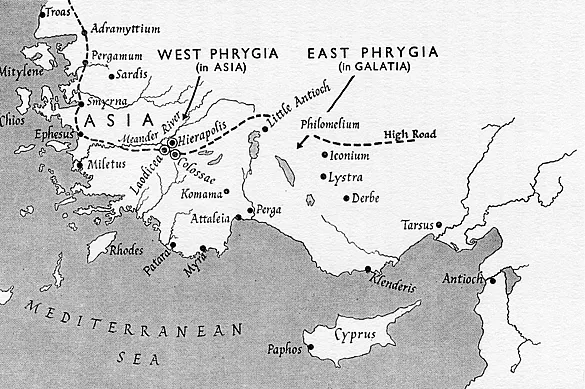
Colossae was a city of Phrygia, about 150 miles to the east of Ephesus, thirteen miles to the northeast of Hierapolis, and ten or eleven miles to the west of Laodicea. The city was in the Southern part of the Roman Province of Asia, or in modern Turkey. Colossae was once a city of great importance and wealth but was overtaken in size by Hierapolis and Laodicea. The earlier wealth of Colossae four or five centuries previous was due to its position on the main road from Ephesus and Sardis to the Euphrates and to its wool industry.1 All three cities were situated in the valley of the River Lycus, a tributary of the river Meander. Colossae would have benefitted from the stream of travelers who brought news and currents of thought to the Lycus Valley from afar. Laodicea became the financial and administrative center of the three cities. Meanwhile Hierapolis attracted many visitors because of its hot mineral springs. However, by Paul’s time Strabo and Pliny described Colossae as a small town.2 Philo and Josephus indicate that there were Jewish colonies in these cities of Phrygia, although the church of Colossae was predominantly gentile when Paul wrote. Colossae, though small, was relatively prosperous, exporting wool and a highly prized purple dye.
Although he preached in Phrygia, we have no record that Paul ever visited Colossae, though it is possible that he passed through the city without pausing to preach. According to Acts 19:10, Paul made Ephesus his center for operations for two years. His letter to the believers in Colossae was prompted when he received a report of the church from Epaphras, probably when Paul was under guard or in prison in Rome. Epaphras was probably the founder of the Colossian church (Col 1:6–7), perhaps around about the mid-50s. We need not imagine that Paul’s audience was a single gathering of Christians for there may have been more than one house church in Colossae.
What concerned Paul enough to write to a church that he himself had not founded? A. S. Peake writes, “Recently they [the Colossians] had been assailed by a form of false teaching, and while they remained, so far, loyal to the doctrine they had been taught (1:4; 2:5), the danger was sufficiently serious to call forth this letter.”3
B. The False Teaching, Formerly Called
“The Colossian Heresy”
“The Colossian Heresy”
Dunn writes, “There has been a long tradition of speaking of ‘the Colossians heresy’ or ‘false teaching’ as that which Paul sought to attack and refute, a tradition that continues to the present. The language is potentially misleading.”4 He argues this on two grounds. First, there was once a clear conception of what Christian orthodoxy embodied with clearly delineated boundaries which marked off “Christianity” from other religious groupings. He argues, “such a view can no longer be sustained, at least in that simple form.”5 Dunn claims that earliest Christianity itself contained a large measure of diversity. He has written extensively on this theme.6 Dunn’s position is understandable in the light of subsequent over-tight notions of orthodoxy. However, departures from Pauline Christianity clearly characterize Paul’s opponents in Colossae. We can avoid the term “heresy” without losing Paul’s concern for right or correct Christology.
Second, Dunn argues that according to the older view the c...
Table of contents
- Title Page
- Part I
- Part II: Exegesis
- Bibliography
Trusted by 375,005 students
Access to over 1.5 million titles for a fair monthly price.
Study more efficiently using our study tools.
Frequently asked questions
Yes, you can cancel anytime from the Subscription tab in your account settings on the Perlego website. Your subscription will stay active until the end of your current billing period. Learn how to cancel your subscription
No, books cannot be downloaded as external files, such as PDFs, for use outside of Perlego. However, you can download books within the Perlego app for offline reading on mobile or tablet. Learn how to download books offline
Perlego offers two plans: Essential and Complete
- Essential is ideal for learners and professionals who enjoy exploring a wide range of subjects. Access the Essential Library with 800,000+ trusted titles and best-sellers across business, personal growth, and the humanities. Includes unlimited reading time and Standard Read Aloud voice.
- Complete: Perfect for advanced learners and researchers needing full, unrestricted access. Unlock 1.5M+ books across hundreds of subjects, including academic and specialized titles. The Complete Plan also includes advanced features like Premium Read Aloud and Research Assistant.
We are an online textbook subscription service, where you can get access to an entire online library for less than the price of a single book per month. With over 1.5 million books across 990+ topics, we’ve got you covered! Learn about our mission
Look out for the read-aloud symbol on your next book to see if you can listen to it. The read-aloud tool reads text aloud for you, highlighting the text as it is being read. You can pause it, speed it up and slow it down. Learn more about Read Aloud
Yes! You can use the Perlego app on both iOS and Android devices to read anytime, anywhere — even offline. Perfect for commutes or when you’re on the go.
Please note we cannot support devices running on iOS 13 and Android 7 or earlier. Learn more about using the app
Please note we cannot support devices running on iOS 13 and Android 7 or earlier. Learn more about using the app
Yes, you can access Colossians by Anthony C. Thiselton in PDF and/or ePUB format, as well as other popular books in Theology & Religion & Biblical Commentary. We have over 1.5 million books available in our catalogue for you to explore.