eBook - ePub
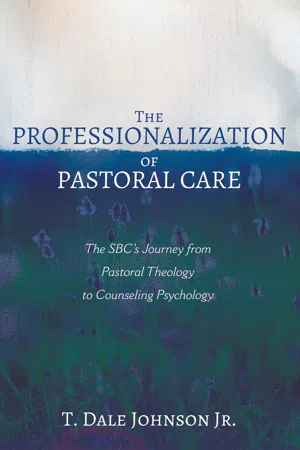
The Professionalization of Pastoral Care
The SBC’s Journey from Pastoral Theology to Counseling Psychology
- 210 pages
- English
- ePUB (mobile friendly)
- Available on iOS & Android
eBook - ePub
The Professionalization of Pastoral Care
The SBC’s Journey from Pastoral Theology to Counseling Psychology
About this book
When the organization and structure of the church in America was altered in the early 1900s to meet modern demands, the role of the pastorate became more specialized to adapt to the burdens of the new, "efficient" structure. In 1920, Gaines Dobbins utilized the business efficiency model at Southern Baptist Theological Seminary to formulate a distinct ecclesiology. Discontent with traditional methods of instruction in theological education, Dobbins sought to implement theories and methodologies from modern educationalists. He adopted a psychologized educational methodology and utilized the psychology of religion as an empirical measure of the soul, human nature, and human behavior.
Use of the social sciences seemed to grant Dobbins, as a practitioner, academic respectability within the realm of theological education. Both the professionalization that resulted from Dobbins's efficiency standards, and a working theory of human nature derived from psychological models, were synthesized into a specialized system of pastoral care. Dobbins followed the new shape of pastoral theology in America, adopting Clinical Pastoral Education (CPE) as the model for pastoral training. As a result, CPE became an integral part of the curriculum at Southern Baptist Theological Seminary for over sixty years, and spread to influence many other SBC entities.
Information
Topic
Theology & ReligionSubtopic
Christian MinistryChapter 2
Tyranny of The Social Sciences in “Dobbinology”
Introduction
In order to gain understanding of the shaping influence of Dobbins on pastoral care in the Southern Baptist Convention, research must not be confined to his works on the subject. While his works regarding pastoral care are pointed,245 a solitary focus will cause the inquirer to miss how pastoral care became specialized and the degree to which secular psychology contributed to its formation. His works were largely a result of the accumulation of his class notes.246
The aim of this chapter is to provide evidence that the theories of business efficiency, educational psychology, progressive education, psychology of religion and religious education within Dobbins’s works were assembled as the foundation of his methodology.247 This evidence provided is intended to draw a simple correlation; Dobbins’s works were infused with the philosophy and methodology of the progressing social sciences of the early twentieth-century by direct influence. This chapter, along with the one following, will reveal that it was the culmination of several subjects in Dobbins’s mind and practice that produced a professionalized view of pastoral counseling.
Each of the men discussed herein leveraged their ideologies for significant impact in the culture of the west. It should be no surprise that those same ideologies wielded significant influence upon the religious leaders of that same culture. To trace theological concepts alone may not reveal the compromise that this thesis suggests. One must track the cultural and ideological concepts that chipped away at orthodox theological practice in order to explain the current situation of pastoral care and counseling. Holifield explained this phenomenon within the broader spectrum of American religious memes:
. . . this is not to suggest that the history of pastoral activity corresponded simply to changing theological conceptions. It is the interweaving of theology with other fields of learning, such as psychology and ethics, and the interconnection of pastoral activity with changes in culture and society that reveal the complexity of the cure of souls in the mainstream of the American churches. Pastoral theology was never a self-contained intellectual system, but rather a complex of inherited ideas and images subject to continued modification in changing social and intellectual settings.248
Dobbins was one of the interweavers within the Southern Baptist Convention to integrate other fields of learning with theology that caused a pivot in several Baptist theological conceptions.
Dobbins was determined to change the form of theological education, in an effort to add practicality to the training of pastors. Allen Graves, writing an essay in honor of Dobbins said, “Dr. Dobbins was sure of one thing—change. How to deal with a changing world, how to respond appropriately to changing circumstances, how to guide the processes of change that were both inevitable and often desirable were matters of great concern.”249 Dobbins responded to the modern changes with a progressive vision of organizational ecclesiology, person-centered religious education, and clinical pastoral training. The changes in pastoral theology, pastoral care, and pastoral counseling, from Dobbins’s perspective, were not tacit. The following sections reveal the categories of thought from which Dobbins synthesized his views, which accumulated into the specialization of pastoral care and counseling.
Business Efficiency
Dobbins was influenced by three major people or groups toward the ideas of efficiency. First, Arthur Flake, of the Baptist Sunday School Board utilized business methodology in growing Sunday School. Second, progressive educators also yielded to the principles of efficiency and, by so doing, these principles were reinforced as a part of Dobbins’s training in religious education. Third, the works of Harrington Emerson, Frederick Taylor, and Roger Babson had tremendous impact on Dobbins’s formulation of the “Efficient Church.”
During the early twentieth century, the public pressure toward efficiency and economy grew not only for business but also in the arena of education.250 The success of American businessmen like Carnegie, Rockefeller, and Vanderbilt pressured educators to “become more practical in order to serve the business society better.”251 The table was now prepared for, “the great preacher of the gos...
Table of contents
- Title Page
- Introduction
- The New Department of Practical Studies
- Tyranny of The Social Sciences in “Dobbinology”
- The Professional Pastoral Care in “Dobbinology”
- The New Department of Psychology of Religion
- Conclusion
- Appendix
- Bibliography
Trusted by 375,005 students
Access to over 1.5 million titles for a fair monthly price.
Study more efficiently using our study tools.
Frequently asked questions
Yes, you can cancel anytime from the Subscription tab in your account settings on the Perlego website. Your subscription will stay active until the end of your current billing period. Learn how to cancel your subscription
No, books cannot be downloaded as external files, such as PDFs, for use outside of Perlego. However, you can download books within the Perlego app for offline reading on mobile or tablet. Learn how to download books offline
Perlego offers two plans: Essential and Complete
- Essential is ideal for learners and professionals who enjoy exploring a wide range of subjects. Access the Essential Library with 800,000+ trusted titles and best-sellers across business, personal growth, and the humanities. Includes unlimited reading time and Standard Read Aloud voice.
- Complete: Perfect for advanced learners and researchers needing full, unrestricted access. Unlock 1.5M+ books across hundreds of subjects, including academic and specialized titles. The Complete Plan also includes advanced features like Premium Read Aloud and Research Assistant.
We are an online textbook subscription service, where you can get access to an entire online library for less than the price of a single book per month. With over 1.5 million books across 990+ topics, we’ve got you covered! Learn about our mission
Look out for the read-aloud symbol on your next book to see if you can listen to it. The read-aloud tool reads text aloud for you, highlighting the text as it is being read. You can pause it, speed it up and slow it down. Learn more about Read Aloud
Yes! You can use the Perlego app on both iOS and Android devices to read anytime, anywhere — even offline. Perfect for commutes or when you’re on the go.
Please note we cannot support devices running on iOS 13 and Android 7 or earlier. Learn more about using the app
Please note we cannot support devices running on iOS 13 and Android 7 or earlier. Learn more about using the app
Yes, you can access The Professionalization of Pastoral Care by T. Dale Johnson,T. Dale Johnson Jr. in PDF and/or ePUB format, as well as other popular books in Theology & Religion & Christian Ministry. We have over 1.5 million books available in our catalogue for you to explore.