- 226 pages
- English
- ePUB (mobile friendly)
- Available on iOS & Android
eBook - ePub
About this book
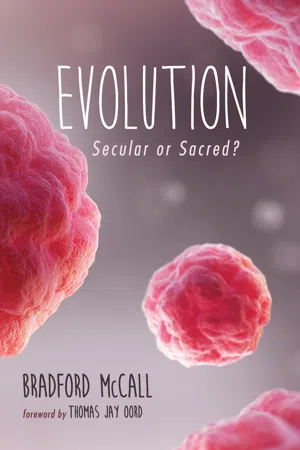
Should we attempt to understand (macro-)evolutionary biology, in the twenty-first century, as secular or sacred? This book will attempt to answer this question by exploring the secular evolutionary worldview, the author's view of kenotic-causation, Whitehead's views on chance, Derrida's views on non-human animals, a statement upon the God of chance and purpose, Augustine's various theologies of creation, a decidedly non-dualistic (macro-)evolution, a provocative thesis regarding evolutionary Christology, the connection between kenosis and emergence, and an explication of both Anders Nygren and Thomas Jay Oord's views of love in the contemporary environ. It also develops the author's personal view regarding necessary, kenotically-donated, and self-giving love, and argues that kenosis and emergence can add to the discussion of understanding the theology-science-love symbiosis. It advocates and explicates herein a monistic process-based view of the overlapping relationship between theology and science.
Information
Topic
Theology & ReligionSubtopic
Systematic Theology & EthicsPart 1
Programmatic Essay upon the Secular Evolutionary Worldview
1
The Secular Evolutionary Worldview
An Introduction and Critique
In this chapter, one will find an exposition of the overarching “Secular Evolutionary Worldview” (SEW) of the biological sciences. The core of the SEW is well summarized by George Gaylord Simpson: “Man is the result of a purposeless and natural process that did not have him in mind. He was not planned. He is a state of matter, a form of life, a sort of animal, and a species of the Order Primates, akin nearly or remotely to all of life and indeed to all that is material.”1
Secular Science is grounded in Darwinian evolution. Carl Sagan states simply, “Evolution is a fact, not a theory.”2 Huxley exclaims, “The first point to make about Darwin’s theory is that it is no longer a theory, but a fact . . . Darwinianism has come of age so to speak. We do no longer have to bother about establishing the fact of evolution.”3 Antony Flew is scandalized by the notion that there was a time, “unbelievably,” when the Vatican questioned “the fact of the evolutionary origin of the species.”4 I will first define what a worldview itself contains and connotes, for it is only after defining “worldview” appropriately that I can then shift to the individual scholars individual scholars about whom I wish to write (primarily the secularists Michael Ruse and Elliot Sober, though I will include five anthologies that contain works by various other authors). After defining the term “worldview,” I will then highlight about a dozen topics and theses in a logical sequence, consisting of: the notion of Progress; the entailments of Adaptation/ism, with the sub-theses of natural and sexual selection, the units of selection, and functions; the process of speciation, with the subtheses of the causes of speciation and of species concepts.
The meaning of the term “worldview” (also seen to be used as “world-view” or “world view” by various authors) seems self-evident: an intellectual perspective on the world or universe. But it has many characteristics. Indeed, the online edition of the Collins English Dictionary defines worldview as a “a comprehensive, esp. personal, philosophy or conception of the world and of human life.”5 The CED similarly defines the German noun Weltanschauung—from which we get our English term worldview—as “a comprehensive, esp. personal, philosophy or conception of the universe and of human life.”6 In “The Question of a Weltanschauung,” from his New Introductory Lectures in Psycho-Analysis, Sigmund Freud describes Weltanschauung as “an intellectual construction which solves all the problems of our existence uniformly on the basis of one overriding hypothesis, which, accordingly, leaves no question unanswered and in which everything that interests us finds its fixed place.”7
But this does not mean that the meaning of the term worldview as I use it herein does not have other connotations, some of which I will now unpack. Indeed, notably, in the Discipleship of the Mind, James W. Sire defines worldview as “a set of presuppositions” which we hold “about the makeup of our world.”8 Worldview, then, represents one’s most fundamental beliefs and assumptions about the universe they inhabit. It reflects how he would answer fundamental questions about who and what we are, where we came from, et cetera. Worldviews operate at both the individual level and the societal level.
Rarely will two people have exactly the same worldview, but within any society certain worldview types will be represented more prominently than others, and will therefore exert greater influence on the culture of that society. The elements of one’s worldview, the beliefs about certain aspects of Ultimate Reality, are one’s: epistemology, which could be defined as beliefs about the nature and sources of knowledge; metaphysics, which could be defined as beliefs about the ultimate nature of reality; anthropology, which could be defined as beliefs about the nature and purpose of humanity, in general, and oneself, in particular; axiology, which could be defined as beliefs about the nature of value, what is good and bad, what is right and wrong; cosmology, which could be defined as beliefs about the origins and nature of the universe, life, and especially humanity; and theology, which could be defined as beliefs about the existence and nature of God.9
The various definitions just given are essentially in accord with one another. However, it is in Freud’s sense of the meaning of Weltanschauung that I will use the term worldview in this chapter. As such, a worldview is the set of beliefs about fundamental aspects of reality that ground and influence all one’s pe...
Table of contents
- 00.McCall.frontmatter
- 01.McCall.chapters
- 02.McCall.biblography
Trusted by 375,005 students
Access to over 1.5 million titles for a fair monthly price.
Study more efficiently using our study tools.
Frequently asked questions
Yes, you can cancel anytime from the Subscription tab in your account settings on the Perlego website. Your subscription will stay active until the end of your current billing period. Learn how to cancel your subscription
No, books cannot be downloaded as external files, such as PDFs, for use outside of Perlego. However, you can download books within the Perlego app for offline reading on mobile or tablet. Learn how to download books offline
Perlego offers two plans: Essential and Complete
- Essential is ideal for learners and professionals who enjoy exploring a wide range of subjects. Access the Essential Library with 800,000+ trusted titles and best-sellers across business, personal growth, and the humanities. Includes unlimited reading time and Standard Read Aloud voice.
- Complete: Perfect for advanced learners and researchers needing full, unrestricted access. Unlock 1.5M+ books across hundreds of subjects, including academic and specialized titles. The Complete Plan also includes advanced features like Premium Read Aloud and Research Assistant.
We are an online textbook subscription service, where you can get access to an entire online library for less than the price of a single book per month. With over 1.5 million books across 990+ topics, we’ve got you covered! Learn about our mission
Look out for the read-aloud symbol on your next book to see if you can listen to it. The read-aloud tool reads text aloud for you, highlighting the text as it is being read. You can pause it, speed it up and slow it down. Learn more about Read Aloud
Yes! You can use the Perlego app on both iOS and Android devices to read anytime, anywhere — even offline. Perfect for commutes or when you’re on the go.
Please note we cannot support devices running on iOS 13 and Android 7 or earlier. Learn more about using the app
Please note we cannot support devices running on iOS 13 and Android 7 or earlier. Learn more about using the app
Yes, you can access Evolution by Bradford McCall in PDF and/or ePUB format, as well as other popular books in Theology & Religion & Systematic Theology & Ethics. We have over 1.5 million books available in our catalogue for you to explore.