- 68 pages
- English
- ePUB (mobile friendly)
- Available on iOS & Android
eBook - ePub
About this book
"A unique and fascinating book featuring a patient, his mandalas, and the commentary by his analyst, David Rosen, an outstanding figure in the world of Jungian psychology. A must-read for anyone interested in therapy and the healing process."
--Henry Abramovitch, Founding President, Israel Institute of Jungian Psychology
"Soul Circles offers a powerful visual journey into a living individuation process. The dialogue between the partners is fresh and informative, respectful of personal details while highlighting a transformational process captured in mandala imagery."
--Joe Cambray, President, Pacifica Graduate Institute
"Soul Circles is a beautiful document of the self-regulating function of the psyche and the healing that comes through accepting and giving space to the creative urge that accompanies this function. It demonstrates the importance of a relationship of trust and empathy for the unfolding of the inner process. Deepest gratitude to both authors for sharing their experience with us."
--Milena Sotirova-Kohli, Jungian analyst, Bern, Switzerland
Information

David H. Rosen
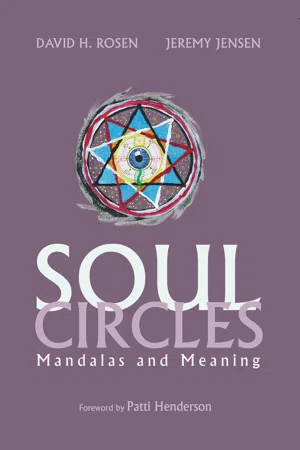
In Jeremy Jensen’s first mandala, there is a square with a circle inside, and the Star of David embraces the central red circle. In addition to the Star of David, there are 8 red circles around the square. There are also several other circles in this drawing. So there are multiple mandalas, since mandala means circle. It’s noteworthy that there is a sun circle in the top right corner, which is the future quadrant. Note also that this drawing is quite faint in color and form.
The analysand grew up in a community of Mormons, but because of his mother, he was not raised in the faith. I didn’t realize there was a connection between Judaism and Mormonism until I attended a Jungian meeting in Salt Lake City and a Mormon Jungian analyst invited us to visit their Temple and have lunch in Brigham Young’s home. When I noticed a large Star of David at the top of the Temple, I was told that Mormons believe they are one of the lost tribes of Israel. Thus it becomes clear why the Star of David appears in this analysand’s first image, as well as several future images.
Jeremy Jensen
I had been seeing David for just over a year, and in that time I had avoided his promptings to create art as part of the therapeutic process. A major factor in this avoidance was self-doubt, that voice of self-doubt would say, “you can’t create something meaningful. Whatever you do, it will be crap.” I needed to remind myself that things grow from crap, or it could be also known as the “prima materia.” Once I set self-judgement aside, the images started to come forth.
The most salient features of this mandala to me are the green Star of David in the center, and the eight points around it making a 16 petaled Rose. I did not think of this until I began writing, but the Star of David and the Rose, are similar enough to David Rosen’s name. Maybe an unconscious symbolic pun? Maybe some sort of feeling of identification with David, the analyst and healer? I am not sure. However, at the face of it, I personally think the Star of David seems to be balanced and positive; it feels like a beneficent starting point. The triangle pointing upwards to the sky and spirit, and the triangle pointing downwards to the Earth and soul.

Rosen
It’s readily apparent in his second mandala that this individual is already centering himself. The difference between this and his first image is striking, as this one already has far bolder and darker colors, and braver, more defined shapes than the first. To begin here, green is the color of growth, and it is thus noteworthy that he begins his journey open to development, like a strong, green tree. He identifies with the tree, which Jung describes in his writings as a symbol of the Self. The numerology of six appears in this drawing with the dots along the edge of the circle. First, this relates to early trauma, perhaps around the age of six, and it’s also likely that family figures are represented by the dots. Age six is also an important year because if the individual feels inherently good about him or herself at that time, they can more easily actualize their potential. This matches with the analysand’s history, as he was was identified as gifted in the educational system. In addition, a circle represents not only wholeness but also the feminine. This is interesting since, in numerology, even numbers, and particularly the number six, represent feminine energies like caring, loving, and healing. This is why six is also called the “motherhood number.”1 So here we have a big circle which is feminine, and six small circles that are feminine. Below the tree lies an infinity sign, which signifies wholeness and finding oneself. Interestingly, there are two triangles outside the central circle. Triangles are considered masculine because they have three sides, and odd numbers are masculine. The triangles are also located outside the feminine circle, as those two energies have not been integrated.
Jensen
As I was suffering from bouts of insomnia, David advised that when I couldn’t sleep, I should try making a mandala. So, this mandala occurred at 4:00 in the morning after I had been up for some time with acute anxiety. I was unprepared with materials, and I made this with a used scrap of paper from my graduate program. The only drawing implement I could find was my 5-year-old son’s green Crayola marker. As I sat in front of the paper, an evergreen tree came clearly to my mind’s eye. My immediate association with the tree were the many pine trees in Oregon. I also thought of “ever green” as meaning continually alive, immortal. Though, I also associate green with jealousy, money, or inexperience. Green may mean health in plants, thought a green complexion in a person may mean sickliness. Overall at the time, the evergreen tree felt strong, sturdy and positive.
After I had put the tree down on the page, it felt as though the image drew itself. I felt right to have the tree encircled by six points (which could be connected into another Star of David), and below an infinity symbol (which is the first instance of a repeating theme through the series of mandalas). I was struck by at the time was mysterious scribbled columns to either side of the circle, which appeared to me to have eyes at the base of each. Two columns or trees also become a repeating pattern through this series of mandalas. It also felt appropriate to place two upwards pointing triangles at the 4 and 6 o’clock points on the circle (active principles, connecting to spirit). After I finished the mandala, I felt a sense of relief from my anxiety and was able to go to sleep.

Rosen
You can see how this third mandala is more balanced, which reflects the patient’s immediate therapeutic progress. This mandala represents wholeness and his overcoming emotional difficulties. In the center is an ouroboros, which is an ancient symbol of a snake eating its own tail. It signifies infinity and wholeness (which is again highlighted in the bottom of the mandala), as well as death and rebirth. The five orange circles, mirrored by the five serpents, relates to trauma around age five, which clearly is being faced. The orange trees in the green forest perhaps indicate balancing both family and education.
At this time, he had a dream of three animals—a big buck, a bobcat, and a wolf. All three were white in color with gold highlights and were larger than they would be in real life. The bobcat attacked his right side, just above the liver, which is significant because of a later dream in which he has a liver transplant. He was able to take them on with a knife and prevent his own death. Concurrently, he was doing well in his studies, but doubted that he would be able to graduate. However, it seemed to me that he was right on track to finish his degree, which I emphasized. The blue square symbolizes his masculine identity and feeling more secure as a father and husband, and that he could achieve his dream.
Jensen
The first image that came forth in this mandala was the Ouroboros, the snake eating its own tail, as it encapsulates the center of the image, which is dotted with a purple background. This seemed to me like a starry sky, or the cosmos....
Table of contents
- 0fm
- 1chapters
Trusted by 375,005 students
Access to over 1.5 million titles for a fair monthly price.
Study more efficiently using our study tools.
Frequently asked questions
Yes, you can cancel anytime from the Subscription tab in your account settings on the Perlego website. Your subscription will stay active until the end of your current billing period. Learn how to cancel your subscription
No, books cannot be downloaded as external files, such as PDFs, for use outside of Perlego. However, you can download books within the Perlego app for offline reading on mobile or tablet. Learn how to download books offline
Perlego offers two plans: Essential and Complete
- Essential is ideal for learners and professionals who enjoy exploring a wide range of subjects. Access the Essential Library with 800,000+ trusted titles and best-sellers across business, personal growth, and the humanities. Includes unlimited reading time and Standard Read Aloud voice.
- Complete: Perfect for advanced learners and researchers needing full, unrestricted access. Unlock 1.5M+ books across hundreds of subjects, including academic and specialized titles. The Complete Plan also includes advanced features like Premium Read Aloud and Research Assistant.
We are an online textbook subscription service, where you can get access to an entire online library for less than the price of a single book per month. With over 1.5 million books across 990+ topics, we’ve got you covered! Learn about our mission
Look out for the read-aloud symbol on your next book to see if you can listen to it. The read-aloud tool reads text aloud for you, highlighting the text as it is being read. You can pause it, speed it up and slow it down. Learn more about Read Aloud
Yes! You can use the Perlego app on both iOS and Android devices to read anytime, anywhere — even offline. Perfect for commutes or when you’re on the go.
Please note we cannot support devices running on iOS 13 and Android 7 or earlier. Learn more about using the app
Please note we cannot support devices running on iOS 13 and Android 7 or earlier. Learn more about using the app
Yes, you can access Soul Circles by David H. Rosen,Jeremy Jensen in PDF and/or ePUB format, as well as other popular books in Psychology & History & Theory in Psychology. We have over 1.5 million books available in our catalogue for you to explore.