- 168 pages
- English
- ePUB (mobile friendly)
- Available on iOS & Android
eBook - ePub
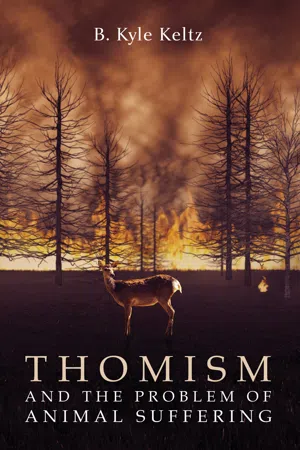
Thomism and the Problem of Animal Suffering
About this book
The problem of animal suffering is the atheistic argument that an all-knowing, all-powerful, and all-good God would not use millions of years of animal suffering, disease, and death to form a planet for human beings. This argument has not received as much attention in the philosophical literature as other forms of the problem of evil, yet it has been increasingly touted by atheists since Charles Darwin. While several theists have attempted to provide answers to the problem, they disagree with each other as to which answer is correct. Also, some of these theists have given in to the problem and believe it entails that God is limited in certain ways. B. Kyle Keltz seeks to provide a classical answer to the problem of animal suffering inspired by the medieval philosopher/theologian Thomas Aquinas. In doing so, Keltz not only utilizes the wisdom of Aquinas, but also contemporary insights into non-human animal minds from contemporary philosophy and science. Keltz provides a compelling neo-Thomistic answer to the problem of animal suffering and explains why the classical God of theism would create a world that includes animal death.
Information
Topic
Theology & ReligionSubtopic
Christian Theology1
The Problem of Animal Suffering
The problem of evil is an issue that humans have pondered since ancient times.1 “Why do people suffer and die, and why do people mistreat each other so much?” In the context of theism, the problem of evil becomes even worse. It is assumed that if there is an all-good, all-powerful, and all-knowing God who created and sustains the world, then that God would prevent evil from happening; yet evil occurs each day in our world.
Of course, there are many proposed solutions to the problem. Many theists (at least as far back as Augustine of Hippo2) have argued that people are allowed to perform evil because God wants a world with free-willed beings.3 The only way for God to guarantee that no evil occur would be for him to eliminate the free will of angels and humans. But for various reasons, God wants a world with free-willed beings. Thus, God allows evil by preserving free will. Moral evil (e.g., theft, murder, rape, etc.) exists because humans have free will, and natural evil (e.g., disease, earthquakes, tornadoes, death, etc.) possibly exists because of the free will of fallen angels.4
Other theists (at least as far back as Irenaeus5) have argued that God allows evil so humans will mature spiritually in preparation for living with God forever in the afterlife.6 If moral evil did not exist, humans would never learn the value of moral choices. Moreover, without natural evil, humans would not fully appreciate living with God in an afterlife devoid of suffering. This soul-making view concludes that the existence of evil is not an accident because it is intended for a good purpose.
The history of Christian philosophy is filled with discussions on evil and why God might allow it. Yet, the discussion, until recent times, has focused on why bad things are allowed to happen to human beings. Theists generally did not think it necessary to provide a reason for why God allows nonhuman animals to suffer and die. Until modern times, theists believed that animals were created by God specifically to serve and provide food for humans.7 Christian theologians, such as Augustine, argued that predatory animals were necessary for the beauty of the world.8 Following Aristotle, Thomas Aquinas did not believe that nonhuman animal suffering is morally significant because nonhuman animals do not possess rational souls.9
It seems that two main factors gave rise to a higher awareness of animal suffering among Christian theologians in the modern period: social changes and scientific advancements. Regarding social changes, pet-keeping became widespread in Europe among the middle class in the 1600s.10 Derek Wiertel believes that although pet-keeping was not new to European society, especially among the upper classes, pet-keeping was a crucial factor in “deepening” an appreciation for the moral status of nonhuman animals.11
Scientists increasingly began uncovering evidence for the vast amount of nonhuman animal suffering in this period also. In the late 1600s, English natural philosopher Robert Hooke confirmed that fossils were the preserved remains of once-living organisms (Micrographia, 1665). In the late 1700s, scientists, such as Comte de Buffon (Les Époques de la Nature, 1778) and Pierre Laplace (Exposition du système du monde, 1796), theorized that the earth was formed according to natural laws over a long period of time. In the 1800s, Jean Lamarck proposed the idea that animals can acquire new traits based on the environment in which they live (Philosophie Zoologique, 1809), and Charles Darwin theorized that animal populations arise from common descent and natural selection (On the Origin of Species, 1859).
As more scientists concluded that the earth and all life on earth formed through natural processes over long periods of time, so also did they become increasingly aware of the vast amount of nonhuman animal suffering in the earth’s natural history. Among these scientists, Darwin’s comments on nonhuman animal suffering are probably the most famous. In a letter to Asa Gray on May 22, 1860, Darwin wrote,
With respect to the theological view of the question; this is always painful to me. I am bewildered. I had no intention to write atheistically. But I own that I cannot see, as plainly as others do, & as I should wish to do, evidence of design & beneficence on all sides of us. There seems to me too much misery in the world. I cannot persuade myself that a beneficent & omnipotent God would have designedly created the Ichneumonidæ with the express intention of their feeding within the living bodies of caterpillars, or that a cat should play with mice. Not believing this, I see no necessity in the belief that the eye was expressly designed. On the other hand I cannot anyhow be contented to view this wonderful universe & especially the nature of man, & to conclude that everything is the result of brute force. I am inclined to look at everything as resulting from designed laws, with the details, whether good or bad, left to the working out of what we may call chance. Not that this notion at all satisfies me. I feel most deeply that the whole subject is too profound for the human intellect. A dog might as well speculate on the mind of Newton. Let each man hope & believe what he can.12
As is apparent, Darwin struggled with the understanding that a sovereign, all-good, all-powerful, and all-knowing God sustains a world in which nonhum...
Table of contents
- Title Page
- Abbreviations
- Chapter 1: The Problem of Animal Suffering
- Chapter 2: The Nature of Animal Suffering and God’s Goodness98
- Chapter 3: The Nature of the Animal Soul198
- Chapter 4: Animal Suffering and God’s Purpose for the Universe299
- Chapter 5: Could a Good God Allow Death before the Fall?346
- Appendix A: Thomistic Answer to the Evil-God Challenge1
- Bibliography
Trusted by 375,005 students
Access to over 1.5 million titles for a fair monthly price.
Study more efficiently using our study tools.
Frequently asked questions
Yes, you can cancel anytime from the Subscription tab in your account settings on the Perlego website. Your subscription will stay active until the end of your current billing period. Learn how to cancel your subscription
No, books cannot be downloaded as external files, such as PDFs, for use outside of Perlego. However, you can download books within the Perlego app for offline reading on mobile or tablet. Learn how to download books offline
Perlego offers two plans: Essential and Complete
- Essential is ideal for learners and professionals who enjoy exploring a wide range of subjects. Access the Essential Library with 800,000+ trusted titles and best-sellers across business, personal growth, and the humanities. Includes unlimited reading time and Standard Read Aloud voice.
- Complete: Perfect for advanced learners and researchers needing full, unrestricted access. Unlock 1.5M+ books across hundreds of subjects, including academic and specialized titles. The Complete Plan also includes advanced features like Premium Read Aloud and Research Assistant.
We are an online textbook subscription service, where you can get access to an entire online library for less than the price of a single book per month. With over 1.5 million books across 990+ topics, we’ve got you covered! Learn about our mission
Look out for the read-aloud symbol on your next book to see if you can listen to it. The read-aloud tool reads text aloud for you, highlighting the text as it is being read. You can pause it, speed it up and slow it down. Learn more about Read Aloud
Yes! You can use the Perlego app on both iOS and Android devices to read anytime, anywhere — even offline. Perfect for commutes or when you’re on the go.
Please note we cannot support devices running on iOS 13 and Android 7 or earlier. Learn more about using the app
Please note we cannot support devices running on iOS 13 and Android 7 or earlier. Learn more about using the app
Yes, you can access Thomism and the Problem of Animal Suffering by B. Kyle Keltz in PDF and/or ePUB format, as well as other popular books in Theology & Religion & Christian Theology. We have over 1.5 million books available in our catalogue for you to explore.