eBook - ePub
Christ Meets Culture
The Influence of Sociocultural Factors on the Translation of the Gospel in Brazil
- 204 pages
- English
- ePUB (mobile friendly)
- Available on iOS & Android
eBook - ePub
Christ Meets Culture
The Influence of Sociocultural Factors on the Translation of the Gospel in Brazil
About this book
How does Christ meet, engage, change, challenge, dialogue, interact with, and bridge cultures? What is the role of the gospel in transforming ethics and culture? These daunting questions guide the present investigation about Evangelical Christianity in Brazil, the largest Catholic country in the world. This book critiques the quantitative and qualitative growth of Evangelical Christianity in Brazil and presents tools for studying the global south and other cultures. Indeed, sociocultural factors play a significant role in the translation of the gospel and may work as bridges and/or barriers within the cultural and religious milieu of the largest country in Latin American. Particularly, four traits impacts the preaching of the Christian message in Brazil, namely: cordiality, religiosity, the Brazilian way of coping, and collectivism. Through oral history methodology, and literature review, this book evaluates how biblically sound translation happens through the Brazilian Baptist Convention as suggested by key leadership writings, practices, and memoirs. This work features an overview of the history of Brazilian Christianity, including its Animistic background, African-Brazilian religious influences, the present Pentecostal majority, and the challenge of Neopentecostalism, in an era of music, TV, and social media.
Information
Topic
Theologie & ReligionSubtopic
Christlicher Dienst1
Christ Meets Culture
The Influence of Sociocultural Factors on the Translation of the Gospel in Brazil
This dissertation argues that sociocultural factors1 are significant in the translation of the Gospel in Brazil as expressed among the Brazilian Baptist Convention [BBC]. This research investigates whether the sociocultural traits of cordiality,2 religiosity,3 the Brazilian way of coping,4 and collectivism5 provide bridges and/or barriers for a biblically sound translation of the Gospel in the country.6 Studying Brazilian Christianity as a phenomenon of an evangelical explosion in terms of growth and diversity is still an emerging academic trend in World Christian Studies [WCS]. Scholarship concerning contemporary Brazilian and Latin American Christianity does not equate in breadth and depth to the studies of forces such as Chinese, Nigerian, Asian, and African Christianities, even though all are powerful entities in the Global South.7 It is time to seize the moment and attempt to make a contribution to the field, as this dissertation proposes to do in its own small way.
Wherever and whenever Christ meets culture, the encounter produces a vibrant and complex expression. Perhaps nowhere is this currently truer than in Brazil. Richard Niebuhr proposes, “Christ converts humankind inside their culture and society, and not apart from it.”8 He suggests four aspects of this debate: (1) Christ against culture, (2) Christ as part of the culture, (3) Christ above culture, or (4) Christ and culture in paradox.9 The central point is that Christ is the transformer and redeemer of culture.10 D. A. Carson refined Niebuhr’s thesis to relate only to cultural freedom in depending on Christ in an orthodox and thoroughly biblical way, with Christ sometimes against culture and transforming culture work simultaneously.11
To that end, this introduction presents an overview of the research. It explains the author’s interest in the topic, and describes the context of the study. This chapter includes a literature review, a definition of WCS terms and Brazilian sociocultural values. It ends with an historical panorama of Brazilian Evangelicalism and Baptist work in the country.
Justification for the Study
There are four primary reasons for this study. First, as noted by Philip Jenkins, World-Wide Christianity—of which Brazilian Christianity is an influential part—is in a sense, a new phenomenon.12 Over the last century, Christianity shifted its dominant presence from the Global North to the Global South. Jenkins considers the growth rates in the southern portion of the globe impressive.13 In 1900, only 13 percent of the world’s Christian population was in Africa and Latin America; presently, both continents comprise 21 percent, and by 2050, it is anticipated to be 29 percent.14 Timothy C. Tennent describes the same shift in the “center of gravity” of Christianity, although he prefers the term Majority Christianity, as this author also prefers, rather than Global South, since the former seems to place the North as the center of the world.15
A second reason to study the translation of the Gospel in Brazil is that this country has the second largest Christian population in the world and is one of the fastest growing evangelical communities in the Global South. Based upon research conducted by the Center for the Study of Global Christianity [CSGC] at Gordon-Conwell Theological Seminary, Brazil has the largest Christian population in Latin America. Brazil has the third highest Protestant population in the world (34 million), behind the United States [US] (56 million) and Nigeria (53 million).16 The study notes that “Protestants and Independents combined represented 12.9% of the population in 1970 but are expected to grow to 28.8% by 2020.”17
The national census (2010) indicated that 86.8% of the Brazilian population identify as Christians, of whom 64.6% are Catholic (making Brazil the nation with the largest Catholic population), and 22.2% evangelical. According to the CSGC’s report, Brazil has the second largest Protestant denomination in the world—the Assembly of God Church (25 million). In comparison, the Chinese Three-Self Movement has 26 million adherents.18 The growth of the evangelical church in Brazil is reflected in the fact that, in 1970, 91.8% were Catholics, while evangelicals comprised 5.2%.19 The graphic below shows the major religious groups in Brazil.
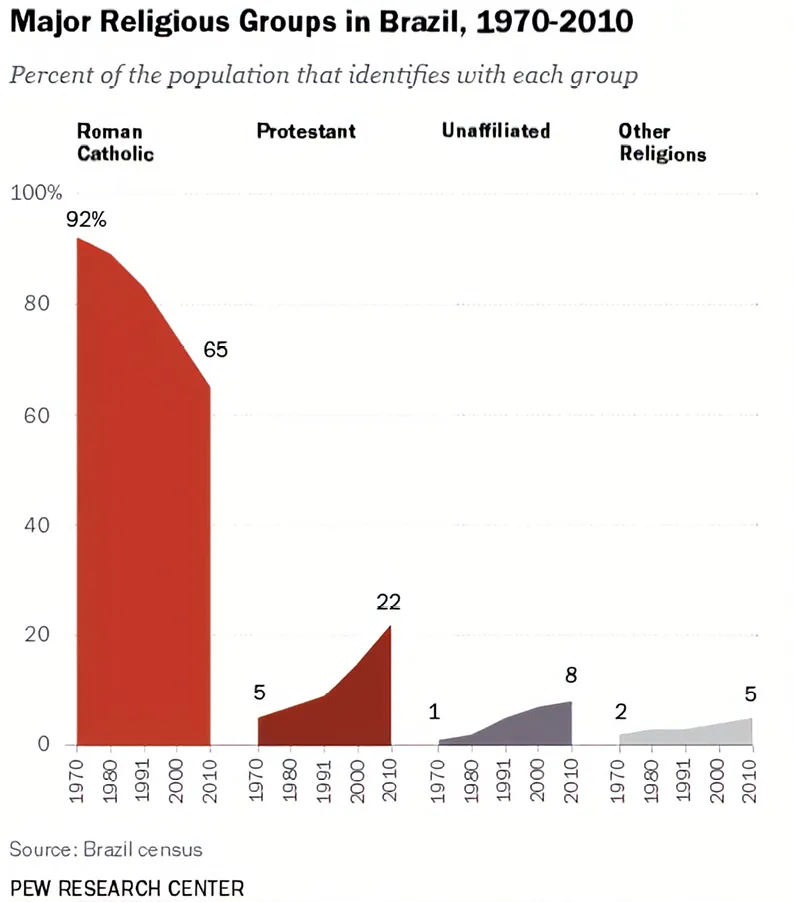
Figure 1: Major Religious Groups in Brazil, 1970–201020
The third justification for this study is its originality and newness regarding Brazilian Baptists. A survey of the translation of the Gospel inside the BBC from a WCS perspective has not yet been done.21 To the knowledge of the author, there are no other dissertations or books dealing with the influence of Brazilian sociocultural traits in the translation of the Gospel within the country inside the BBC.22
| a) “Translation” and “Gospel” and “Brazil” | b) “Gospel” and “Culture” and “Brazil” | c) “Sociocultural” and “Gospel” and “Brazil” | |
| ProQuest | 0 | 0 | 0 |
| ATLA | 0 | 2 | 1 |
| WorldCat | 1 | 21 | 0 |
Table 1. Research on the Translation of the Gospel in Brazil
Finally, the author’s involvement with evangelism and discipleship, particularly since college and during his professional career as a journalist, prompted an initial curiosity about the relation between Christianity and Brazilian culture. The researcher’s life history predisposed him to pursue research from an emic perspective about his people and the translation of the Gospel. The emic perspective refers to a study done from inside the system, whereas, an etic viewpoint studies behavior from outside the system.23 In this case, the goal is an emic-theological analysis in which the culture is studied by an insider to expound the Gospel in a living, applicable, and comprehensible way in the universe of the people.24
The author interacted with diverse cultures while studying for the Master of Divinity degree at Southwestern Baptist Theological Seminary in Fort Worth, Texas. He also served in an American church (Greater Vision Fellowship, Azle, TX) for eight months and as an associate minister at Central Brazilian Baptist Church (Bedford, TX) for two and a half years. He was further involved with the international community on the seminary campus. Besides that, the author traveled to seven states and preached revivals in churches of different nationalities, including a Brazilian one, an American one, and two Hispanic ones in three different states. These experiences provided him a broader awareness of cultural differences and diversity and their impact on the translation of the Gospel.
The practice of personal evangelism explored in the course, “Contemporary Evangelism,” taught by David Mills in the Fall of 2011 and in the followi...
Table of contents
- Title Page
- Introduction
- Abstract
- Abbreviations
- Preface
- Chapter 1: Christ Meets Culture
- Chapter 2: Christ Engages Culture
- Chapter 3: Christ Changes Culture
- Chapter 4: Christ Challenges Culture
- Chapter 5: Christ Dialogues with Culture
- Chapter 6: Christ Interacts with Culture
- Chapter 7: Christ Bridges Cultures
- Appendix: Barriers Turned into Bridges
- Bibliography
Trusted by 375,005 students
Access to over 1.5 million titles for a fair monthly price.
Study more efficiently using our study tools.
Frequently asked questions
Yes, you can cancel anytime from the Subscription tab in your account settings on the Perlego website. Your subscription will stay active until the end of your current billing period. Learn how to cancel your subscription
No, books cannot be downloaded as external files, such as PDFs, for use outside of Perlego. However, you can download books within the Perlego app for offline reading on mobile or tablet. Learn how to download books offline
Perlego offers two plans: Essential and Complete
- Essential is ideal for learners and professionals who enjoy exploring a wide range of subjects. Access the Essential Library with 800,000+ trusted titles and best-sellers across business, personal growth, and the humanities. Includes unlimited reading time and Standard Read Aloud voice.
- Complete: Perfect for advanced learners and researchers needing full, unrestricted access. Unlock 1.5M+ books across hundreds of subjects, including academic and specialized titles. The Complete Plan also includes advanced features like Premium Read Aloud and Research Assistant.
We are an online textbook subscription service, where you can get access to an entire online library for less than the price of a single book per month. With over 1.5 million books across 990+ topics, we’ve got you covered! Learn about our mission
Look out for the read-aloud symbol on your next book to see if you can listen to it. The read-aloud tool reads text aloud for you, highlighting the text as it is being read. You can pause it, speed it up and slow it down. Learn more about Read Aloud
Yes! You can use the Perlego app on both iOS and Android devices to read anytime, anywhere — even offline. Perfect for commutes or when you’re on the go.
Please note we cannot support devices running on iOS 13 and Android 7 or earlier. Learn more about using the app
Please note we cannot support devices running on iOS 13 and Android 7 or earlier. Learn more about using the app
Yes, you can access Christ Meets Culture by Jair Fernandes de Melo Santos in PDF and/or ePUB format, as well as other popular books in Theologie & Religion & Christlicher Dienst. We have over 1.5 million books available in our catalogue for you to explore.