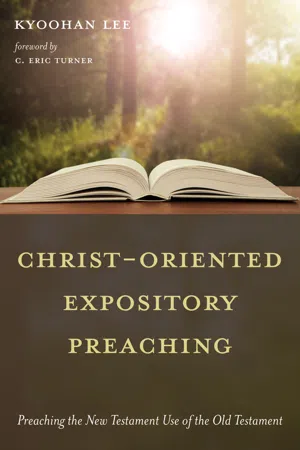
eBook - ePub
Christ-Oriented Expository Preaching:
Preaching the New Testament Use of the Old Testament
- 200 pages
- English
- ePUB (mobile friendly)
- Available on iOS & Android
eBook - ePub
Christ-Oriented Expository Preaching:
Preaching the New Testament Use of the Old Testament
About this book
This book provides an exegetical-theological-rhetorical paradigm, "the Christ-oriented approach" (Lk 24:27, 44), that facilitates accuracy, effectiveness, and practicality in preaching the New Testament use of the Old. In providing a practical expository model, and sermon preparation/evaluation principles, this work moves beyond the level of theory into the realm of praxis, and will thus appeal to practitioners as well as to academics.
Information
Chapter 1
Introduction
We ought at least to begin by extending to the writers of the NT the courtesy of trying to understand how they saw their task as they cited and explained the documents associated with the old covenant, the documents that they revered as hē graphē (“the Scripture”).1
Between Two Horizons
Today’s sermons encounter serious attacks from the spirit of the fallen world. The postmodern worldview, which embraces strong subjectivism and relativism, has flown into the church and mitigated the authority of the proclamation of the Word of God.2 As Steven Lawson puts it: “There is a spiritual famine in the land. A death of biblical preaching has left the evangelical movement weak, starving for spiritual truth, and susceptible to the ravages of the enemy. . . . Preaching itself is on the decline in a major way.”3
In his work, The Two Horizons, Anthony C. Thiselton remarks, “Understanding takes place when the interpreter’s horizons engage with those of the text. This merging of two horizons must be considered a basic element in all explanatory interpretation.”4 However, many biblical scholars and preachers have lost the horizon of the text, and instead accept human autonomy and subjective experience as the primary authorities for biblical interpretation. Present-day churches tend to rely on human-centered hermeneutics, because they do not think that accurate and effective preaching can be achieved by faithfully unfolding the truths of Scripture.5 The authoritative ground of biblical interpretation has moved significantly from the text of Scripture to the subjective experience of the interpreter.6
From Reconstruction To Deconstruction
A range of philosophical, theological, and cultural forces have caused this hermeneutical-homiletical crisis. First, the Enlightenment—a broad and diverse intellectual movement that embraced and lauded empiricism, rationalism, and scientific enquiry—led to the erosion of the Reformers’ doctrine of sola scriptura.7 In particular, Friedrich Schleiermacher opened the way for the contemporary era of subjectivity in religion, in which the subjective feelings of interpreters came to be a major part of biblical interpretation. Hence, interpreters’ varying opinions, derived from unreliable human experiences, have usurped what were formerly held to be objective biblical grounds.8
In the vortex of liberal theologies that followed Schleiermacher, all with their roots in the Enlightenment, the neo-orthodoxy fostered by Karl Barth and Emil Brunner paradoxically also contributed to the erosion of the principle of sola scriptura, only from another angle, since their theological method did make a radical turn from the God of Immanence to the God of Scripture.9 While Barth was trying to compensate for various Enlightenment trends with which he disagreed,10 he ended up denying biblical inerrancy, general revelation, and knowability of God through human natural capacity.11 The Barthian understanding of the Bible and revelation has since significantly influenced modern existential hermeneutics,12 in its interaction with the Enlightenment, liberal theology, neo-orthodoxy, and postmodern hermeneutics.13 Today, many contemporary hermeneutists and preachers consider human autonomy in subjective experience as the primary element in biblical interpretation, and the authoritative ground of Bible interpretation has...
Table of contents
- Title Page
- Tables and Figures
- Foreword
- Chapter 1: Introduction
- Chapter 2: The Self-Attesting Christ of Scripture
- Chapter 3: Hermeneutical Concerns in the NT Use of the OT
- Chapter 4: The Apostle Peter’s Pentecost Sermon
- Chapter 5: Homiletical Principles and Application Model
- Chapter 6: From Exposition to Sermon
- Chapter 7: Sermon Evaluation
- Chapter 8: Conclusion
- Appendix 1: Common Sense Common Ground Approach
- Appendix 2: A Sample Sermon manuscript
- Bibliography
Trusted by 375,005 students
Access to over 1.5 million titles for a fair monthly price.
Study more efficiently using our study tools.
Frequently asked questions
Yes, you can cancel anytime from the Subscription tab in your account settings on the Perlego website. Your subscription will stay active until the end of your current billing period. Learn how to cancel your subscription
No, books cannot be downloaded as external files, such as PDFs, for use outside of Perlego. However, you can download books within the Perlego app for offline reading on mobile or tablet. Learn how to download books offline
Perlego offers two plans: Essential and Complete
- Essential is ideal for learners and professionals who enjoy exploring a wide range of subjects. Access the Essential Library with 800,000+ trusted titles and best-sellers across business, personal growth, and the humanities. Includes unlimited reading time and Standard Read Aloud voice.
- Complete: Perfect for advanced learners and researchers needing full, unrestricted access. Unlock 1.5M+ books across hundreds of subjects, including academic and specialized titles. The Complete Plan also includes advanced features like Premium Read Aloud and Research Assistant.
We are an online textbook subscription service, where you can get access to an entire online library for less than the price of a single book per month. With over 1.5 million books across 990+ topics, we’ve got you covered! Learn about our mission
Look out for the read-aloud symbol on your next book to see if you can listen to it. The read-aloud tool reads text aloud for you, highlighting the text as it is being read. You can pause it, speed it up and slow it down. Learn more about Read Aloud
Yes! You can use the Perlego app on both iOS and Android devices to read anytime, anywhere — even offline. Perfect for commutes or when you’re on the go.
Please note we cannot support devices running on iOS 13 and Android 7 or earlier. Learn more about using the app
Please note we cannot support devices running on iOS 13 and Android 7 or earlier. Learn more about using the app
Yes, you can access Christ-Oriented Expository Preaching: by Kyoohan Lee in PDF and/or ePUB format, as well as other popular books in Theology & Religion & Biblical Criticism & Interpretation. We have over 1.5 million books available in our catalogue for you to explore.