- 166 pages
- English
- ePUB (mobile friendly)
- Available on iOS & Android
eBook - ePub
About this book
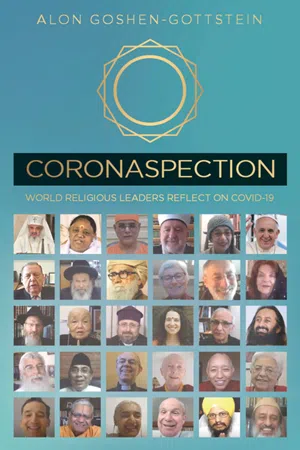
Coronaspection is a groundbreaking series of forty video interviews concerning COVID-19 and its spiritual challenges, featuring major faith leaders worldwide. Coronaspection was created as a means of providing hope and inspiration to faithful of all religions, as humanity struggled, and as it continues to struggle, with the challenges posed by COVID-19. This volume seeks to answer questions that have emerged following the release of the video interviews: How is religion functioning during COVID-19? Do different religions respond to the crisis differently? These and similar questions require a synthetic view of the project, which in turn is based on an analysis of its themes and messages.
Information
Topic
Theologie & ReligionSubtopic
Ethik & Religion1
Introducing Coronaspection
The Birth of a Project
It’s funny how big ideas can be born almost coincidentally. I had just visited the ashram of Amma (Amritanandamayi Ma), the world-famous hugging saint, in Kerala, India. I had gone there to obtain Amma’s signature on a Declaration of Friendship Across Religions. I had been working on this declaration for some time, since the release of a project of video interviews calling for friendship across religions.1 Amma participated in that project, as did the pope, the Dalai Lama, and a star-studded cast of premier world religious leaders. The project was a great hit, had huge global outreach and one of its outcomes was the decision to compose a declaration on friendship across religions. This declaration could then serve as a driver for a global movement of religious leaders who would collaborate in friendship, sharing wisdom and community-oriented activities. It was February. COVID-19 had broken out, but life was still normal. Amma had agreed to sign the declaration and before leaving the ashram she asked me if I had received it. I had not. This led me to call the ashram time and again, upon my return home, in an attempt to talk to the swami from whom I was supposed to receive the signed document. As weeks progressed, I realized timing may not be optimal, with the advance of the pandemic. I called the ashram to talk to one of my contacts. She described the reality of life in the ashram, how busy everyone was, how busy the swami I was after was, and agreed it would be better to wait with my request. The entire ashram was busy sewing protective masks. “If you want to help,” she said, “get your organization to help with sewing masks.” I explained to her that I ran an organization with generals, but no soldiers. My organization, the Elijah Interfaith Institute and its Board of World Religious Leaders, brings together some of the world’s most prominent religious leaders in study, spiritual sharing, friendship, outreach, and more. That’s how I could do the “Make Friends” campaign, at the instigation of Mark Woerde, an advertising genius from Amsterdam who sought my help in realizing this project, when not a single religious leader returned his calls. But, as I told Janni, we have no soldiers. Hence, we were useless at the moment. I was useless.
Or was I? This exchange, coupled with the urgings of a prospective employee who thought we needed to do more in terms of public relations, led me to consider what I could do to serve the world at this moment of crisis. It gradually dawned on me that I was uniquely positioned. With access to so many of the world’s major religious leaders, with a history of friendship, a track record of successful activities, and a high degree of trust in me and in Elijah (the organization), I could actually serve in the niche that I occupy. “Make Friends” had suggested to me a particular way of addressing the world, through video interviews with premier religious leaders. Why not repeat the formula again? Surely the world needs more than masks at this moment. It needs meaning. It needs direction. It needs hope. It needs tools to overcome not only the physical challenges presented by the Coronavirus but also the spiritual challenges. And, I believe, it also needs to draw on religious teachers and teachings as part of a collaborative interreligious effort that brings the perspectives and teachings of all religions to all of humanity. There is, once again, I believe, special power in the coming together of religious leaders in their diversity, to deliver a message at a given point in time, especially a time of global crisis. If the crisis is global, the teaching too must be global. While every teacher addresses his or her community, no one had sought to bring together voices across religious diversity in order to offer teaching, meaning, and hope. Having realized this, I was no longer useless. I had my own special Corona-mission.
The first step was to begin in-house consultations among members of the Elijah Board of World Religious Leaders. What did we need to do as a group? What challenges and needs could we address? Some thirty participants, about half the forum, took part in a series of consultations. They brought to the conversation not only diverse religious perspectives but also diverse geographic perspectives. Through these consultations the questions of what we agreed to call “Coronaspection”—spiritual introspection in light of Coronavirus—came into relief. Our job as religious leaders was to offer guidance in relating to the spiritual challenges of the pandemic, to offer a perspective on how to understand it, to suggest a vision for the world following COVID-19
The shape the project took was that of a series of interviews with religious leaders. The leaders were Elijah affiliated leaders, but not only. By force of circumstance, and based on prior relationships, it fell to me to conduct almost all the interviews. Initially I tried to simply recreate “Make Friends” with the same cast of players. I soon realized I need not be tied to the particular composition of that project. I was free to form a new project, in part an expression of the diversity, vision, and standing of the Elijah Board of World Religious Leaders; in part a continuation of “Make Friends,” and in part a function of whom I considered might have something worthwhile to say to the world at this point in time. Balance is notoriously hard. I had to balance different religions; to ensure women were present, even if they are absent or do not play a major role in a particular religion’s formal structures; to balance religious hierarchy and representativity with bringing forth important voices that may be less well known. I had to also deal with some practical complications that COVID-19 placed on certain leaders who, for a variety of reasons, could not take part in the project as a consequence of the pandemic. With all these factors taken into account, and with efforts made to achieve optimal balances, I was able to engage close to forty important voices in this project. The scope of participants, their diversity, their international spread, and the multiplicity of their views yielded a collection that I consider truly outstanding. I am grateful to editors of Tablet magazine for their appreciation of this fact and for their eagerness to feature the project in its entirety in this important venue.
Interview Questions
The process of interviewing was in principle straightforward. The consultations at Elijah helped me identify the concerns. These yielded a set of questions, which were shared with leaders in advance of the interview. It would be useful for viewers of the series to be aware of these questions, as the fundamental framework for conducting the interviews. We set out to answer seven questions.
1. What have been your greatest challenges in dealing with the present Corona crisis?
2. Corona is bringing out a lot of fear in people. How does one deal with fear? What spiritual advice could you offer to people struggling with fear?
3. Corona has forced people into solitude. How should time be spent in solitude? Many people do not have experience and habits that would allow them to make the most of this opportunity. What advice could they be given?
4. Corona brings about deprivation. We are deprived of our freedom, of our habits. We lose things, and even more so—people we love. How does one deal with all forms of deprivation?
5. What does Corona teach us about our interconnectivity? What are spiritual applications that people can practice consciously?
6. Corona forces us into our own protective space, but it also calls us to solidarity. How can we practice solidarity? What are teachings that support solidarity? What actions express solidarity? What can one do to express solidarity, even from within the confines of one’s home and protection?
7. Many people say the world will be different after this Corona crisis. What blessings do you see Corona bringing to the world? How can the world be different, for the better, following this crisis?
The early interviews adhered to the format, almost religiously. However, the interview process was dynamic. The most important development was the intuition that we should conclude interviews with prayers. We were trying to provide spiritual food and not only share theoretical perspectives. Prayer was therefore a significant resource in helping future viewers as they struggled with the spiritual challenges of COVID-19. Prayer expanded to meditation. Especially with reference to Buddhist participants, it became clear that they were in possession of some powerful tools that could aid others in coping with spiritual challenges. Some of the interviews therefore featured, at times quite extensively, meditative tools for altering interior attitudes. These tools can aid future viewers in dealing with the spiritual challenges posed by the Coronavirus, the ensuing lockdown, and various changes in their lives as a consequence of the pandemic. The collection of interviews became, in this way, also a collection of spiritual practices, shared by participating leaders with whoever would watch the series, regardless of their religion. In hindsight, the series offers us a fascinating comparative window on how different religious leaders, across a diversity of traditions, open themselves up to the divine or the higher reality. This is both a comparative teaching about religions and a cross-religious inspiration for the spiritual life.
Friendship and Personal Spiritual Testimony
There was another sense in which the interview process evolved as the project advanced. Increasingly, I felt less bound by the script. I soon realized that I was an active partner in co-creating this series with the religious leaders and not just the voice that poses a predefined set of questions. The interview, then, became a matter of encounter between myself and the religious leaders, most of whom I had prior relationships with and nearly all of whom were, to some degree or another, friends. Our friendship came across in the interview. It enhanced it. Within that constructive familiarity there was room for each interview to take on a different flavor.
Some of the particularity was a function of the time. The process began before Passover, continued through Easter, and has been going on through Ramadan. Rather than aim for a timeless quality, I preferred to let the time and its message shape the interview. The ultimate religious reality conveyed in the interview remains timeless, allowing people to be nourished by the encounter even after the festival had passed. The particularity was also a function of where I and the interview partner met spiritually. The relationships we enjoy have different flavors, ranging from the more formal to the more intimate, even mystical comradery I enjoy with some of the participants. I tried to let the fullness of the feeling of the relationship come through the interviews, even if the actual foundations upon which friendship or intimacy had been built over the years remained invisible. The outcome of the process was accordingly not only a seriatim presentation of different religious responses to the set of questions presented above. A successful interview, as I came to appreciate it, was one in which a rounded image of the spiritual life and worldview of the contributor was articulated. I take great satisfaction in the fact that in almost all cases it has been possible to feature, through our personal exchange, the very spiritual life of my conversation partner. The answers to contemporary spiritual challenges posed by COVID-19 are therefore grounded in the fullness of the spiritual reality of the person being interviewed. If I have been successful as an interviewer, then success consists in bringing to light that entire complex of views, attitudes, and orientations that makes each believer unique. Religious leaders come through in this project not as so many cookie-cutter-shaped religious personalities, molded by their religious traditions. Rather, each religious leader frames, understands, lives, and expresses his or her religious life in slightly different ways. These draw on the sub-tradition to which he or she belongs. But even more so, these draw on the particular spiritual profile, the soul and religious feeling, of the individual religious leader whom I engaged. Holding these conversations was therefore a journey to discovering the spiritual heart and soul of the individuals I met or interviewed on this journey. From their heart and soul they offered a wisdom that can bring meaning and hope to all as they sought to offer guidance and perspectives on COVID-19.
The process of bringing this deeper vision to light required a kind of personal exchange and dialogue that relies on some common spiritual foundations, some deep empathy, recognition, and knowledge of the tradition of the other, and in almost all cases friendship—the human foundation for the spiritual encounter here described. I could not have imagined at the outset this would be the case, but the project that started out simply as an attempt to gather messages of meaning for a Corona-stricken world ended up finding that meaning in the depth...
Table of contents
- Title Page
- Preface
- Chapter 1: Introducing Coronaspection
- Chapter 2: Thematic Introspections
- Chapter 3: Coronaspection: What Have We Learned?
- Chapter 4: Coronaspection Prayers
Trusted by 375,005 students
Access to over 1.5 million titles for a fair monthly price.
Study more efficiently using our study tools.
Frequently asked questions
Yes, you can cancel anytime from the Subscription tab in your account settings on the Perlego website. Your subscription will stay active until the end of your current billing period. Learn how to cancel your subscription
No, books cannot be downloaded as external files, such as PDFs, for use outside of Perlego. However, you can download books within the Perlego app for offline reading on mobile or tablet. Learn how to download books offline
Perlego offers two plans: Essential and Complete
- Essential is ideal for learners and professionals who enjoy exploring a wide range of subjects. Access the Essential Library with 800,000+ trusted titles and best-sellers across business, personal growth, and the humanities. Includes unlimited reading time and Standard Read Aloud voice.
- Complete: Perfect for advanced learners and researchers needing full, unrestricted access. Unlock 1.5M+ books across hundreds of subjects, including academic and specialized titles. The Complete Plan also includes advanced features like Premium Read Aloud and Research Assistant.
We are an online textbook subscription service, where you can get access to an entire online library for less than the price of a single book per month. With over 1.5 million books across 990+ topics, we’ve got you covered! Learn about our mission
Look out for the read-aloud symbol on your next book to see if you can listen to it. The read-aloud tool reads text aloud for you, highlighting the text as it is being read. You can pause it, speed it up and slow it down. Learn more about Read Aloud
Yes! You can use the Perlego app on both iOS and Android devices to read anytime, anywhere — even offline. Perfect for commutes or when you’re on the go.
Please note we cannot support devices running on iOS 13 and Android 7 or earlier. Learn more about using the app
Please note we cannot support devices running on iOS 13 and Android 7 or earlier. Learn more about using the app
Yes, you can access Coronaspection by Alon Goshen-Gottstein in PDF and/or ePUB format, as well as other popular books in Theologie & Religion & Ethik & Religion. We have over 1.5 million books available in our catalogue for you to explore.