eBook - ePub
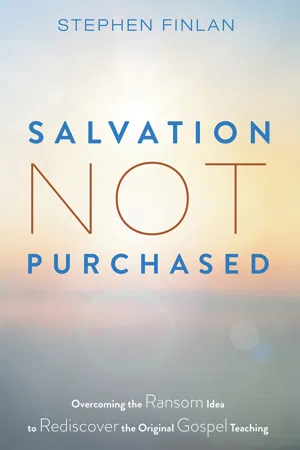
Salvation Not Purchased
Overcoming the Ransom Idea to Rediscover the Original Gospel Teaching
- 120 pages
- English
- ePUB (mobile friendly)
- Available on iOS & Android
eBook - ePub
Salvation Not Purchased
Overcoming the Ransom Idea to Rediscover the Original Gospel Teaching
About this book
Many ministers and faithful Christians instinctively recoil from "washed in the blood" theology, but they hesitate to discuss the subject. This book, by one of the world's leading authorities on atonement doctrine, shows how the "purchased by the blood" idea is out of step with the teachings of Jesus, who said that God reaches the pure in heart without any sacrificial payment. The successors of Paul took the Apostle Paul's sacrificial metaphors far too literally and turned them into an imagined "mechanics" of salvation in which God is "paid off." Over the centuries, this manipulative idea has been the source of confusion and mischief, from the anti-Semitic superstitions of the Middle Ages, to the pedagogy of shame taught in many fundamentalist churches today. Our understanding of Christ will be enhanced if we can recover the original apostolic Christology, which was based on Christ as Creator and life-giver.
Information
Topic
Theology & ReligionSubtopic
Christian Theology1
Assumptions about God
In upcoming chapters, I will address the genesis of the images of sacrificial atonement and ransom. For now, I can mention that our earliest source for the sacrificial and purchase metaphors for the death of Jesus is the Apostle Paul, who was writing in the 50s AD. Paul is also the source of that extremely unfortunate slogan: “you were bought with a price” (1 Cor 6:20; 7:23). Paul’s successors took his metaphors quite literally, blending the notion of sacrifice with the image of ransom and coming up with the idea of the death of Jesus as a ransom payment for the sins of humanity, the idea called “atonement” in theological circles.
In this chapter, I want to respond to the idea of atonement that is popular today, by contrasting it with the teachings of Jesus. My argument is less with Paul than with his more literal-minded successors, and with the crude atonement ideas that developed over time. It is the purchase concept that is most problematic.
The main problem with teaching that Jesus’ death paid for human sin is that it slanders the character of God the Father! If God was either unable or unwilling to forgive without a payment in blood, then God was either weak or cruel. Both are false. God was not compelled to demand that a payment for sin be made, nor was God defending God’s honor. Such ideas emerge when people apply human laws and attitudes to God.
“Somebody had to pay” is based on a series of mistaken assumptions. One is that God is stern and demanding, while Jesus is merciful and kind. This goes against Jesus’ own teachings about his similarity to the Father: “Just as the Father raises the dead and gives them life, so also the Son gives life . . . Whoever has seen me has seen the Father” (John 5:21; 14:9). There is no spiritual contrast between the Father and the Son; they have the same love. This is the good news: there is a circuit of love that flows from the Father, through the Son, to the Spirit, into us, and then among us.
Of course, no Christian wants to say that God is either cruel or weak. Yet Christians commonly fall into that trap unawares, accepting formulas that Christian authorities have told them they must believe, usually accompanied with a fierce and angry energy. Most believers follow their leaders. Instead, we should reflect upon what we have been taught, and see if it needs to be questioned, in the light of Jesus’ own focus on love and forgiveness. What did Jesus himself teach about salvation?
Salvation Now
Jesus made it clear, in his preaching and his ministry to people, that the kingdom of God has come; it is here. Jesus built people up spiritually and told them they were already saved by their exercise of faith. There are seven times in the Gospels where he tells people “your faith has saved you,” even when he has performed a miraculous healing for them. I am counting the times the NRSV renders it “faith has made you well,” as well as the times they translate the same verb as “has saved” (Matt 9:22; Mark 5:34; 10:52; Luke 7:50; 8:48; 17:19; 18:42). The verb is σώζω (sōzō), which has the primary meaning of “saved.” In all seven passages, the verb occurs in the perfect tense (sesōken), so it actually means “has saved.” The choices “made well” or “made whole” make sense in their context, but so does “saved,” and I prefer to stay closer to the verb’s primary meaning.
By no means am I arguing that people are self-saving. That would be too rigid a reading of “your faith has saved you.” Rather, Jesus is generously giving them credit for their faith, and their role in receiving salvation. Actually, salvation results from both the divine downreach and the human upreach: the coming together of God’s love (embodied by Jesus) and a person’s sincere and faithful plea. Jesus does do miracles of healing, but he likes to lift people up and include them. He acknowledges their receptivity to the act when he says “your faith has saved you.” Jesus certainly is the Savior and the Healer, but he likes to emphasize the human end of the divine-human connection.
Throughout the Gospels, Jesus saves people, and tells them they are saved. Without any reference to his coming death, without any substitutionary (taking the place of others) doctrine, he makes it clear that people’s faith has already saved them. Again, the way to salvation and eternal life is wide open. Salvation is made available here and now, whenever people “hear the word, hold it fast in an honest and good heart, and bear fruit with patient endurance” (Luke 8:15; see also 8:21; 11:28). Notice how crucial is the “honest and good heart”—the sincerity of the person. Anyone who honestly recognizes the need for salvation can receive it.
Jesus is the Savior, not because of his death, but because of his divine identity, his power as Creator. He is the one who gave us life in the first place: “Through him all things were made; without him nothing was made that has been made. In him was life, and that life was the light of all mankind” (John 1:3–4 NIV); “in him all things in heaven and on earth were created” (Col 1:16). Jesus is the Savior in exactly the same way that he is the Creator (“he also created the worlds,” Heb 1:2). He was the life-giver in the beginning, and he is the eternal life-giver now.
Jesus extends salvation just as he extended healing. In fact, the main images for salvation in the Gospels are healing and restoration. His healings were a gift of life, or a restoration of healthy life, and salvation is the gift of eternal life. Jesus was the life giver before he ever came to earth in human form. There is no magic in the crucifixion; he did not become the Savior only after he was murdered. He was the Savior from the start. In fact: “In a sense, we were saved by Christ before he was born.”1
Salvation and forgiveness truly are the free gifts of God, not something purchased with blood. The problem with the blood-purchase concept is not what it says about Jesus, but what it says about God. It pictures God as harshly judgmental, and also corrupt: needing a victim, but willing to be satisfied with an innocent victim. What good is it to see Jesus as kind and good, if we see God as sadistic, corrupt, or weak?
There is something not quite healthy in the obsession with blood, as seen in Billy Graham, for instance: “Blood redeems . . . Blood cleanses . . . His blood pumps through your spiritual veins with eternal life . . . Blood justifies . . . Jesus paid for our sins with His blood.”2 William Placher wrote “Christ is our sacrifice. His ...
Table of contents
- Title Page
- Preface
- Introduction
- Chapter 1: Assumptions about God
- Chapter 2: Why Was Jesus Killed?
- Chapter 3: Sacrificial Thinking
- Chapter 4: Christian Theology of Ransom-Sacrifice
- Chapter 5: Psychological Problems with Atonement
- Chapter 6: What of Christology?
- Bibliography
Trusted by 375,005 students
Access to over 1.5 million titles for a fair monthly price.
Study more efficiently using our study tools.
Frequently asked questions
Yes, you can cancel anytime from the Subscription tab in your account settings on the Perlego website. Your subscription will stay active until the end of your current billing period. Learn how to cancel your subscription
No, books cannot be downloaded as external files, such as PDFs, for use outside of Perlego. However, you can download books within the Perlego app for offline reading on mobile or tablet. Learn how to download books offline
Perlego offers two plans: Essential and Complete
- Essential is ideal for learners and professionals who enjoy exploring a wide range of subjects. Access the Essential Library with 800,000+ trusted titles and best-sellers across business, personal growth, and the humanities. Includes unlimited reading time and Standard Read Aloud voice.
- Complete: Perfect for advanced learners and researchers needing full, unrestricted access. Unlock 1.5M+ books across hundreds of subjects, including academic and specialized titles. The Complete Plan also includes advanced features like Premium Read Aloud and Research Assistant.
We are an online textbook subscription service, where you can get access to an entire online library for less than the price of a single book per month. With over 1.5 million books across 990+ topics, we’ve got you covered! Learn about our mission
Look out for the read-aloud symbol on your next book to see if you can listen to it. The read-aloud tool reads text aloud for you, highlighting the text as it is being read. You can pause it, speed it up and slow it down. Learn more about Read Aloud
Yes! You can use the Perlego app on both iOS and Android devices to read anytime, anywhere — even offline. Perfect for commutes or when you’re on the go.
Please note we cannot support devices running on iOS 13 and Android 7 or earlier. Learn more about using the app
Please note we cannot support devices running on iOS 13 and Android 7 or earlier. Learn more about using the app
Yes, you can access Salvation Not Purchased by Stephen Finlan in PDF and/or ePUB format, as well as other popular books in Theology & Religion & Christian Theology. We have over 1.5 million books available in our catalogue for you to explore.