- 160 pages
- English
- ePUB (mobile friendly)
- Available on iOS & Android
eBook - ePub
About this book
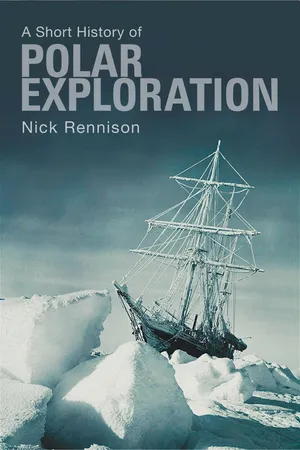
According to Apsley Cherry-Garrard, one of the men who went to Antarctica with Captain Scott, 'Polar exploration is at once the cleanest and most isolated way of having a bad time that has ever been devised. ' Despite this there has never been a shortage of volunteers willing to endure the bad times in pursuit of the glory that polar exploration sometimes brings. Nick Rennison's compelling book tells the memorable stories of the men and women who have risked their lives by entering the white wastelands of the Arctic and the Antarctic, from the compelling tales of Scott, Shacklet on and Amundsen, to lesser known heroes such as Fridtjof Nansen and Robert Peary. A Short History of Polar Exploration also looks at the hold that the polar regions have often had on the imaginations of artists and writers in the last two hundred years examining the pain tings, films and literature that they have inspired.
Information
Topic
StoriaSubtopic
Storia militare e marittimaPolar Explorers:
A Brief Biographical Dictionary
Luigi Amedeo, Duke of the Abruzzi (1873–1933)
A grandson of the Italian king, Victor Emmanuel II, and the son of a man who was briefly King of Spain, the Duke of the Abruzzi (as he was usually known) was a member of the highest levels of European aristocracy. He was also an adventurer who travelled the world in order to satisfy his passion for mountaineering. In 1899–1900, he led a failed expedition to the North Pole.
Jameson Adams (1880–1962)
With experience in both the Merchant Navy and the Royal Navy, Adams joined Shackleton’s Nimrod expedition as its second in command in 1907. He was one of the four men who reached a Furthest South of 88° 23’ in January 1909.
Roald Amundsen (1872–1928)
Amundsen is a towering figure in polar history and some historians even argue that he was the first man to reach the North Pole as well as the first to make it to the South Pole. Born in Norway, he was a member of de Gerlache’s Belgica expedition to the Antarctic in 1897–99. On board a small ship named the Gjoa, he was the leader of the first expedition to traverse the Northwest Passage in 1903–06. While planning an attempt on the North Pole in 1909, he heard about Peary’s claims to have got there and changed his plans. He travelled south instead and journeyed with four other men to the South Pole, beating Scott to the goal by a matter of weeks. In 1926, he flew in the airship Norge to the North Pole, accompanied by Lincoln Ellsworth and Umberto Nobile. He lost his life two years later while searching for Nobile who had disappeared on another polar trip.
Salomon August Andrée (1854–1897)
Andrée was a Swedish engineer with an interest in aeronautics who was convinced that the best way to reach the North Pole was to travel there by balloon. In 1897, with two companions, he set off in his balloon, The Eagle, to prove his case. He was never seen alive again. It was not until 1930 that the fate of the expedition was discovered.
George Back (1796–1878)
Born in Stockport, Back joined the navy as a boy. He served as a young officer in Franklin’s disastrous first voyage in the Arctic and in the same commander’s more successful second one. In the 1830s he commanded two expeditions himself. On the first he became the first white man to see the large river in northern Canada which is named after him; on the second, he nearly lost his ship after it was icebound north of Hudson Bay for many months.
William Baffin (c.1584–1622)
Baffin’s early life is largely a mystery but it is known that he sailed on an expedition to Greenland in 1612. He returned to the Arctic three years later and then, in 1616, he sailed further north than anyone else had done at the time and discovered the bay that now bears his name. He later joined the East India Company and was killed in an attack on a Portuguese garrison in the Persian Gulf.
Willem Barents (c.1550–1597)
Born in the Frisian Islands off the Dutch coast, Barents was one of the earliest explorers to search for a Northeast Passage from the Atlantic to the Pacific. In the 1590s, he undertook three voyages in the seas north of the Siberian coast. On the last of these he made the first sighting of Spitsbergen but his ship was caught in the winter ice. He died during a boat journey towards safety and was buried on an island in the Novaya Zemlya archipelago.
Robert Bartlett (1875–1946)
Born in Newfoundland, Bartlett became one of the most experienced Arctic travellers of the first half of the twentieth century. He accompanied Peary on three expeditions and was desperately disappointed not to be included in the party that headed for the pole in 1909. During Stefansson’s disastrous Karluk expedition in 1914, it was Bartlett who made a heroic march across the ice to bring help when the ship sank. He also captained the ship which took Richard Byrd to the Arctic for his flight to the North Pole in 1926.
Frederick Beechey (1796–1856)
The son of a well-known portrait painter, Beechey was a naval officer who first went to the Arctic with Franklin in 1818. He returned there twice on other expeditions in the 1820s. Beechey Island is named after him.
Edward Belcher (1799–1877)
Belcher had travelled with Beechey to the Bering Strait and was later to make the first survey of Hong Kong after it came into British hands in 1841. In 1852, he was in overall command of several ships that formed the last government-sponsored expedition to search for Sir John Franklin and his men.
Fabian von Bellingshausen (1778–1852)
A naval officer born in what is now Estonia, Bellingshausen played a major role in the first Russian circumnavigation of the world in the first years of the nineteenth century. Between 1819 and 1821, he was the commander of the Russian expedition which first sighted the Antarctic continent and sailed around it.
John Biscoe (1794–1843)
After serving in the Royal Navy in the Anglo-American War of 1812–15, Biscoe became a captain on merchant ships and was chosen by the whaling company Enderby & Sons to lead an expedition in search of new hunting grounds in 1830. While becoming the third man in history to circumnavigate the Antarctic continent, he made several significant sightings of land which he named after his patron and the First Lord of the Admiralty at the time.
Olav Bjaaland (1873–1961)
An expert skier who had won numerous prizes in competitions in Norway and elsewhere, Bjaaland joined Amundsen’s polar expedition in 1910 and was one of the five men to reach the South Pole in December 1911.
Carsten Borchgrevink (1864–1934)
The Anglo-Norwegian Borchgrevink made his first voyage to Antarctica on a whaling ship captained by Henrik Bull in 1894–95. Several years later, he was the leader of the Southern Cross Expedition, the first to spend a winter on the Antarctic continent.
Henry Bowers (1883–1912)
Known to everyone as ‘Birdie’ because of the beak-like prominence of his nose, Bowers was a young officer in the Royal Indian Marine Service who joined Scott’s Terra Nova expedition. He accompanied Wilson and Cherry-Garrard on the so-called ‘worst journey in the world’ in the winter of July 1911 and was chosen by Scott to be one of the final polar party five months later. He died in the tent with his leader on the way back from the pole.
Edward Bransfield (1785–1852)
An Irish officer in the Royal Navy, Bransfield was stationed in South America when he was despatched southwards to investigate talk of islands recently discovered beyond Cape Horn. In January 1820, he was one of the first navigators to sight the Antarctic continent.
William S Bruce (1867–1921)
Born in London into a Scottish family, Bruce studied at the University of Edinburgh and made his first trip to Antarctica on a whaling ship in 1892. After several voyages to the Arctic later in the decade, he led the Scottish National Antarctic Expedition between 1902 and 1904. Later plans for a transcontinental Antarctic expedition had to be abandoned for lack of funding.
Richard E Byrd (1888–1957)
A member of a wealthy and politically powerful family from Virginia, Byrd was a pioneering American aviator who undertook a series of significant flights over both the Arctic and the Antarctic and organised major expeditions to the Far North and the Far South. In 1926, he undertook a controversial flight which, he claimed, took him to the North Pole. Two years later he led his first expedition to the Antarctic and flew to the South Pole in November 1929. He organised four more expeditions to the continent and became America’s most famous Antarctic explorer.
Umberto Cagni (1863–1932)
A mountaineering companion of the Duke of the Abruzzi, Cagni journeyed to the Arctic with his friend in 1899. When the Duke lost toes to frostbite and was unable to lead the trip towards the pole, Cagni took over command. He reached a new Farthest North but failed to get as far as the pole.
Jean-Baptiste Charcot (1867–1936)
The son of a famous neurologist, Charcot became a doctor himself but his passion was for the sea and exploration. He was the leader of two French expeditions to Antarctica, in 1904–07 and 1908–10, both of which charted long stretches of Antarctic coastline for the first time.
Apsley Cherry-Garrard (1886–1959)
As a young man, Cherry-Garrard was a member of the Terra Nova expedition and was one of the party which discovered the bodies of Scott, Wilson and Bowers in November 1912. With Bowers and Wilson he had earlier travelled to Cape Crozier in search of penguin eggs in the winter of 1911, an epic trip he described in his classic account of polar exploration, The Worst Journey in the World.
Richard Collinson (1811–1883)
One of the many naval officers employed in the long search for the Franklin expedition, Collinson captained HMS Enterprise when it entered the Arctic Ocean from the Bering Strait in 1851. He found no trace of Franklin but spent two winters amidst the ice.
Frederick A Cook (1865–1940)
Cook’s first trip to the Arctic was on an expedition led by Robert Peary in the early 1890s. He was the doctor on de Gerlache’s Belgica expedition to the Antarctic in 1897–99. He led two expeditions to Mount McKinley between 1903 and 1906, on the second of which he said he had reached the summit. His claim was later proved to be false. His claim that he reached the North Pole in April 1908 was also shown to owe more to imagination than reality.
James Cook (1728–1779)
The greatest navigator of his age (arguably of all time), Cook made significant contributions to the history of both the Arctic and the Antarctic. On his second voyage, in January 1773, his ships became the first to cross the Antarctic Circle and, although he never sighted the Antarctic mainland, his extensive travels in the southern oceans proved that Terra Australis, a temperate and well-populated land long thought to exist there, was nothing more than a fable. On his third voyage, which culminated ...
Table of contents
- Cover
- Blurb
- About the Author
- Title
- Extract
- Acknowledgements
- Contents
- Introduction
- The Arctic Pre-1900
- The Antarctic Pre-1900
- First to the North Pole: Arguments and Debates
- The Race for the South Pole
- The Arctic 1910–1960
- The Antarctic 1912–1960
- The Poles in the Last Fifty Years
- The Polar Regions in the Imagination
- Polar Explorers: A Brief Biographical Dictionary
- Bibliography
- Copyright
Trusted by 375,005 students
Access to over 1.5 million titles for a fair monthly price.
Study more efficiently using our study tools.
Frequently asked questions
Yes, you can cancel anytime from the Subscription tab in your account settings on the Perlego website. Your subscription will stay active until the end of your current billing period. Learn how to cancel your subscription
No, books cannot be downloaded as external files, such as PDFs, for use outside of Perlego. However, you can download books within the Perlego app for offline reading on mobile or tablet. Learn how to download books offline
Perlego offers two plans: Essential and Complete
- Essential is ideal for learners and professionals who enjoy exploring a wide range of subjects. Access the Essential Library with 800,000+ trusted titles and best-sellers across business, personal growth, and the humanities. Includes unlimited reading time and Standard Read Aloud voice.
- Complete: Perfect for advanced learners and researchers needing full, unrestricted access. Unlock 1.5M+ books across hundreds of subjects, including academic and specialized titles. The Complete Plan also includes advanced features like Premium Read Aloud and Research Assistant.
We are an online textbook subscription service, where you can get access to an entire online library for less than the price of a single book per month. With over 1.5 million books across 990+ topics, we’ve got you covered! Learn about our mission
Look out for the read-aloud symbol on your next book to see if you can listen to it. The read-aloud tool reads text aloud for you, highlighting the text as it is being read. You can pause it, speed it up and slow it down. Learn more about Read Aloud
Yes! You can use the Perlego app on both iOS and Android devices to read anytime, anywhere — even offline. Perfect for commutes or when you’re on the go.
Please note we cannot support devices running on iOS 13 and Android 7 or earlier. Learn more about using the app
Please note we cannot support devices running on iOS 13 and Android 7 or earlier. Learn more about using the app
Yes, you can access A Short History of Polar Exploration by Nick Rennison in PDF and/or ePUB format, as well as other popular books in Storia & Storia militare e marittima. We have over 1.5 million books available in our catalogue for you to explore.