- 160 pages
- English
- ePUB (mobile friendly)
- Available on iOS & Android
eBook - ePub
Robin Hood
About this book
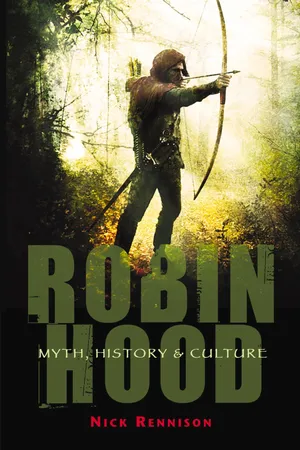
Robin Hood is England's greatest folk hero. Everyone knows the story of the outlaw who robbed from the rich and gave to the poor. Nick Rennison's highly entertaining book begins with the search for the historical Robin. Was there ever a real Robin Hood? Rennison looks at the candidates who have been proposed over the years, from petty thieves to Knights Templar, before moving on to examine the many ways in which Robin Hood has been portrayed in literature and on the screen.
Information
Robin in Literature
As we have seen in an earlier chapter, Robin Hood began his literary life in ballads of the late Middle Ages. At roughly the same time, he became established as a character in the May Games which took place throughout the country to welcome the arrival of summer. Both forms, the ballad and the mumming play, were ephemeral. The Robin Hood folk plays were local rituals, rarely written down and even more rarely preserved for later generations to read. The ballads may have been printed but they were not intended to survive for posterity. They were entertainments of and for the moment. Their writers would be astonished if they could know that some of their productions are still being read and studied four and five centuries after they first appeared in print. It was only in the latter half of the sixteenth century that Robin Hood began to figure in more conventional literature. Writers who were familiar with the stories from the ballads and the games started to include Robin in their own works.
It is a pity that the greatest of English playwrights never chose to write about the greatest of English outlaws. Shakespeare clearly knew the tales and the characters who populated them. There is a throwaway reference to ‘the bare scalp of Robin Hood’s fat friar’ in Two Gentlemen of Verona and another in Henry IV Part Two when Justice Silence, boozily crooning to himself, sings of ‘Robin Hood, Scarlet and John’. In As You Like It, in many ways a tale of the greenwood without its most familiar inhabitants, the duke is compared to the outlaw. ‘They say he is already in the Forest of Arden,’ a character remarks in the very first scene, ‘and a many merry men with him; and there they live like the old Robin Hood of England. They say many young gentlemen flock to him every day, and fleet the time carelessly, as they did in the golden world.’ In Shakespeare’s mind, Robin is clearly associated with a kind of forest Arcadia. However, Stratford’s greatest son did not make use of the legend in any more extensive way.
In fact, only two of Shakespeare’s contemporaries produced dramatic works that have survived in which Robin Hood is one of the principal characters. (There is evidence of other plays that are no longer extant. A ‘pastorall plesant commedie’ called Robin Hood and Little John, for example, is entered in the Stationers Register in 1594 but has been lost. There are also plays such as George A Greene by Robert Greene and Look About You, written by an anonymous author and printed in 1600, in which Robin appears in a subsidiary role.) The first was Anthony Munday, a prolific author of the Elizabethan and Jacobean eras, who is credited with the writing of two plays entitled The Downfall of Robert, Earl of Huntington and The Death of Robert, Earl of Huntington. In truth, these plays, like so many of the dramas of the period, may well have had more than one author. The diary of the theatrical entrepreneur Philip Henslowe records that he paid Munday £5 for a Robin Hood play in February 1598 but a later entry indicates that another playwright Henry Chettle was paid a further 10s for ‘the mending of the first parte of Robart Hoode’. Presumably the two plays that we have were, in some sense, collaborative works, although there is no doubt that Munday produced much more of the text than Chettle and it is his name that is usually associated with them. Both works were printed in 1601. The first of them, The Downfall of Robert, Earl of Huntington, is notable for the fact that its hero, the man who becomes known as Robin Hood, is a dispossessed aristocrat. The idea of the outlaw as a wronged nobleman is very familiar in later works, from nineteenth-century novels to twentieth-century films, but here is its first appearance in a work of art. The earliest hints that Robin might have been something other than a yeoman appear decades before The Downfall of Robert, Earl of Huntington – in the work of the historian John Major and in the 1569 Chronicle at Large by Richard Grafton, a printer and scholar, who summarised what Major had said and then went on to report, ‘In an olde and auncient Pamphlet I finde this written of the sayd Robert Hood. This man (sayth he) discended of a nobel parentage: or rather beyng of a base stocke and linage, was for his manhoode and chivalry advaunced to the noble dignitie of an Erle.’ However, it was Munday who first introduced the notion into a work of the imagination and he was the first to provide his hero with the title of the ‘Earl of Huntington’.
The Downfall is not a particularly good play and it is only remembered today because of its subject matter. It opens with a curious scene in which Munday pretends that what we are about to see is written not by him but by the earlier Tudor poet John Skelton who is also supposed to be playing the role of Friar Tuck. Once this conceit is established and the main action of the drama is underway, Munday wastes no time in despatching his hero into exile in Sherwood. When he gets him there, however, he seems unsure what to do with him. The new gentrified Robin can’t be seen indulging in the activities of the old yeoman Robin of the ballads. He can’t rob and kill and persecute churchmen and noblemen in quite the same way when he now comes, like them, from the upper stratum of society. In the ballads, there was a class antagonism between the outlaw and his victims. In Munday’s plays he comes from the same social group as his enemies and the confrontation between them must be based on personal feelings rather than class tensions. The result is that the story of Robin as outlaw and the romance between him and Marian, identified by Munday as the daughter of Lord Fitzwalter, becomes entangled with plotting and conspiracy between the noblemen surrounding Prince John. The Downfall must have been a successful play at the time since there was sufficient demand for a sequel to be written but The Death provides even less scope for the outlaw hero. In fact, Munday kills him off early in the drama (giving him an improbably extended death scene) and turns his attention to the tribulations of the bereaved Marian.
The second playwright of the period to approach the legend was Ben Jonson. Author of satirical comedies such as Volpone and The Alchemist, Jonson is often considered the most gifted of Shakespeare’s contemporaries. The Sad Shepherd, or A Tale of Robin Hood was his last play, unfinished at his death in 1637. We have been left with two acts and a few scenes from what would eventually have been a five-act drama. In The Sad Shepherd almost all sense of Robin as a genuine outlaw and robber has been banished. In its place is Robin Hood as gentle and genteel lord of the forest, planning to preside over feasting and festivities for his followers. He welcomes his ‘friends and neighbours to the jolly bower’ and ‘to the greenwood walks’. He invites them to ‘awake/The nimble hornpipe and the timburine/And mix our songs and dances in the wood’. He acts like the courtly host of upper-class revels. Here too is Robin as devoted lover who spends far more time kissing and embracing Marian than he does engaging in the less lawful pursuits of a traditional outlaw. The celebrations in the forest are interrupted, and the play’s plot set in motion, by two events. One is the arrival of Eglamour, the Sad Shepherd of the title, who believes that his lover Earine has fallen into the Trent near the mill belonging to Much’s father and has been drowned. The other is the interference of a witch who disguises herself as Marian in order to abuse Robin and harass him and his guests. It is difficult to know where Jonson planned to take his play (although it was completed and staged in the late eighteenth century by an actor/writer named Francis Waldron) but what we have demonstrates that he had problems with the material. Once Robin is so thoroughly gentrified and taken away from the illegal and violent activities that fuel the narratives of the ballads, there is not a lot for him to do. In The Sad Shepherd, the figure that provides the play with its subtitle is in danger of being shunted into the background. Even his responsibilities for slaying the deer to feed his guests are passed on to Marian.
It was not just dramatists of the Jacobean and Caroline eras who were drawn to the stories of Robin Hood. As we have seen, anonymous scribblers continued to produce ballads, often naïve in language and versification, throughout the period but more sophisticated poets also began to recognise Robin’s significance and to include him in their work. Michael Drayton’s Polyolbion was first published in 1612, although the poet had been working on it since the late 1590s. The book is a huge poem which attempts to describe successively all the counties of England and Wales. Drayton imagines assorted topographical features (rivers, valleys, hills) boasting in verse of the traditions and myths associated with them and, in the section of his work about Nottinghamshire, Sherwood Forest itself sings of the exploits of the famous outlaw who lived there. Drayton assumes universal knowledge of Robin Hood and writes that, ‘In this our spacious isle, I think there is not one/But he hath heard some talk of him and Little John’. He knows how extensive and wide-ranging the stories are (‘The merry pranks he played, would ask an age to tell/And the adventures strange that Robin Hood befell’) and he knows that one of the fundamental differences between Robin and other outlaws was his generosity and charity. ‘What often times he tooke,’ he writes, ‘he shar’d amongst the poor.’
Twenty years after Polyolbion was published and a few years before Jonson set about working on The Sad Shepherd, a man named Martin Parker produced what was probably the most substantial work on Robin in the ballad tradition since the Gest one hundred and thirty years earlier. Parker was a professional ballad writer living in London. Records suggest that he may also have been an inn-keeper. Where anonymity hides the identities of most of those who produced the broadsides of the seventeenth and eighteenth centuries, his name was attached to A True Tale of Robin Hood, a poem of nearly five hundred lines that was first published in the 1630s and reprinted more than fifty years later. His work is a kind of fusion of the stories from several ballads into one narrative and was clearly aimed at a slightly more upmarket audience than the cheap, single-sheet broadsides sold on the streets and at fairs. The poem also shows clear signs that Parker knew Munday’s two plays and borrowed the idea of an aristocratic Robin from them. Parker’s Robin, like Munday’s, is the one-time Earl of Huntington. Exiled to the forest for debt, he takes to outlawry with enthusiasm. His hatred for religious figures (‘His chiefest spight to the clergie was’) does not seem initially unusual and Parker’s highlighting of his hero’s anti-clerical credentials is unsurprising in an era which had little time for Catholic clergy, past or present. What is rather eye-catching is his casual reference to Robin castrating monks and friars (‘Their stones [testicles] he made them leese [lose]’), a habit that no other ballad records. As a means of preventing clerical lechery and the fathering of bastard children, which the author claims was Robin’s intention, it seems a bit extreme. In fact, as the poem progresses, Parker places more and more emphasis primarily on the outlaw’s opposition to ‘th’crewell clergie’ and twists himself into knots trying to portray him as no real threat to state or rightful king. He ‘never practised any thing/Against the common wealth’, he assures his readers. His eagerness to assert the truth of the tales he is reporting is matched only by his desire to stress how impossible it would be for such lawlessness to take place now. ‘We that live in these latter dayes/Of civill government,’ he comments, ‘have a hundred wayes/Such outlaws to prevent’. It all seems a little odd until one remembers that Parker was writing in an age when disobedience to the powers that be was no laughing matter. Charles I was on the throne and the Civil War was only a decade away when he published his True Tale of Robin Hood. An outlaw was an ambivalent hero even for a popular ballad and Parker, clearly more royalist than roundhead in the making, produced a Robin Hood tale for his time.
Equally rooted in its era is a strange little play published thirty years later than Parker’s work, after all the upheavals of the Civil War, Cromwell’s rule and the restoration of the king in 1660. Only just over 150 lines long and entitled Robin Hood and his Crew of Souldiers, the play, according to the title page of the edition printed in 1661, was ‘acted at Nottingham on the day of His Sacred Majesties Corronation’. It shows Robin’s acknowledgement of past crimes and acceptance of a pardon as a counterpart to the submission of former rebels to the new authority of the restored Charles II.
For a century after the publication of Robin Hood and his Crew of Souldiers, the stage was one of the principal places where Robin could be found. Ballads continued to be published and already existing ballads were gathered together in anthologies and ‘garlands’. However, new depictions of the outlaw hero in this period were most likely to emerge from the world of the London theatre. Robin became a regular character in the ballad operas that were popular at the time and was just as likely to burst into song as to let fly an arrow. (The vast majority of these eighteenth-century works for the stage were notable more for their music than any other qualities and they are considered in the later chapter entitled ‘Musical Robin’.) It was only later in the century that an entirely new chapter in the literary history of Robin Hood was begun and, paradoxically, it was initiated by someone who was primarily interested in looking back at older versions of the story.
In the second half of the eighteenth century, a fashion for the folk poetry of the past developed. James Macpherson’s The Works of Ossian, supposedly verse by an ancient Celtic bard, was the literary sensation of the 1760s. Thomas Percy, a churchman and future bishop, published his Reliques of Ancient Poetry in the same decade which included a handful of references to the Robin Hood ballads. Other collections followed. The time was ripe for a re-assessment of all the Robin Hood ballads. In 1795, an eccentric scholar named Joseph Ritson published a book with the impressive title of Robin Hood: A Collection of All the Ancient Poems, Songs, and Ballads, Now Extant Relative to That Celebrated English Outlaw: To Which are Prefixed Historical Anecdotes of His Life. It remains one of the most significant volumes ever published on the subject of the outlaw of Sherwood. Born in Stockton-on-Tees in 1752, Ritson moved to London as a young man and he earned his living as a conveyancer. His real interest, however, was in literature and he soon gained a reputation as a savage critic of those whose opinions on the subject he disliked. He was no respecter of reputation and even Dr. Johnson, then an old man, was on the receiving end of Ritson’s attacks, lambasted for what the younger writer claimed were glaring errors in his edition of Shakespeare. In his own life as well as in his literary opinions, Ritson was a man unafraid of marching to the beat of a different drum. He was a vegetarian at a time when not eating meat was unusual and one of the last of his works published in his lifetime was entitled An Essay on Abstinence from Animal Food, as a Moral Duty; he was a political radical who welcomed the French Revolution and continued to express admiration for what the revolutionaries were doing long after other English supporters had lost their enthusiasm as a result of the excesses of the Terror. Quarrelsome and argumentative, Ritson was a man whose inability to get on with almost everybody often seemed close to pathological. In 1803, eight years after the publication of his great work on Robin, he did indeed lose his mind. After barricading himself in his lodgings and trying to burn all his manuscripts, he was removed to an asylum at Hoxton where, within a short time, he died.
It is difficult to overemphasise the importance of Ritson’s work both in establishing the canon of Robin Hood literature from earlier centuries and in providing a sourcebook for those writers in later years who wanted to reinterpret and re-work that canon. Before Ritson there was a chaos of material which no scholar had properly organised; after him there was no comparable collection until the American Francis Child published his edition of the Gest and other ballads in 1888. The irascible scholar not only gathered together previously scattered material on the outlaw. He also provided his own interpretation of Robin Hood which has proved influential for more than two centuries. To Ritson, the reader of Tom Paine and the enthusiast for the French Revolution, Robin was a hero for all radicals. He was a man, as he wrote, ‘who, in a barbarous age, and under a complicated tyranny, displayed a spirit of freedom and independence which has endeared him to the common people, whose cause he maintained (for all opposition to tyranny is the cause of the people), and, in spite of the malicious endeavours of pitiful monks, by whom history was consecrated to the crimes and follies of titled ruffians and sainted idiots, to suppress all record of his patriotic exertions and virtuous acts, will render his name immortal.’
In the decades following the publication of Ritson’s massive work, and largely because of it, there was a resurgence of interest in Robin Hood. Writers of the Romantic era found much to attract them in the old legends and in the ballad form. In 1820, Leigh Hunt, perhaps best known today as a radical journalist and editor who was imprisoned for mocking the Prince Regent as a ‘fat Adonis of forty’, wrote four poems about Robin Hood in imitation of the medieval ballads he had read and admired. Reflecting Hunt’s own political beliefs, these show Robin as a champion of the poor and social justice, killing a deer in order to feed a starving peasant and defying corrupt churchmen, but they also celebrate the freedom and idealised community of the greenwood. ‘How Robin and his Outlaws Lived in the Woods’ describes, in cheery near-doggerel, the round of drinking, feasting, fighting and dancing in which Robin and his merry men engage. It was this liberating loosening of social constraints, as much as any political radicalism that could be read into the legend, that writers of the Romantic era found so appealing. Two years before Hunt published his poems in one of the magazines he edited, a minor poet named John Hamilton Reynolds wrote two sentimental sonnets in which he mourned the disappearance of ‘the sweet days of merry Robin Hood’. He sent them to a friend for his opinion. The friend was John Keats. In a reply to Reynolds, Keats included his own verse on the subject of Robin Hood. Keats, of course, was a much superior poet to both Reynolds and Hunt and his lines have a sophistication and ambiguity that neither of them could match. He has sympathy with the longing for an imagined past that features so strongly in his friend’s two poems but he turns his back on it. ‘No! those days are gone away,’ the very first line of Keats’s poem proclaims and, although he may regret their departure and be more than prepared to give, ‘Honour to bold Robin Hood/Sleeping in the underwood’, he clearly sees little value in the kind of nostalgic musings in which Reynolds indulges.
Another Romantic, the later Poet Laureate Robert Southey, was drawn to the Robin Hood story throughout his life. As early as 1804, when he was casting around for a suitable subject for the English epic he was planning, he considered the possibility of using the outlaw leader but finally decided that Robin was not sufficiently elevated a topic for his purpose. He ‘lowers the key too much’, Southey wrote to a friend, although he continued to nurse the ambition to write a Robin Hood poem for decades to come. All that ever saw the light of day were a few fragments of a longer work and these were only published in a volume edited by his second wife that appeared in 1847, four years after his death.
Thomas Love Peacock’s short novel Maid Marian was published in 1822 but, as its author was keen to point out in an authorial note, perhaps to avoid accusations of pinching ideas and characters from Sir Walter Scott’s...
Table of contents
- Cover
- About the Book
- About the Author
- Title
- By the Same Author
- Contents
- Introduction
- Robin in the Ballads
- Robin in the May Games
- Historical Robin
- Robin in Literature
- Robin on the Screen
- Illustrated Robin
- Musical Robin
- Computer Robin and the Future of a Legend
- Merry Men (and Others)
- Further Reading
- Copyright
Trusted by 375,005 students
Access to over 1.5 million titles for a fair monthly price.
Study more efficiently using our study tools.
Frequently asked questions
Yes, you can cancel anytime from the Subscription tab in your account settings on the Perlego website. Your subscription will stay active until the end of your current billing period. Learn how to cancel your subscription
No, books cannot be downloaded as external files, such as PDFs, for use outside of Perlego. However, you can download books within the Perlego app for offline reading on mobile or tablet. Learn how to download books offline
Perlego offers two plans: Essential and Complete
- Essential is ideal for learners and professionals who enjoy exploring a wide range of subjects. Access the Essential Library with 800,000+ trusted titles and best-sellers across business, personal growth, and the humanities. Includes unlimited reading time and Standard Read Aloud voice.
- Complete: Perfect for advanced learners and researchers needing full, unrestricted access. Unlock 1.5M+ books across hundreds of subjects, including academic and specialized titles. The Complete Plan also includes advanced features like Premium Read Aloud and Research Assistant.
We are an online textbook subscription service, where you can get access to an entire online library for less than the price of a single book per month. With over 1.5 million books across 990+ topics, we’ve got you covered! Learn about our mission
Look out for the read-aloud symbol on your next book to see if you can listen to it. The read-aloud tool reads text aloud for you, highlighting the text as it is being read. You can pause it, speed it up and slow it down. Learn more about Read Aloud
Yes! You can use the Perlego app on both iOS and Android devices to read anytime, anywhere — even offline. Perfect for commutes or when you’re on the go.
Please note we cannot support devices running on iOS 13 and Android 7 or earlier. Learn more about using the app
Please note we cannot support devices running on iOS 13 and Android 7 or earlier. Learn more about using the app
Yes, you can access Robin Hood by Nick Rennison in PDF and/or ePUB format, as well as other popular books in Social Sciences & British History. We have over 1.5 million books available in our catalogue for you to explore.