![]()
A Church within a Church, a State within a State (1145–1291)
The Second Crusade
The Second Crusade (1147–49) provided a measure of how successfully the Templars had established themselves in the years after the Council of Troyes and the three great bulls of privilege. On Christmas Eve 1144, the city of Edessa fell to an army under the command of Imad ad-Din Zengi, the Atabeg (governor) of Mosul and Aleppo. When news finally reached Pope Eugenius III the following autumn, he immediately wrote to King Louis VII of France, imploring him to lead a new crusade to rescue Edessa from the infidel. Louis was not at all popular in France at the time, as three years earlier he had started a war when he illegally seized lands belonging to his most powerful vassal, Theobald of Champagne, and he seems to have been surprised when none of his barons showed much interest in his proposal for a new expedition to the East. It was decided that the matter would be settled at a meeting at Vézelay in Burgundy at Easter 1146. Realising that he was potentially without allies, Louis turned to the one man who had the clout to rally would-be crusaders, and that was Bernard of Clairvaux.
The scene at Vézelay on 31 March 1146 was reminiscent of Clermont in 1095 – huge crowds had gathered, drawn by the prospect of hearing Bernard preach the crusade. So many had arrived in Vézelay that Bernard had to deliver his sermon from a specially constructed platform on the out skirts of town. Bernard's words found a receptive audience. As soon as he had finished speaking, King Louis was the first to pledge allegiance, followed by his brother Robert, the Count of Dreux. Of all of those who vowed to journey to the East that day, many were the sons and grandsons of the original crusaders, to whom maintaining family honour was at least as important as liberating Edessa. Bernard later wrote to King Louis of the success of Vézelay: 'Villages and towns are now deserted … Everywhere you will see widows whose husbands are still alive.'(9)
On 27 April 1147, a Chapter meeting of the Paris Temple welcomed both King Louis and Pope Eugenius in the build-up to the crusade's departure. Also present were four archbishops, 130 Templar knights and at least as many Templar sergeants and squires. Eugenius appointed Aymar, the Templar treasurer, to receive the tax that he had imposed on all Church goods to finance the crusade. William of Tyre, the great chronicler who was writing a generation later, believed that it was at this meeting that the Pope conferred on the Templars the right to wear a red cross on their white mantles, which symbolised their willingness to suffer martyrdom in defending the Holy Land against the infidel.
Germany was fermenting with crusading zeal by this time, after King Conrad III had heard Bernard preach in the Rhineland. Eugenius had originally wanted Conrad to help in the fight against his primary foe, the Norman king, Roger of Sicily, but as Conrad could not be dissuaded from going on crusade, it was decided that he should lead a German force that would work alongside the French.
Everard des Barres, Master of the Temple in France, together with the knights present at the April Chapter meeting, accompanied the French army under Louis on the overland route taken by the First Crusade. Everard proved himself to be one of Louis' most trusted advisors, and the French king sent the Templar Master ahead to Constantinople to negotiate the Crusade's passage through Byzantine territory. Unlike his predecessor Alexius, the Byzantine Emperor Manuel Comnenus had not asked for Western help, and was somewhat nervous at the prospect of the crusading force (made up largely of the French and German armies) bearing down upon his lands. Everard succeeded in getting the Crusaders through, although Manuel was looked upon with grave suspicion by the Franks, as he had signed a peace treaty with the Seljuk Turks in order to wage war against Roger of Sicily. Manuel was equally uneasy with the crusaders, and was glad to see the back of them.
In January 1148, the Crusade got into further difficulty. Demoralised by severe weather and the news that Conrad's army – which had gone ahead of the French – had suffered a defeat at Dorylaeum by the Seljuk Turks, the French came under attack in the narrow passes of the Cadmus moun tains. The Franks' heavy cavalry was useless in such terrain, and the columns of crusaders came under constant attack from the Turkish light infantry, whose archers were masters of firing from the saddle. The Franks were further hampered by an acute shortage of horses and provisions, and it seemed as though the Crusade would be over before it ever reached Outremer. Once again, Louis turned to Everard des Barres and the Templars. Everard broke the army up into units of 50, each under the command of a Templar, who in turn were answerable to another Templar knight, Brother Gilbert. This provided the beleaguered French with sufficient morale and order to continue as far as the Byzantine port of Attalia, where Louis took his best troops by boat to Antioch.
At Antioch, the Crusade took yet another turn for the worse. Louis had all but exhausted his funds in getting the army across Asia Minor; once again, Everard des Barres was the man to whom Louis turned for help. On 10 May, Everard sailed from Antioch to Acre, where he raised sufficient capital to fund the rest of the crusade, either by drawing directly from the treasury at the Templar preceptory in Acre, or by borrowing using the Order's possessions as security. Whichever was the case, it proved that the Templars had become a major financial institution, and it cemented the relationship between the Order and the French crown, with the result that the Templars effectively became the French royal treasury until the late thirteenth century.
The Templars seem to have played a less prominent role in the remainder of the crusade. A council of war was convened at Acre in June to decide on a course of action, with the Templar Grand Master Robert de Craon present, together with the Grand Master of the Hospital, Raymond du Puy. After debating whether they should head for Edessa via Aleppo, or whether they should instead strike out for Ascalon in the south, it was eventually decided that the target should be Damascus, which the crusaders planned to attack the following month. After initial success in besieging the city from the west, the crusaders made the tactical blunder of decamping to a position on the east of the city. Unlike their original position, which had been well supplied, this new eastern position had no water and also faced the best fortified section of the city walls. With rumours that a huge Muslim army under Zengi's son Nur ed-Din (Zengi having died in 1146) was on its way, the crusaders lost their nerve and retreated. The Second Crusade was over, and the recriminations for its failure began.
There were various theories as to why the Second Crusade had been such a fiasco. Accusations of treachery abounded, with various parties being named as the chief culprits. The crusaders, unused to life in the East, were shocked by the way Christians in Outremer had assimilated Eastern ways, and the 'Men of Jerusalem', as they were called, were seen as the guilty party by a number of commentators in the West. John of Würzburg, a German monk who travelled to Outremer in the 1160s, believed that the Crusade's failure was due to Templar treachery. John's anonymous colleague, known as the Würzburg Annalist, went even further, and stated that the Templars had been paid off by the Damascenes to lift the siege. Only later was it found that the money the Orders had been paid was in fact counterfeit, which was seen as Divine punishment for betraying the Christian cause. Other variants of the story had the 'Men of Jerusalem' accepting the money, while the early thirteenth-century chronicle of Ernoul and Bernard the Treasurer had the Hospitallers working alongside the Templars in putting profit before God. However, the Military Orders' sternest critic of the time, William of Tyre, does not mention either the Templars or the Hospitallers in connection with the failure of the Crusade. As the bad press the orders received dates from several decades later, it would seem that the chroniclers were reflecting contemporary disillusion with both the Temple and the Hospital and projecting it back to 1148.
Given that the Templars played a major role in financing the Second Crusade, it might be worth examining the role the Order played in the financial affairs of both Outremer and the West, and the subsequent dominance they exerted over what was to evolve into a system of international banking.
The Temple as Bankers
The Templars quite early on in their history developed a reputation for being reliable bankers. They were – in effect – Europe's first bank. They developed a system of credit notes whereby money deposited in one Templar preceptory could be withdrawn at another upon production of a credit note. Monies thus deposited proved to be quite safe, as Templar keeps were formidable buildings. Some of their castles in Outremer, for instance, were so well defended that they were impregnable (such as their massive fortress at 'Atlit, which was actually a fortified peninsula rather than a mere castle). In Europe, the imposing edifice of the Paris Temple became their financial base (as did, to a lesser extent, the London Temple).
Louis VII was the first of a number of European monarchs whose finances were saved from collapse by Templar loans, although the size of the loan that the Templars provided brought the Order close to bankruptcy. It is thought that the Order provided him with 2,000 marks of silver and 30,000 livres parisis. The magnitude of this amount of money can be seen when it is compared to revenues from French royal lands which, even 20 or so years after the Second Crusade, were only about 60,000 livres parisis per year.
Louis VII was not the only French monarch who was to become reliant on the Order's financial services. The Second Crusade saw the beginning of a long association between the Order and the kings of France. By the reign of Philip II (1180–1223), the Templars were effectively the French royal treasury. During the course of his reign, they increased the revenues from royal estates by 120 per cent, and were heavily involved in Philip's restructuring of Capetian finances. During the thirteenth century, the Templar treasurer in Paris was always a man selected by the king, and the treasurers became trusted advisers to Philip and his successors. When Louis' great-grandson, Louis IX, was held hostage after the disasters of the Seventh Crusade in 1250, it was to the Temple that the French commanders looked for the remaining 30,000 livres that they required to bail him out (although, on this occasion the Templar commander, Stephen of Otricourt, was less than happy to comply).
That the Templars proved themselves to be so successful as bankers is due in no large part to the meticulousness of their records, and their objectivity in dealing with clients. Records survive from the Paris Temple for the period 12 March 1295 to 4 July the following year, and they give a clear indication of how busy the Paris Temple was in its role as banker. These records – eight surviving sheets of parchment – record the date and the Templar on duty at the time, in addition to the amount deposited, by whom, into which account the money should be paid and from where the amount came from. At the end of each day, the receipts collected would be taken to the strong rooms to be deposited. (During the 1260s and 1270s, a great tower was built in order to house the various monies the Order was keeping.) There were more than 60 active accounts at the Paris Temple during this period, with the account holders being a mixture of royalty, clergy, important nobles and Templar officials. No business was done at Christmas, Easter and Ascension, and also on the Feast Days of saints who had a particular relevance for the Order, such as John the Baptist. Outside of these dates, the hours the Temple was open for business depended largely on the needs of its clients. In August 1295, for instance, they were only open for six days, whereas that December, they were far busier, being at one point open on 11 consecutive days. The Paris Temple also sent out statements to important clients several times a year, detailing the movements within their accounts.
Matters did not always go smoothly, however, as the chronicler Joinville discovered to his cost on the Seventh Crusade. While the army was recuperating at Acre following King Louis' ransom, Joinville received 400 livres in wages. He kept 40 and deposited the remaining 360 with the Templars. When he sent one of his men to withdraw an other 40 for current living expenses, the Templar treasurer denied all knowledge of Joinville and his savings. Joinville then complained to the newly elected Grand Master, Reginald de Vichiers, who was initially dubious at Joinville's accusation that the treasurer had lost his money. Reginald looked into the matter, and several days later was able to report to a much relieved Joinville that his money had been found; the treasurer was transferred out of Acre.
The Papacy also came to be dependent on the Templars for its financial needs. The Templars were acting as Pope Alexander III's (1159–81) bankers from as early as 1163, and, as they had been involved with the overhaul of Capetian finances under Philip II, so the Order was also used by Pope Innocent III when he undertook to reorganise crusading finances at the time of the Fourth Crusade (1202–4). A new tax, levied on the clergy for the express purpose of being used to fund the campaigns in the East, was to be paid into Templar and Hospitaller preceptories; the military orders would then be responsible for transporting the money safely to the Holy Land. A similar procedure was followed by Honorius III when he was raising funds for the Fifth Crusade (1218–21), with the money raised to be transferred to the papal legate in Egypt.
Kings from other countries likewise came to the Temple. The kings of Aragon were heavy borrowers, and King Henry II of England (1154–89) used the Order to accumulate crusading funds in Jerusalem, whilst his brother King John (1199–1216) was borrowing anything from nine marks of gold for an offering to be made when he was absolved following the lifting of his excommunication in 1213, to loans of over 4,000 marks two years later to pay the wages of troops in Poitou and Gascony. During his wars with the barons, John's son Henry III (1216–72) moved the crown jewels to the Paris Temple for safekeeping in 1261, where they were inventoried and stored until further notice. The further notice duly came three years later, when Henry used them as security on a loan to finance further campaigns against the barons.
The Templars' financial services were not restricted to providing loans, however, and not just for the royalty and nobility. As crusaders and pilgrims might be away from Europe for several years, the Templars also accepted precious documents and objects for safekeeping, including wills. One such example was the will of Pierre Sarrasin, which was drawn up in June 1220 before he set out for Santiago de Compostella. In it, he specified that, if he failed to return, the Templars should pay 600 livres parisis to the Abbey of St Victor, and that this should be used to buy rents from corn, the annual proceeds from which (about 200 livres parisis) were to be used to make daily donations of bread; furthermore, there were additional beneficiaries, including his mother, who was to be paid 100 livres.The remainder of the estate was to be held by the Templars until Pierre's heirs came of age.
The Structure of the Order
As the Temple grew from being the original nine soldier monks sworn to poverty, chastity and obedience into what we would nowadays recognise as a multinational corporation, so too did the structure of the Order evolve to reflect and support its expanding role in the affairs of the crusader states.
The Grand Master was the absolute ruler over the Order; after the bull Omne datum optimum of 1139 he was answerable only to the Pope. Grand Masters were chosen by an electoral college of 13 senior Templars, comprising eight knights, four sergeants and one chaplain. Generally, the electoral college would try to choose someone who was already based in the East. Given the importance of the Paris Temple to the French monarchy, French kings could – and often did – influence the choice of a Grand Master, such as during the election of Reginald de Vichiers in 1250. As the Order expanded, so did the trappings of office: by the time of Bertrand de Blancfort's tenure (1156–69), a Grand Master could expect to have four horses, and an entourage made up of two knights, a sergeant, a chaplain, a turcopolier, a farrier, a cook and a Saracen secretary. The Master also had first choice whenever the Order received a fresh batch of horses from the West.
Immediately beneath the Grand Master was a Chapter of senior officials. The Seneschal was both deputy and adviser to the Grand Master. On occasion, Seneschals would eventually become 'promoted' to Grand Master – the politics of the electoral college permitting – such as André de Montbard, who was one of Hugues de Payen's original knights. After acting as Seneschal for four years, he finally became Grand Master in 1153 after the short Mastership of Bernard de Tremelay had come to an abrupt and bloody end at Ascalon. Like the Grand Master, the Seneschal also had his own staff. The Marshal was responsible for all military decisions, such as the purchase of horses and equipment, and also had jurisdiction over the regional commanders. These were commanders who had responsibility for one specific area: the Commander of the Kingdom of Jerusalem acted as the Order's treasurer, oversaw the Kingdom and had the same powers as the Grand Master within it; the Commander of the City of Jerusalem, who likewise was overlord of the city only, also had the same powers as the Grand Master within its walls; and the commanders of Tripoli, Acre and Antioch were invested with similar powers. Each major kingdom in the West with a significant Templar presence had a Master who was answerable to the Grand Master: France, England, Aragon, Portugal, Poitou, Apulia and Hungary. The Draper was responsible for the issue of clothing and bedding, and made sure that individual brothers did not hoard private property. He was also authorised to distribute gifts made to the Order.
There were further roles that seem to have been subservient to the various masters and commanders. The Commander of Houses was responsible for specific Templar houses in the East and was answerable to the higher ranks; the Commander of Knights acted as deputy to the Commander of the Kingdom of Jerusalem; the Turcopolier, who was in charge of the turcopoles (the light cavalry who were often local troops engaged for a fixed period); the Under Marshal, who oversaw the footmen and the equipment; the Standard Bearer, who was usually a sergeant and was responsible for the conduct of the squires; and the Infirmarer looked after sick and aged brothers, who would often be sent back to reside in the Order's Western houses, away from the front lines of Outremer and the Iberian Peninsula.
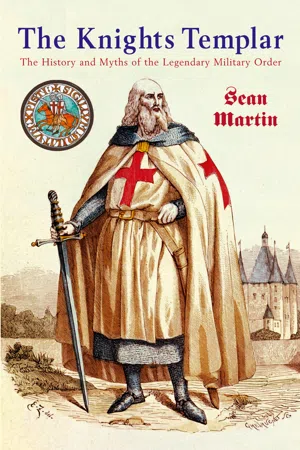
The elite of the Templar fighting force was comprised of the group perhaps most readily pictured when we think of the Order – the knights with their white mantles bearing the distinctive red cross over the heart. They would already be expected to be skilled in the arts of war before joining the Order, when they would hand over their secular clothes and be issued with armour, equipment and clothing to wear when not in the field. Although originally knights could be from any social group (including excommunicates, such was the constant need for manpower in the East), by the time of the Second Crusade it was necessary for knights to be descended from knightly stock. Each knight would be granted three horses and a squire, whose role would be to assist the knight and to make sure that he was fully equipped and ready to go into battle. Like the tu copoles, squires were usually not fully sworn-in Templars, but often locals who were hired for a set period.
The other main group of fighting Templars was the sergeants, who, unlike the knights, wore black or brown mantles, and were not as heavily armed. Sergeants were from a much more socially and racially mixed background than the knights, and their ranks were often made up with men of Armenian and Syrian origin. They had to make do with only one horse, and were required to be their own squires.
Gaza and Ascalon
Despite the major setback of the Second Crusade, the Christian presence in Outremer continued to be pre-emptive. The one coastal city that remained in Muslim hands was Ascalon, and a series of forts had been built around it to hem it in. During the winter of 1149–50, King Baldwin III gave the Templars Gaza, which lay a dozen or so miles to the south. The city was largely in ruins, and the Templars set about rebuilding the fort – it was the first important castle the Order received in the Kingdom of Jerusalem. The Egyptian forces, now unable ...