We are living in an age where we are constantly bombarded with lies, fakery and spin. This is especially true of the work place. Liars Paradise exposes the techniques used by liars and corporate cheats.
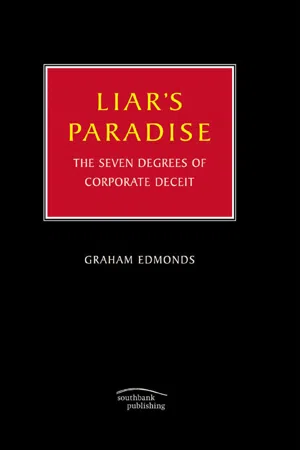
- 224 pages
- English
- ePUB (mobile friendly)
- Available on iOS & Android
eBook - ePub
About this book
Trusted by 375,005 students
Access to over 1.5 million titles for a fair monthly price.
Study more efficiently using our study tools.
Information
1
Levels of Honesty, Degrees of Deceit
Honesty may be the best policy, but it’s important to remember that apparently, by elimination, dishonesty is the second-best policy.
George Carlin
Comedian and actor
Comedian and actor
Grading lies
For the most part, we work not by pursuing our own self-interests, but doing what is right and morally correct, doing the right thing for the right reason even if we are not religious or subscribe to a particular faith. Most of us live by a basic code of goodness and fair play.
Things get complicated when something threatens our livelihood and our comfortable lifestyle or when ambition or greed takes over. More lies get told and life starts to change as the degree and type of lies start to become more complex.
Moral codes play little significance in business, neither does religion for that matter, but early religious leaders were among the first to categorise lies. Saint Augustine played a key role in the development of early Christianity and he divided lies into these categories:
- lies in religious teaching;
- lies that harm others and help no one;
- lies that harm others and help someone;
- lies told for the pleasure of lying;
- lies told to please others ‘in smooth discourse’;
- lies that harm no one and that help someone;
- lies that harm no one and that save someone’s life;
- lies that harm no one and that save someone’s ‘purity’.
Obviously he didn’t know about corporate life, although he didn’t feel that lies told for fun (jocose) were really lies at all, which is excellent.
The medieval Italian philosopher monk, St Thomas Aquinas, had slightly different views. He divided lying into three types:
- the useful;
- the humorous;
- the malicious.
He classed the first two as ‘venial sins,’ in other words lies told to help, in ignorance or for fun. They may involve a ‘temporary fall from grace’ but are considered harmless, providing the liar repents.
The third though is a ‘mortal sin.’ This is a ‘grave matter’ and one that involves full knowledge and is committed deliberately. This means that if you don’t repent properly before you die, you’re in for it come Judgement Day.
These days religion and moral behaviour rarely come into the workplace. It’s forgotten at the office door, as at work it’s a battleplace. Some people are able to take on a different personality to that which their family (or their church) is familiar, while others are duplicitous no matter what the situation.
A previous boss once admitted to me that her husband would be appalled at her behaviour at work; she was able to take on the mantle of mother and wife at home, but that of competitive bitch at work. Another colleague raised money for good causes and played a key role at his church but at work was nicknamed the ‘chameleon’ for his ability to change sides according to which he thought would work out best for him. He was one of the least popular managers I’ve ever met.
Essentially they both found the level of honesty at which they were comfortable, working within their own moral code and ethical viewpoint; it’s just that theirs is one that most of us are not comfortable with.
It’s axiomatic that a person who lies a lot is more suspicious of others and often thinks that they are being lied to. Conversely a person who doesn’t lie much assumes that people are generally telling them the truth and has difficulty picking up on what is bullshit and what’s not.
Halfway through a negotiation course with several of my management peers, the instructor singled me out and said ‘you don’t lie much do you?’ I said that I didn’t see the point of it. He turned to Sheila, one of the other attendees, and said ‘you lie a lot?’ She admitted that she did.
He turned to the group and demonstrated that my personality type was one that took things at face value, which was something I had to watch out for in business. He then, through a role play exercise, demonstrated how lying can backfire on you in a negotiation, with Sheila as the star player. I’ll never forget the look on Sheila’s face as she realised she had been made a fool of. Back at the office, the reaction of our colleagues was an interesting one; despite the ‘lesson’ handed out during the course, Sheila carried on lying and they treated her with suspicion. However, when dealing with me they just lied more, thinking that I wouldn’t pick up on it. I have of course given you the impression that Sheila isn’t her real name as I want to think that I’m a nice guy and want to protect her, but the real truth is that I can’t remember what her name was…
US-based psychologist Bella DePaulo and her colleagues spent years analysing lying and liars and concluded that people who told more lies were more manipulative, were more sociable and more concerned with self-presentation. However, they were less adapted to society and generally didn’t have many friends, especially of the same sex. They also told more self-serving lies. People who told fewer lies were more adapted to society’s needs and reported higher quality relationships with people of the same sex.
Notice that she refers to ‘fewer’ or ‘more’ lies, assuming that everyone lies. Based on her work she thinks that on average people lie around twice a day. This is a lower level than is considered to be the case in the UK where we hit somewhere between five and 20 lies a day, depending on which bit of research and which polls you read. Britons are supposed to tell more lies than any other Europeans: either that, or maybe the British just answer polls more honestly.
Let’s look at the mechanics of lying, the tricks used, the observable traits used by liars and the basic techniques.
Lying – The Technicalities
Before we get on to the scale or seriousness of the lie, let’s start with the basic techniques associated with lying.
- Assumption – the liar leaves others to assume facts and fictions. E.g. saying you live in an affluent area, leaving others to assume then that you are affluent too.
- Believability – successful lies have to be believable, not too over the top or understated. See Details.
- Bluff – image and behaviourally-led fakery which is designed to impress. It’s about looking the part, wearing the right suit, belonging to the right club, going to the right school – it’s all bluff and puffery.
- Camouflage – pretending to have a certain agenda while all the while planning to take your competitor by surprise.
- Contact – or rather lack of it. The less contact or the further the distance the liar is from their victim, the easier it is to get away with the lie. The phone is the best tool as it’s easy to deceive with the voice without seeing the person you’re talking to. A good example of this is when Southampton FC manager Graeme Souness received telephone calls from former World Footballer of the Year George Weah and French international David Ginola recommending the talents of one Ali Dia. Souness, believing the calls to be genuine, signed up Dia and played him without a trial. The amazing thing is that it took 20 minutes for Souness to substitute him, despite his being so obviously a poor footballer. Dia was actually a student at Newcastle University. Lying by written word is usually avoided as it has the potential to become evidence.
- Credibility – taking the moral high ground is a key part of a liar’s strategy, being in a position where the truth can’t challenge the lie.
- Details – embellishing a story with more detail builds up credibility and the lie becomes more believable. Saying you’re late due to heavy traffic isn’t as good a lie as saying that there was an awful accident and the roads were blocked for miles around.
- Emotion – using guilt, pride and avarice are key tools for the manipulators among us. Many a business leader starts to believe the publicity that is created by them and the people that suck up to them, often with disastrous results.
- Equivocation – something said that while not literally false will cleverly avoid an unpleasant truth. Watch any political interview or any episode of Yes, Minister and you’ll get the picture.
- Exaggeration – taking a truth and falsely representing it as greater (or less) than it really is, to give advantage or for entertainment. Well, we all do it.
- Falsehood – an outright untruth, said for the hell of it or for some gain.
- Flattery – use of praise to gain acceptance and raise credibility.
- Material – physical evidence created or destroyed to perpetuate a lie or because it could have led to a lie being exposed. See the chapter on the Enron affair.
- Omission – to leave out important information; this could later have a profound effect on a specific result.
- Prevarication – to evade the truth by the use of ambiguity and the general use of evasiveness; another ploy of the politicians and civil servants who are being ‘economical with the truth.’ Possibly the most famous example being Michael Howard’s consistent avoidance in answering Jeremy Paxman’s question about whether, when Home Secretary, he threatened to overrule the Director of the Prison Service in relation to the suspension of a prison governor. Paxman asked the same question some 14 times, and each time Howard answered indirectly. While not actually lying, he avoided what was to him an unpleasant truth. It backfired of course because in his keen attempts to avoid a direct answer, we all assumed Howard was lying anyway.
- Spin – to give the impression something is better than it actually is, to give an opinion designed to change perceptions. E.g. an ‘improved sleep solution’ sounds better than a ‘new bed.’
- Statistics – using numbers to give a certain impression, to back an argument or sell a product. It was Benjamin Disraeli who, while Prime Minister in Victorian Britain, said ‘There are three kinds of lies: lies, damned lies, and statistics,’ but maybe Churchill was more to the point when he said ‘The only statistics you can trust are those you falsified yourself.’
- Uncaring attitude – it’s easier to lie to people you don’t care about.
This list is just about the ‘delivery vehicle’ as a skilled corporate bullshitter would say, it’s all very well using these techniques, but it’s the degree of seriousness attached to the deceit that really matters.
The Seven Degrees of Deceit
Here is a scale that helps to illustrate the degrees of deceit; it’s a simple guide to the level of seriousness applied to lies. Most people don’t get past the Bullshit stage, but a few go for the Ultimate.
- White Lie – a simple lie told to make someone feel better or to avoid embarrassment, usually harmless and often told for good or to entertain.
- Fib – although relatively insignificant, fibs are small lies that appear in things like CVs or as an excuse. Often just slight exaggerations of the truth; it’s often an accumulation of fibs that creates a bigger lie. This includes forms of flattery and the subtler arts of damnation with faint praise.
- Bl...
Table of contents
- Cover
- Title Page
- Acknowledgements
- Contents
- Introduction
- 1: Levels of Honesty, Degrees of Deceit
- 2: Improving on the Truth
- 3: It Won’t Happen to Us
- 4: Enron
- 5: Boo.com
- 6: White Lies and Fibbing
- 7: Incompetence, Excuses and Why it all Went Wrong
- 8: Lies and Leadership
- 9: PR, Image and Spin
- 10: Australian Wheat Board
- 11: The Language of Lies
- 12: Meetings
- 13: Liar, Liar!
- 14: In the Company of Rogues
- 15: Lie or Not to Lie?
- Copyright
Frequently asked questions
Yes, you can cancel anytime from the Subscription tab in your account settings on the Perlego website. Your subscription will stay active until the end of your current billing period. Learn how to cancel your subscription
No, books cannot be downloaded as external files, such as PDFs, for use outside of Perlego. However, you can download books within the Perlego app for offline reading on mobile or tablet. Learn how to download books offline
Perlego offers two plans: Essential and Complete
- Essential is ideal for learners and professionals who enjoy exploring a wide range of subjects. Access the Essential Library with 800,000+ trusted titles and best-sellers across business, personal growth, and the humanities. Includes unlimited reading time and Standard Read Aloud voice.
- Complete: Perfect for advanced learners and researchers needing full, unrestricted access. Unlock 1.5M+ books across hundreds of subjects, including academic and specialized titles. The Complete Plan also includes advanced features like Premium Read Aloud and Research Assistant.
We are an online textbook subscription service, where you can get access to an entire online library for less than the price of a single book per month. With over 1.5 million books across 990+ topics, we’ve got you covered! Learn about our mission
Look out for the read-aloud symbol on your next book to see if you can listen to it. The read-aloud tool reads text aloud for you, highlighting the text as it is being read. You can pause it, speed it up and slow it down. Learn more about Read Aloud
Yes! You can use the Perlego app on both iOS and Android devices to read anytime, anywhere — even offline. Perfect for commutes or when you’re on the go.
Please note we cannot support devices running on iOS 13 and Android 7 or earlier. Learn more about using the app
Please note we cannot support devices running on iOS 13 and Android 7 or earlier. Learn more about using the app
Yes, you can access Liar's Paradise by Graham Edmonds in PDF and/or ePUB format, as well as other popular books in Business & Business General. We have over 1.5 million books available in our catalogue for you to explore.