Silent cinema was never truly silent as performances were more often than not accompanied by live music and the noise of enthusiastic audiences. Yet silent cinema is regarded as a specific era in the history of the medium, and often as a separate art form in its own right. New York Times-bestselling author Brian J. Robb's lively resource traces how, from the origins of cinema onwards to the coming of sound in 1929 with The Jazz Singer, many of the ground rules of cinema were laid and filmmaking techniques developed, including editing and special effects, styles of acting, and filming on location. Studying the earliest origins of cinema, including the stars, comedians, and directors who became popular from the late-Victorian era to the end of the 1920s, including D. W. Griffiths, Cecil B. DeMille, and Sergi Eisenstein, this book also includes a look at the Hollywood scandals of the time. The accompanying DVD includes lengthy excerpts from films such as The Perils of Pauline, Phantom of the Opera, Salomé, and Son of the Sheik.
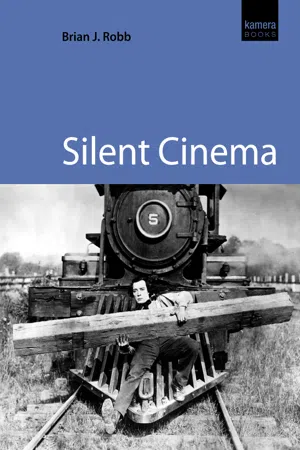
- 168 pages
- English
- ePUB (mobile friendly)
- Available on iOS & Android
eBook - ePub
Silent Cinema
About this book
Information
Subtopic
Film & VideoTHE SILENT CLASSICS
Le Voyage dans la lune/A Trip to the Moon (1902)
Directed by: George Méliès
Country: France
Cast: Georges Méliès, members of the Châtelet Ballet/Folies Bergère
One of the earliest science fiction films, Le Voyage dans la lune gave the world the iconic image of the moon (complete with face) with a giant rocket ship embedded in its left eye. Méliès’ loose version of the 1865 Jules Verne story From the Earth to the Moon (with elements from HG Wells’ then new First Men in the Moon, 1901) was the 400th film the inventive director had made. It cost him 10,000 Francs, a large investment, but Méliès had amassed enough experience by then to know that he’d make that back and more in distributing his film, before the inevitable pirate copies began circulating. The film charts the journey of a group of Victorian explorers on a joyride to the moon and is a whimsical narrative notable for its invention of a host of fascinating cinematic techniques, without which much of the history of cinema would not have been possible. Méliès developed the art of special effects through many of his films, including double exposures, performers (often himself) acting with themselves through split screens, and dissolves and fades. Méliès also pioneered film editing by linking individual reels together. The backgrounds were simple, painted theatrical flats. Méliès’ movie has all the elements of the modern science fiction blockbuster, from adventurous scientists, a trip through space, unbelievable special effects and life forms from faraway lands and planets.
The Birth of a Nation (1915)
Directed by: DW Griffith
Country: USA
Cast: Ralph Lewis, Lillian Gish, Elmer Clifton, Robert Harron, Miriam Cooper, Mae Marsh, Walter Long
Still controversial almost 100 years later, Griffith’s openly racist epic is a product of its time. Based on the 1905 play The Clansman, the film charts the creation of the USA and is regarded as perhaps the single most important American film in the development of cinema technique. While Griffith did not invent all the techniques on display in The Birth of a Nation, he did refine and develop ideas such as sequential and parallel editing, night photography, outdoor shooting, colour tinting, moving cameras, iris and fade-out effects, dissolves, panoramic shots and many more. This one film brought together many of the basics of cinematic technique that remains unchanged today. At three hours and an eventual cost of in excess of $100,000, this was the biggest film of its era. The controversy the film sparked in its portrayal of black Americans remains to this day, with its position at #44 on the American Film Institute’s Top 100 and controversial selection for the US National Film Registry in the mid-1990s. Despite the problems of its content, the film is still important as the foundation of modern cinematic style.
Intolerance (1916)
Directed by: DW Griffith
Country: USA
Cast: Lillian Gish, Robert Harron, Mae Marsh, Fred Turner
Often considered the single greatest film of the silent era, Griffith’s In tolerance avoids the political controversies of The Birth of a Nation and further develops that film’s cinematic techniques. Essentially a time-tripping soap opera, the film featured four different time periods, and the trials and tribulations of love and relationships. Buster Keaton’s Three Ages (1923) effectively spoofs Griffith’s masterpiece. Tackling the theme of social injustice through the ages, Intolerance began with a ‘contempo-rary’ 1914 sequence (about a wrongly convicted Catholic), before exploring conditions in AD27 (the story of Christ), AD1572 (the persecution of the Huguenots) and 539BC (the fall of Babylon). Griffith effectively introduces non-linear storytelling, jumping between parallel events in each time zone, with each individual story illuminating the overall themes of injustice, hypocrisy, hatred and persecution. Lillian Gish’s cradle rocking ‘everywoman’ links the sequences together.
The most expensive film of its time, with some estimates close to $2 million, Intolerance was a commercial flop, failing to captivate an audience unused to the intricate narrative that unfolded. The cost of the Babylonian sections became an early byword for Hollywood excess, as did Griffith’s insistence on full orchestral accompaniment wherever the film was screened. The seeming pacifism of the film was also out-of-step with audiences facing the carnage of World War I. Crane shots, epic crowd scenes and live animals all advanced filmmaking as Griffith further consolidated his claim to be the ‘inventor’ of cinema.
Broken Blossoms (1919)
Directed by: DW Griffith
Country: USA
Cast: Lillian Gish, Richard Barthelmess, Donald Crisp
Griffith once again directs Gish, this time as tragic Cockney waif Lucy Burrows. Gish delivers one of cinema’s most melodramatic performances, regarded as quaint today, but central to the style of cinema at the time. The film relates the story of a seemingly mystical, fragile romance in London’s foggy slums between a young, gentle, opium-addicted Chinese man (Barthelmess) and an illegitimate waif (Gish), who is abused and ultimately killed by her bigoted prize-fighting father (Crisp). Much smaller in scale and ambition than either The Birth of a Nation or Intolerance, in Broken Blossoms Griffith brought all his considerable cinematic technique to bear on a personal tragic story based around the relationships between three main characters. Adapted from Thomas Burke’s book Limehouse Nights, the film revolves around the performance by Gish that laid the foundation of much movie acting in the silent era. The controversial, soap opera subject matter drew audiences to Broken Blossoms just as the serious epic of Intolerance had put them off. Taking place almost entirely in just two small, contained interior sets, and shot in a simple soft-focus style (by cinematographer Henrick Sartov), this intimate drama was filmed over three weeks and on a modest budget, proving that Griffith was a master of more than just the overblown cinema epic.

Das Kabinett des Dr. Caligari
The Cabinet of Dr. Caligari (1920)
Directed by: Robert Wiene
Country: Germany
Cast: Friedrich Feher, Hans Heinrich, Werner Krauss, Conrad Veidt, Lil Dagover
Extremely influential on the developing genre of 1930s’ horror cinema (particularly the Universal cycle of monster movies), the German expressionist classic The Cabinet of Dr. Caligari also had long-lasting influence on the post-World War II genre of film noir. A young man, Francis, recounts a tale of murder in which the death of his friend Alan is predicted by hypnotised sleepwalker Cesare, part of Dr. Caligari’s travelling fair. Is Caligari controlling Cesare and having him commit murder? The twist at the end of the film, revealing that the narrator, Francis, in whom the audience has put its faith, is in fact unreliable (he is a patient in Dr. Caligari’s asylum), was brand new at the time and incredibly influential. Owing something to Paul Wegener’s The Student of Prague (1913), Caligari brought dreamlike expressionist style to the screen in its extreme sets which loomed above the characters at all angles. The film originally had intertitles shot in an angular style consistent with the film’s bizarre sets. The subjective perception of the film’s unreliable narrator is reflected in the uncanny appearance of the world in which the film takes place. Nothing, from the acting to the make-up, escapes the expressionist touch. The possible poetry of silent cinema was revealed by the dream world of The Cabinet of Dr. Caligari.
Der Golem, wie er in die Welt kam
The Golem (How He Came into the World) (1920)
Directed by: Paul Wegener
Country: Germany
Cast: Paul Wegener, Albert Steinruck, Lyda Salmonova
Der Golem is possibly the first great monster movie. This was actually the third time director-star Paul Wegener had played the title creature, his earlier efforts (now lost) being rough drafts for his final, more elaborate drama based upon the original Jewish legend. His first version (Der Golem, 1914) was a contemporary-set tale in which an antique dealer revives the 400-year-old creature. The second (The Golem and the Dancer, 1917) was a comedy in which a man (Wegener), after seeing the 1914 Der Golem in a cinema, dresses up as the creature to frighten a dancer (Salmanova) in what may be the horror genre’s first ironic sequel. The final 1920 version is a prequel, and tells the origins of the Golem. When the Emperor decrees that the Jews of medieval Prague should be evicted from the ghetto, mystical Rabbi Loew creates a clay giant and summons the demon Astaroth who animates the Golem. Intended as a protector, the golem’s purpose is twisted and the ‘monster’ terrorises the guilty and innocent alike, until a little girl ingenuously ends his reign of fear. Wegener’s golem is an impressive creation, a pre-Frankenstein (1930) lumbering creature with simple intentions. While modern audiences may regard the Golem creature as more comical than frightening, the film remains an unusual cinematic retelling of a folk story.
The Kid (1921)
Directed by: Charles Chaplin
Country: USA
Cast: Charlie Chaplin, Jackie Coogan, Edna Purviance, Albert Austin
Chaplin’s little tramp inherits an abandoned baby (‘misplaced’ by unwed mother Purviance) that he reluctantly commits to looking after. Five years on, the kid and the tramp have formed a criminal partnership, relying on each other to survive in a...
Table of contents
- Cover
- Title Page
- Table of Contents
- SILENT CINEMA: AN INTRODUCTION
- THE ORIGINS OF CINEMA
- THE DEVELOPING ART
- GEORGES MÉLIÈS: INNOVATOR AND ENTERTAINER
- THE DIRECTORS
- THE DRAMATIC STARS
- THE SILENT CLOWNS
- SILENT SCANDALS
- INTERNATIONAL SILENT CINEMA
- THE SILENT CLASSICS
- THE COMING OF SOUND
- SILENT CINEMA RESOURCES
- NOTES
- Pocket Essentials by this author
- Copyright
- Advertisement
Trusted by 375,005 students
Access to over 1.5 million titles for a fair monthly price.
Study more efficiently using our study tools.
Frequently asked questions
Yes, you can cancel anytime from the Subscription tab in your account settings on the Perlego website. Your subscription will stay active until the end of your current billing period. Learn how to cancel your subscription
No, books cannot be downloaded as external files, such as PDFs, for use outside of Perlego. However, you can download books within the Perlego app for offline reading on mobile or tablet. Learn how to download books offline
Perlego offers two plans: Essential and Complete
- Essential is ideal for learners and professionals who enjoy exploring a wide range of subjects. Access the Essential Library with 800,000+ trusted titles and best-sellers across business, personal growth, and the humanities. Includes unlimited reading time and Standard Read Aloud voice.
- Complete: Perfect for advanced learners and researchers needing full, unrestricted access. Unlock 1.5M+ books across hundreds of subjects, including academic and specialized titles. The Complete Plan also includes advanced features like Premium Read Aloud and Research Assistant.
We are an online textbook subscription service, where you can get access to an entire online library for less than the price of a single book per month. With over 1.5 million books across 990+ topics, we’ve got you covered! Learn about our mission
Look out for the read-aloud symbol on your next book to see if you can listen to it. The read-aloud tool reads text aloud for you, highlighting the text as it is being read. You can pause it, speed it up and slow it down. Learn more about Read Aloud
Yes! You can use the Perlego app on both iOS and Android devices to read anytime, anywhere — even offline. Perfect for commutes or when you’re on the go.
Please note we cannot support devices running on iOS 13 and Android 7 or earlier. Learn more about using the app
Please note we cannot support devices running on iOS 13 and Android 7 or earlier. Learn more about using the app
Yes, you can access Silent Cinema by Brian J. Robb in PDF and/or ePUB format, as well as other popular books in Media & Performing Arts & Film & Video. We have over 1.5 million books available in our catalogue for you to explore.