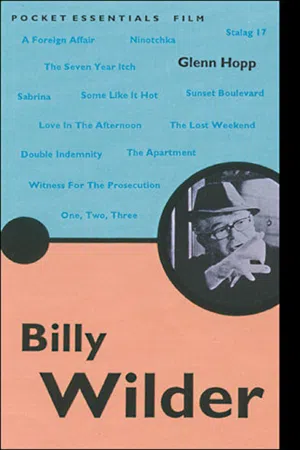
“It’s Not Necessary For A Director To Know How To Write; However, It Helps If He Knows How To Read”
Wilder’s directing career grew out of his desire to see on screen the script that he and Charles Brackett had written. This early period proved to be one of the richest of his career. The films also reveal an attentive directorial eye. In 1945, Wilder served in the psychological warfare division of the American military; he used existing footage to supervise and edit the war department’s information film, Death Mills, about the horrors of the concentration camps.
The Major And The Minor (1942)
Director: Billy Wilder
Writers: Charles Brackett & Billy Wilder, from the play Connie Goes Home by Edward Childs Carpenter, and a story by Fannie Kilbourne
Cast: Ginger Rogers (Susan Applegate), Ray Milland (Major Philip Kirby), Rita Johnson (Pamela), Diana Lynn (Lucy), Robert Benchley (Mr Osborne), Lela Rogers (Mrs Applegate), 101 minutes
Story: Susan Applegate has had twenty-five jobs during her year in New York. She quits working for a hair-care company after making an evening call on a Mr Osborne, a long-standing customer who clearly expects more than a scalp massage from his visitor. Susan has kept train fare for her return home to Stevenson, Iowa, but ticket prices have gone up. In her penniless desperation, she disguises herself as a twelve-year old to qualify for a child’s fare. Two conductors suspect her ruse, and she runs into a stateroom to avoid being put off the train.
The stateroom belongs to Major Philip Kirby, the instructor at a boys’ military school. Kirby’s bad eye disqualifies him for active duty. The next morning Kirby’s fiancée, Pamela, boards the train early and finds Susan still in the major’s compartment. Kirby persuades Sue-Sue, as he calls Susan, to accompany him to his school to explain the appearance of a woman in his stateroom. Pamela and the faculty, seeing Susan in her little-girl outfit, accept the explanation, but Pamela’s street-smart younger sister Lucy immediately sees through Susan’s disguise. Lucy and Susan become friends since neither has much use for Pamela: Susan herself is attracted to Kirby, and Lucy resents the way Pamela has connived to keep Kirby inactive for military service. Lucy, who plans to be a scientist, infuriates her sister by using Pamela’s crystal wedding bowl to house a tadpole. The girls outsmart Pamela and obtain for Kirby his commission. At a school dance, one of the cadets’ fathers turns out to be Mr Osborne, the man with the dry scalp from New York. He reveals Susan to Pamela, who uses her knowledge to blackmail Susan into leaving the school.
Back in Stevenson, Susan’s mother gets a call from Kirby. He has been transferred to active duty and will stop by on his way to San Diego. Susan decides to welcome him disguised as her mother. Kirby reports that Pamela wed someone else and that his train will later stop at Las Vegas, where couples can get married in five minutes. After sending him off to the depot, Susan meets him there, dressed as herself.
Subtext: In its overall structure, the film plays coyly with a subtext of paedophilia, but in its development this Lolita theme is not really exploited. Kirby always treats Sue-Sue with exaggerated avuncular politeness, and his deeper attraction to her seems to occur without his entirely realizing it. The best scenes nevertheless work on more than one level and generate a comic tension through Susan’s pleasant discomfort over recognizing, along with the audience, that Kirby desires her. The well-done final scene resolves this courtship-in-the-making without ever really spelling out for Kirby quite what has gone on.
Background: Wilder wanted to make the most popular movie he could to calm front-office fears that he would flop as a novice director by undertaking some overly ambitious drama. He made a good choice, perhaps desiring to continue the playful tone of Ball Of Fire. The trailer for this film announced it as ‘a bedtime story for grown-up children.’ Ginger Rogers’ mother in the film is played by her real-life mother. The film was remade as a Dean Martin and Jerry Lewis vehicle (with Jerry in the Ginger Rogers part), You’re Never Too Young (1955). Diana Lynn also appeared in that film.
The Script: This may be the only romantic comedy that ends with a ‘meet cute.’ In the final scene at the depot, Brackett and Wilder wisely avoid the expected, ‘on the nose’ approach. The audience has been wondering how Kirby and Susan will handle the obligatory ‘It was you all along’ scene. The writers solve the problem by simply making the scene non-obligatory. Susan, who has fooled Kirby by disguising herself both as Sue-Sue and as her own mother, now greets him as herself. She frankly tells him that she is headed to Las Vegas to marry a soldier and then kisses him by using the same make-out ruse that the cadets had earlier tried on her.
The comedy of confused identities in the train compartment anticipates the later scene in the upper berth between Jack Lemmon and Marilyn Monroe in Some Like It Hot. Brackett and Wilder pepper the script with some clever in-jokes: playful references to Greta Garbo and Veronica Lake, a swipe at Charles Boyer.
The Wilder Mensch: The smart, no-nonsense Lucy keeps the cuteness of the film from becoming cloying. She teaches Susan the 23 musts and 24 must-nots of life at the military school. She keeps Susan in cigarettes, which Susan playfully lights from Lucy’s Bunsen burner. Most important, Lucy tells Susan about Pamela’s plot to keep Kirby from active duty. The girls commandeer the switchboard and place a long-distance call to Washington to negate Pamela’s scheme. (This scene, in which Ginger Rogers coaxes the cadet on switchboard duty away from his post with a fetching tap-dance, is one of the film’s highlights.) The most directly honest line in the script is Lucy’s confession to Susan that she is more her sister than Pamela ever was.
Meaningful Objects: When Major Kirby arrives at Susan’s home in Iowa he brings a present from Lucy—a jar with the frog that Lucy’s tadpole has finally become. Kirby will soon find when he gets to the train station that Sue-Sue has similarly transformed herself, Gigi-like, into a fully grown woman. Moths and butterflies, tadpoles and frogs underline the film’s comic theme of transformation.
The Visual Element: Wilder’s first solo effort at directing looks very assured. The brief montage of Ginger Rogers in the ladies’ lounge adapting the contents of her suitcase into little girl’s attire may be unneeded, however. Later, in Some Like It Hot, Wilder cuts directly from Jack Lemmon and Tony Curtis deciding to disguise themselves as women to a shot of them in drag walking to their train. The audience simply accepts that they somehow solved all the problems in creating the disguise.
When Sue-Sue first enters the mess hall, Wilder italicizes the moment with a nicely done tracking shot of lines of cadets turning their heads to notice her. A similar moment occurs later when Miss Shackleford brings the girls from her school to the cadets’ dance. One of the cadets tells Sue-Sue about the epidemic at Miss Shackleford’s school. All of the girls, including their headmistress, have come down with Veronica Lake symptoms. Sue-Sue looks in puzzlement at the long perspective of girls waiting to dance and sees that they all have the peekaboo hair style of the famous Forties star.
Perhaps the subtlest visual touch comes when Susan returns to Stevenson, Iowa. She sits on the front porch with her home-town beau. Wilder pans to a close-up of the porch light with moths fluttering around it, and then cuts to a shot of a serene Susan watching them. Wordlessly, this sequence permits us to read her mind and know that she is recalling the analogy of moths and light bulbs Major Kirby used to caution Sue-Sue about the cadets’ attraction to her. It was the first time Kirby revealed his own awareness of her appeal. With these two shots we see that Susan’s mind and heart are still back at the school with Kirby.
The Verdict: The early scenes buying the train ticket and eluding the conductors may slow the pace somewhat, but everything else works beautifully. 4/5
Five Graves To Cairo (1943)
Director: Billy Wilder
Writers: Charles Brackett & Billy Wilder, from the play Hotel Imperial by Lajos Biro
Cast: Franchot Tone (Bramble), Anne Baxter (Mouche), Akim Tamiroff (Farid), Erich von Stroheim (Rommel), Peter Van Eyck (Schwegler), Fortunio Bonanova (Sebastiano), Miles Mander (Colonel Fitzhume), 97 minutes
Story: A tank of corpses rolls across the desert of North Africa. One near-dead British soldier tumbles out of the tank turret and onto the sand. He staggers to Sidi Halfaya, an evacuated village, and to the Empress Of Britain hotel. He is only minutes ahead of the advancing Germans, who have routed the British Eighth Army at Tobruk. This soldier, J J Bramble, is tended to by the Egyptian hotel manager Farid and the French chambermaid Mouche. Before the famous Desert Fox Rommel arrives, his advance troops, led by Lieutenant Schwegler, prepare the way. Coldly efficient, Schwegler confirms details about Farid and Mouche by consulting a small notebook. Farid and Mouche marvel at his knowledge about them. Meanwhile, Bramble dresses himself upstairs in the clothes of Davos, the hotel’s club-footed waiter recently killed in an air raid.
When Rommel arrives, Bramble sees from his treatment that Davos was really a German spy supplying the advance information about Farid and Mouche to the Nazis. A group of captured British officers is brought in. Rommel can’t resist giving them the chance at dinner to question him about his brilliance in maintaining his supply lines. He tells them that the secret is not in bringing supplies to the men but in taking the men to the supplies. He refuses, however, to reveal the location of the German provisions and ammunition buried in the Egyptian desert; later Bramble stares at Rom-mel’s map of Egypt trying to discern their location. With a tip from Farid, Bramble suddenly realizes the clever positions of the ‘fi...