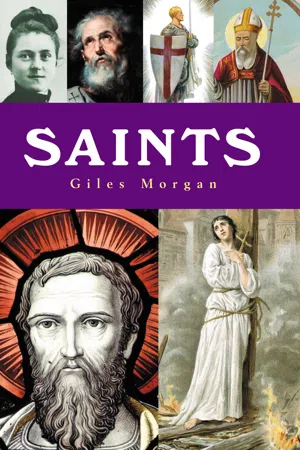
For millions of people saints provide comfort, hope and inspiration and act as intercessors to God. But whilst the earliest saints and martyrs served an essentially spiritual role within society their impact and influence can also be found today throughout the modern secular world. The term saint comes from the Latin word 'sanctus' meaning Holy. Many of the first saints were Christian martyrs who died for their faith. The original meaning of the accolade of martyr was 'witness'.
The earliest recorded account of the veneration of a Christian martyr relates to St Polycarp who died for his faith in 156 AD. The surviving text recounts that his fellow Christians gathered his bones or 'relics' together and placed them at a site where they could be re-visited on the anniversary of his death.
Initially, Christians prayed for their holy martyrs in memory of their sacrifices but over time began to regard them as intercessors between themselves and God. The sites of their burials became shrines for pilgrims to visit and their feast day's important events. However, it has been observed that many of the aspects of the cults of different saints can be found in pre-Christian traditions. In the ancient Greek world the concept of a patron or localised god or goddess was commonplace. For example the city of Athens was said to be under the protection of Athena whilst the matron goddess of Byzantium was Artemis.
During the Middle Ages the veneration of saints reached an apogee reflected in the popularity of the Golden Legend a written account of the lives of the saints compiled by Jacobus de Voragine. But where in the past individuals had become saints through the popular acclamation of the local community during the middle ages the Holy See itself would take sole responsibility for according that status. Pope Innocent III is now viewed as having established the right of the papacy to canonise individuals.
A study of the lives and values of those individuals who have been accorded the status of saints often reveals wildly differing world-views and philosophical outlooks on the part of those who revere them as such.
In an unexpected and fascinating turn of events slaves in the new world combined elements of their own traditions and spiritual beliefs with the European veneration of saints to produce a unique religious hybrid known as Santeria, a form of Voodoo practised in Cuba. More recently dramatic world events have led to the creation of modern saints such as the Martyrs of the Spanish Civil War and the recognition of the martyrdom of the Romanov family by the Russian church.
The stories of the lives of the saints and the different aspects of their cults underpin many of the fundamental concepts of the modern world. From the little known Christian figure that gave his name to St Valentine's Day to the mysterious St Nicholas or Santa Claus, saints continue to be invoked in the most commercial and arguably spiritually sterile of settings. Saints continue to serve as patrons of countries, professions, and occupations and provide help with medical, personal and spiritual problems. The differing roles of saints ranges from the surprising such as the archangel Gabriel being patron saint of broadcasters to the bizarre with St Quentin serving as the patron saint of Locksmiths.