- 260 pages
- English
- ePUB (mobile friendly)
- Available on iOS & Android
eBook - ePub
About this book
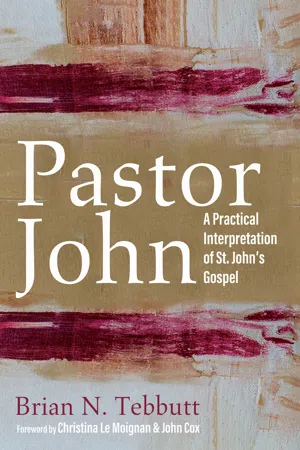
Puzzled by John? This exciting book illuminates the Gospel in a completely fresh way. Reading and working with it will deepen fellowship and skill in pastoral care. The text is mined for gems of insight into ourselves, and as a rich resource of ample illustrative material for preachers and teachers. Poetry, prose, and hymn references abound.
Pastor John elucidates the first four chapters of John's Gospel, presenting new insights into the text in a way that involves us in the story. When we read, we come nearer to Jesus, who is always with us anyway! A guide is provided for understanding ourselves, experienced by sharing with each other. Precise guidance is given for workshops, where all contribute something of themselves in the light of the text.
This experience of John's Gospel is illuminated using the latest way of reading the text. What the story means is conveyed in detailed Bible study. It becomes real for us, and this reality is explored by understanding the process of reading and observing our reactions to the text. John's Christ becomes central to who we are.
Information
Topic
Theology & ReligionSubtopic
Biblical CommentaryIntroduction 1
What Language Shall I Borrow?1
May we study you and study ourselves, we pray.
This is a book with a practical pastoral approach based on a fresh study of St. John’s Gospel. St. John’s Gospel is like an art gallery. Each chapter is like a room that gives a new vision of an answer to the question, “How does Jesus give himself to us?” Each chapter is journeyed through from a narrative-critical and reader-response point of view, defined below. Of course, I try to honor all Johannine scholarship. The emphasis here is that part of the message of John is devoted to pastoral theology and to an answer to that key question. Side by side with this, and step by step through the Gospel, connections are made to the deep pastoral care of persons, and an understanding of human personality development. In particular, I shall be using a developed model deriving from Clinical Theology and the work of psychiatrist Dr. Frank Lake. Alignments with John are made in sequence, with particular insights based on a psychodynamic approach into the pain and distress that often grows in us. Models of understanding from pastoral counseling, psychotherapy, and literature are brought to bear as a spur to our own awareness and ministry to others. Bringing together text and therapeutic applications in this way puts us in touch with, and enables us to sense, how it is that Jesus Christ can enter and bring healing and peace, the abundant life that consists of abiding in him.
1. The Beginning
Many threads have woven the tapestry of this book over a long period of time. I was privileged to go on a Mid-Service Clergy Training Course at St. George’s, Windsor Castle, UK, in January 1974. My field of interest and experience was group work. I tried to write up a paper on it, especially on the value and effectiveness of group work that is pastorally informed, both in the core and on the edge of church life. The course arranged for small groups to meet for reflection. The tutor presence in the group I was in was Canon Stephen Verney (as he then was). He was sometimes not there, though never an absence, for he was always in our mind in that he was caring for his first wife, who was in hospital dying of cancer. I happened to be the leader on a day when he returned from hospital. We were put in touch with what we suffer when we and our loved ones are ill, and especially of what the ravages of terminal illness mean, and of how distressing many interventions are, both to patient and relative. We were put in touch with the extremity of human suffering and existential threat. We tried to listen and empathize and be not quite inadequate, to be a presence for him out of our own half/mid maturity of ministry.
Indebted to him for his courage, faithfulness, and sensitivity, for the way his ministry and personal journey had a shared integrity, and impressed by the openness of his approach to and passionate conviction about ministry, I suggested him as the person to take the meditations or sermons in the Holy Communion services of the annual Clinical Theology Association Conference in 1974 or 1975. He led four meditations on John, though that is too quiescent a word—four stimuli, stirrings, connectings, provocations (in the narrow sense), expositions—with passion: John 2:1–11; 4:4–26; 8:56—9:10; 15:1–17. The theme was the new consciousness that comes to us with Christ. Something of his own vitality cum pain made the great Johannine words our own—water, life, truth, worship, seeing, abiding, believing. He was representing the truth we were looking for. It was fresh. I was hooked on St. John. Here, text and human personality and faith could run together. These talks were a foundation for his later book in 1985, Water into Wine: An Introduction to John’s Gospel. I thank him for the beginning!
I was inspired to start preaching seriously on St. John’s Gospel! I began my long series in January 1977. There are now more than fifty sermons in it and it is still being added to over forty years later! There is no point at which the text is exhausted. It renews itself and me all the time. I have hopes for its effects on the hearers. The main thrust was to make it come alive in a fresh way for my congregations.
This was meant to happen in two ways. I tried, and am still trying, to relate the content of the message about Christ to personal life. The conviction (and the experience for self and others) is that all that is within us, our interior being, must hear the Gospel. Sadly, so many sermons do not speak to what is actually happening inside us, or in our lives. It is meant to happen for us by allowing a fresh response to the text, free of some of the old traditional issues. The question is, for instance, not so much “Did it happen?” or “What does it (objectively) mean?” as “What is the impact of this narrative on me and how does it touch me?” Later, when the language developed, I discovered this approach was called narrative and reader-response criticism!
Then in 1980 my daughter started her A Level religious education course on St. John’s Gospel! As we swapped testing quotes and questions across the family table, I learnt by heart, for the first time, the content of every chapter and the sequence of every episode and discourse. That was in my development a huge step forward. It is always hard to remember what is in the Gospels, in which one, and in which place! My appreciation grew of the sheer brilliance of the Gospel we have to which we give the name John. The long journey started in earnest to understand how it came to be and what it was saying and how it was saying it, and what it means to us now. That fascination remains. It “remains enigmatic and fascinating.”2
2. Reading John
2a. Some Parameters I Am Using
Some parameters need to be made clear. I am using “John” for the end product, and also for the writer whose writing has notionally completed itself in the final product we now work with. We must, we can, “let John be John.” The narrative-critical approach burst on the scene from literary theory with Alan Culpepper’s Anatomy of the Fourth Gospel: A Study in Literary Design in 1983. The dominance of historical-critical scholarship gave way to a style of looking at texts as literature, “that is as forms of communication that affect those who receive or experience them . . . narrative criticism treats these same texts as mirrors that invite audience participation in the creation of meaning . . . texts shape the way readers understand themselves and their own present circumstances.”3 We are in touch with “The world barely in front of the text.”4 The text’s purpose is to lead “readers...
Table of contents
- Title Page
- Foreword
- Foreword
- Preface
- Acknowledgements
- Abbreviations
- Introduction 1
- Introduction 2
- John 1
- John 2
- John 3
- John 4
- Bibliography
Trusted by 375,005 students
Access to over 1.5 million titles for a fair monthly price.
Study more efficiently using our study tools.
Frequently asked questions
Yes, you can cancel anytime from the Subscription tab in your account settings on the Perlego website. Your subscription will stay active until the end of your current billing period. Learn how to cancel your subscription
No, books cannot be downloaded as external files, such as PDFs, for use outside of Perlego. However, you can download books within the Perlego app for offline reading on mobile or tablet. Learn how to download books offline
Perlego offers two plans: Essential and Complete
- Essential is ideal for learners and professionals who enjoy exploring a wide range of subjects. Access the Essential Library with 800,000+ trusted titles and best-sellers across business, personal growth, and the humanities. Includes unlimited reading time and Standard Read Aloud voice.
- Complete: Perfect for advanced learners and researchers needing full, unrestricted access. Unlock 1.5M+ books across hundreds of subjects, including academic and specialized titles. The Complete Plan also includes advanced features like Premium Read Aloud and Research Assistant.
We are an online textbook subscription service, where you can get access to an entire online library for less than the price of a single book per month. With over 1.5 million books across 990+ topics, we’ve got you covered! Learn about our mission
Look out for the read-aloud symbol on your next book to see if you can listen to it. The read-aloud tool reads text aloud for you, highlighting the text as it is being read. You can pause it, speed it up and slow it down. Learn more about Read Aloud
Yes! You can use the Perlego app on both iOS and Android devices to read anytime, anywhere — even offline. Perfect for commutes or when you’re on the go.
Please note we cannot support devices running on iOS 13 and Android 7 or earlier. Learn more about using the app
Please note we cannot support devices running on iOS 13 and Android 7 or earlier. Learn more about using the app
Yes, you can access Pastor John by Brian N. Tebbutt in PDF and/or ePUB format, as well as other popular books in Theology & Religion & Biblical Commentary. We have over 1.5 million books available in our catalogue for you to explore.