eBook - ePub
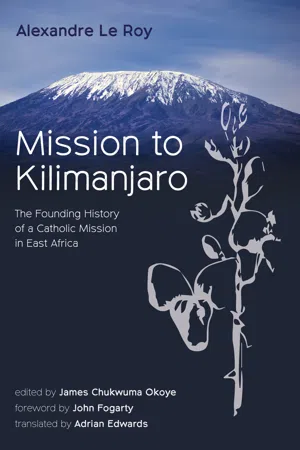
Mission to Kilimanjaro
The Founding History of a Catholic Mission in East Africa
- 272 pages
- English
- ePUB (mobile friendly)
- Available on iOS & Android
eBook - ePub
Mission to Kilimanjaro
The Founding History of a Catholic Mission in East Africa
About this book
Archbishop Alexandre Le Roy was among the founders of the Catholic faith in Zanzibar and Tanzania. He became the fifteenth superior general of the missionary Congregation of the Holy Spirit (1896-1926). Not only was he fluent in Swahili, he was also a botanist and an anthropologist, as evidenced by the thick descriptions of the flora and fauna and the language, culture, and religion of the peoples he encountered. He has written a fascinating account of the beginnings of the faith in that part of the world, clearly delineating, in many cases, qualities disposing to faith and practices that hindered it. This competent account of African society, politics, and religion before the advent of Western civilization is a classic, invaluable for students of mission and African history, culture, and religion.
Information
Topic
Theology & ReligionSubtopic
Christian DenominationsPART ONE
From Zanzibar to Kilimanjaro
Chapter 1: Etymology,
Discovery, Exploration
Its Scientific, Political,
and Religious Importance.
Taking the Road.
and Religious Importance.
Taking the Road.

The Arabs and the Swahili of the east coast of Africa, followed by European travelers and geographers, have given the name Kilima-Ndjaro to an isolated massif of volcanic origin which is situated a little below the third degree of south latitude, about 280 kilometers in a straight line from the coast. For a long time, people have been asking, and in fact they are still asking, the meaning of these two words, or rather of the second word, since the first, Kilima, means “mountain” in Swahili and in several languages of the East African hinterland. But nobody seems to know the meaning of the second word, Ndaro or Njaro. However, in order not to seem ill-informed, which would have been a pity, the recognized travelers have quickly produced a meaning. Here is what Mr. Joseph Thomson, who passed by the mountain in 1883 had to say:
The name, Kilimanjaro, means, it is generally said, “the Great Mountain”; but it seems to me that its meaning really is “the White Mountain,” the term Njaro having been formerly used to indicate whiteness. This meaning has become out of date on the coast, but it can still be found among some tribes in the hinterland.
In fact, on the coast, this usage is so out of date that nobody recalls it, not even among the bearded elders. And as regards the hinterland tribes, who are supposed to know it still, let me be blunt and say that Mr. Thomson would have his work cut out to find them. Mr. H. H. Johnston stated his view in 1886: “This word comes from Kilima, ‘mountain’ and Njaro, the name of a demon, who is thought to cause the cold weather.” With all due respect, this is surely a case of etymology by auto-suggestion.
In reality, the name Kilimanjaro is absolutely unknown to the Wachagga or the Chagga who live upon the mountain. For them there is no general name for the mountain as a whole. Each inhabited area has its own special name. The vast forest that forms a ring round the mountain is called Msitu, “dark wood.” The highest peak is called Kibo, “the white,” and the other peak is called Mawenzi, “the companion mountain.” The Maasai say in their own language, Oi Doinyo Oebor, “The White Mountain.” As to this word Njaro, which Thomson thinks means “something white,” and which Johnston takes for “a demon,” we had it in mind to make a serious study of its meaning when, it so happened, at Taveta, that we were taking a walk with some local children. One of them asked us if we had to stay a long time at Kilimanjaro. I replied, “What are you saying? Kilima-Njaro?” He answered, “Yes.” “But what does that mean, Njaro?” “Njaro, Njaro, in the Maasai language, and for that matter in our own, it is ‘water.’ And that big mountain over there is called ‘the mountain of water’ because all the rivers here and everywhere come from there.” We concluded that this must be the real meaning. At Taveta, which one can say is at the foot of the famous mountain, traders up from the coast would have heard Kilima-Njaro (in the Mombasa dialect of Swahili) and Kilima-Ngaro (in the Pangani dialect). British travelers have written Njaro, using “j” for “dj.” The Germans, not wishing to have to say “Ngaro,” find themselves obliged to write “Ndscharo.” In our opinion, French geographers, who wish to follow the correct coastal pronunciation, should not follow the Germans.
The Portuguese, established at Mombasa from 1507, seem to have had some idea of the existence of this massif, and H. H. Johnston cites a navigator of that period, Enciso, who wrote:
To the west of the harbor of Mombasa, there is Ethiopia’s Mount Olympus, which is very high and beyond which there rise the Mountains of the Moon, where the sources of the Nile are. In all this country, there is a lot of gold and a great number of wild beasts. The population eats locusts.
The old sailor has got a lot of things right in this short passage. Certainly, till now, nobody has seen a lot of gold come from this country; but also, if Kilimanjaro is the African Olympus, it is quite correct to say that, moving westward from the coast further inland one would find these high mountains from which the Nile flows, and which were rediscovered by Stanley. Everywhere in the hinterland, there are fierce animals. As to the locusts, the missionaries who have recently settled on Kilimanjaro know they exist since they have eaten all their corn.
But it was Mr. Rebmann, a German, who worked for the Church Missionary Society of London, who had the honor of having rediscovered Olympus in this century. His compatriot, the Rev. Dr. Krapf, working for the Church Missionary Society, had established a mission in the neighborhood of Mombasa. In 1847–48, Rebmann undertook a journey to the interior, accompanied by only eight porters and an umbrella. The direction he took was at first toward the Taita Mountains, then, on 11th May, he saw across a desert the superb summit of Kibo, covered with snow and shining, under the powerful equatorial sun, like a massive block of silver.
His discovery, subsequently reported to European savants, was very ill-received by them. The President of the Royal Geographical Society of London, Mr. Desborough Cooley, had just invented a very ingenious system for filling up the blank spaces in the map of Africa. Unfortunately, his system did not make any allowance for mountains, particularly snow-covered mountains, in the precise place where poor Mr. Rebmann had seen, and indeed climbed up, them. Mr. Cooley produced a seemingly convincing argument that the missionary had had an apocalyptic vision—very interesting from a psychiatrist’s point of view, but utterly unacceptable in a geographical handbook. Dr. Krapf attempted to come to the support of his friend by going to see the mountain himself, only to be treated in the same manner. And so these missionaries did not dare to raise their voices again to assert the existence of Kilimanjaro.
It was more than a decade later, in 1861, when a German traveler, Baron von der Decken, later killed by the Somalis at Bordera on the Juba River, had the idea of going to look for himself. He saw the mountain, unshaken by the anathemas of the men of science. He then came back the next year and went up it to a height of 3,500 meters. He and his fellow traveler, Kersten, carried out a detailed survey of the Kilimanjaro area, and produced a map which subsequent travelers have accepted as largely correct.
Finally, quite recently, another German traveler, Dr. Hans Meyer, and Mr. Putscheller, an Austrian mountaineer, have been able, with the necessary climbing apparatus, to reach the highest summit, namely, Kibo, whose height they estimate at 6,100 meters, the Mawenzi would have been 5,300 meters, and the plateau between them 4,400 meters.
It is easy to understand how, as soon as this astonishing massif was recognized as existing in reality and not as a missionary daydream, the scientific world was very interested, and the same London societies which had denied its existence wanted to cover up their error in sending a distinguished traveler, Mr. H. H. Johnston, to make an on-the-spot study. Mr. Cooley was unfortunately dead; it would have been a great joke to send him. Johnston, in a very interesting account of his expedition (not translated into French), indicates its significance from a scientific point of view. He writes:
Although the Kilimanjaro massif rises rather sharply from a wide-spreading plain, it would be difficult to describe it as isolated. In fact, it would be more correct to say that an almost unbroken succession of mountain chains and independent peaks link Kilimanjaro with Ethiopia to the north, Natal to the south, and perhaps even Cameroon to the west. Judging by the flora which cover its upper slopes, Kilimanjaro may be seen as a meeting place for a number of botanical species which characterize these three mountain zones, despite very great distances between them.
In the great height of Kilimanjaro and in the equatorial location of this snow-capped mountain—which factors result in an extraordinary variety of climatic factors active on its slopes—there seem to be sufficient causes to explain the birth or development of many surprising features of its fauna and flora. Similar conditions have only been found in Central and South America, for nowhere else do tropical mountains reach the level of permanent snow.
Moreover, the long mountain chains reported from little-known regions are extremely interesting for naturalists. The high mountains isolated from other peaks are rather like islands in a mighty ocean: they serve as last-resort homes to primitive types or local variations which, in larger more crowded spaces, would be caught up in a conflict for resources, and would disappear in the struggle for life. Alternatively, some zoological species or botanical variety, which was formerly present in a large area, finds itself, as the result of varying circumstances, confined to a particular mountain chain or a desert island. There it has shelter and protection in its own development against the dangers coming from the presence of competing species. This can enable it, free from threatening competition, to develop an exuberant range of individual members.
Another interesting aspect of the fauna and flora of these high mountains is that they often still possess elements of an earlier natural system which has been replaced in the lowlands by more recent arrivals for a long period. Thus the Kinabalu, the highest mountain in Borneo, still has on its highest slopes a range of plants related to those of Australia, while on the surrounding plain the vegetation is of Indian origin. In the Alps, one finds butterflies from the arctic fringe of Europe. In the mountains of Ethiopia, there are families and species of animals and plants which belong to countries with temperate climates to the north and south, from Europe to the Cape of Good Hope. The question of how the fauna and flora of Kilimanjaro relate to those of other geographical regions is a very interesting one, and, when it has been solved, it will help us to resolve a number of puzzles concerning the geographical distribution of living organisms.1
Kilimanjaro has therefore considerable scientific interest, but it is still more a cause of interest from the political aspect. As soon as the question of the partition of East Africa was raised, contenders lined up as though it were a competition for climbing the greasy pole. The winner would be whoever laid their hands on the icy mountain. Those who were simply spectators of the changing fortunes of the coun...
Table of contents
- Title Page
- PART ONE
- PART TWO
- PART THREE
Trusted by 375,005 students
Access to over 1.5 million titles for a fair monthly price.
Study more efficiently using our study tools.
Frequently asked questions
Yes, you can cancel anytime from the Subscription tab in your account settings on the Perlego website. Your subscription will stay active until the end of your current billing period. Learn how to cancel your subscription
No, books cannot be downloaded as external files, such as PDFs, for use outside of Perlego. However, you can download books within the Perlego app for offline reading on mobile or tablet. Learn how to download books offline
Perlego offers two plans: Essential and Complete
- Essential is ideal for learners and professionals who enjoy exploring a wide range of subjects. Access the Essential Library with 800,000+ trusted titles and best-sellers across business, personal growth, and the humanities. Includes unlimited reading time and Standard Read Aloud voice.
- Complete: Perfect for advanced learners and researchers needing full, unrestricted access. Unlock 1.5M+ books across hundreds of subjects, including academic and specialized titles. The Complete Plan also includes advanced features like Premium Read Aloud and Research Assistant.
We are an online textbook subscription service, where you can get access to an entire online library for less than the price of a single book per month. With over 1.5 million books across 990+ topics, we’ve got you covered! Learn about our mission
Look out for the read-aloud symbol on your next book to see if you can listen to it. The read-aloud tool reads text aloud for you, highlighting the text as it is being read. You can pause it, speed it up and slow it down. Learn more about Read Aloud
Yes! You can use the Perlego app on both iOS and Android devices to read anytime, anywhere — even offline. Perfect for commutes or when you’re on the go.
Please note we cannot support devices running on iOS 13 and Android 7 or earlier. Learn more about using the app
Please note we cannot support devices running on iOS 13 and Android 7 or earlier. Learn more about using the app
Yes, you can access Mission to Kilimanjaro by Alexandre Le Roy, James Chukwuma Okoye, Adrian Edwards in PDF and/or ePUB format, as well as other popular books in Theology & Religion & Christian Denominations. We have over 1.5 million books available in our catalogue for you to explore.