- 332 pages
- English
- ePUB (mobile friendly)
- Available on iOS & Android
eBook - ePub
About this book
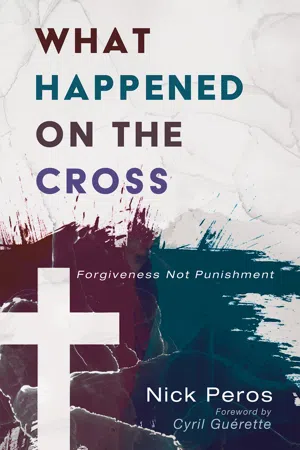
What Happened on the Cross offers a new and biblical understanding of how salvation was accomplished upon the cross, showing that the Penal Substitution view, common since the 1500s, does not have a biblical basis, and also showing that the Christus Victor understanding is inadequate. The book is founded upon the understanding that Jesus Christ is the Second Adam, and that is the foundation of how we are to understand how salvation was accomplished. Both the shedding of blood and death were essential in the accomplishment of salvation, and What Happened on the Cross shows why these were essential. Using over 740 Scripture verses to make its argument, the book gives a comprehensive picture from Genesis to Revelation of the many aspects involved in the accomplishment of salvation--above all showing clearly that the cross had nothing to do with "punishment for sins"--our sins were never punished upon the cross, rather, our sins were forgiven. Understanding how salvation was accomplished upon the cross, and that it was about forgiveness, not punishment, both exalts God and his greatness, demonstrates his perfect love and justice, as well as liberates our hearts towards him.
Information
Topic
Theology & ReligionSubtopic
Christian TheologyPart I
The Beginning
1
Creation
In the beginning, God created the Heavens and the earth.
(Gen 1:1 NIV)
(Gen 1:1 NIV)
God is Creator
The Bible tells us God is the creator, he is the maker of all things, and nothing exists apart from him. The Bible tells us this creation happened “in the beginning.”
The Beginning
What is “the beginning?” The beginning is defined as the initial creation of time and space. Too often, we think of time and space as some sort of preexisting, eternal elements—but they are not. Until God created time and space, they did not exist. Time and space are in fact the physical fabric of creation, they are the canvas upon which the rest of creation was made. Time and space were created by God first, before he created anything else.
Time had a Beginning
Second Timothy 1:9 testifies to the fact that time had a beginning when it tells us: “. . . This grace was given us in Christ Jesus before the beginning of time” (NIV). We are told here that time had a “beginning.” We, as creatures of time and space, cannot comprehend the concept of the creation of time, nor do we even have the language to speak of such a thing since all of our language, as well as our nature, is completely subject to time. Yet, it remains true that time is as much a created thing as is the moon or a rock. When 2 Timothy 1:9 talks about “the beginning of time,” this is, in fact, the same “beginning” as outlined in Genesis 1:1. The creation of time is “the beginning.”
Time and Space: The Fabric of Creation
Existing hand in hand with time is space. Time and space are united elements, the one is inextricably tied in its nature to the other. Time is as much the nature of space as space is the nature of time, and together they act as the fabric of God’s creation.
The term “fabric of creation” means the physical foundation upon which all the rest of creation would be constructed. This concept of the fabric of creation, the foundation upon which all creation was to be laid, is affirmed throughout Scripture:
He stretches out the Heavens like a canopy, and spreads them out like a tent to live in (Isa 40:22 NIV).
The Lord wraps himself in light as with a garment; he stretches out the Heavens like a tent (Ps 104:2 NIV).
The Lord your Maker, who stretches out the Heavens and who lays the foundations of the earth (Isa 51:13 NIV).
In each of these verses, as well as in many others, God’s creative act is described as a “stretch[ing]” out of the heavens—these are the heavens of Genesis 1.1—with those heavens being spread out like a “tent” or a “canopy.” These are words and images of fabric and material. All the heavens exist only within and upon the foundation of time and space, so as God “stretches” out the heavens, and “spreads” them out like a tent, it is implicit that includes the foundational fabric upon which the heavens are laid, and that foundational fabric is the fabric of time and space.
The Fabric of Creation Created First
Since time and space are the foundational fabric of creation, they were created before the heavens and the earth that were to be laid upon that fabric, and therefore the creation of time and space constitutes the beginning. In Genesis 1:1, the “beginning” precedes the creation of the heavens and the earth. Since “the beginning” precedes the creation of the heavens and the earth, and since the creation of time and space constitutes “the beginning”, this again affirms that time and space was created first, and then, as stated in Genesis 1:1, the heavens and the earth were created next.
Time and space, as the foundational fabric of creation, are themselves wholly physical and, as such, define the physicality of God’s creation. All of God’s creation as created in Genesis 1.1, including all the heavens, is constructed upon the foundation of time and space and, as such, is therefore just as physical as is time and space. The entirety of God’s creation is a physical creation.
The Heavens
In Genesis 1:1, after the “beginning,” after the creation of time and space, God then created the heavens. Why is the word “heavens” plural? If we contrast Genesis 1:1 with Revelation 21:1, we see a slight difference:
In the beginning God created the heavens and the earth. (Gen 1:1 NIV)
Then I saw a new heaven and a new earth, for the first heaven and the first earth had passed away, and there was no longer any sea. (Rev 21:1 NIV)
In Genesis 1:1, God is described as creating the “heavens,” while Revelation 21:1 describes a new “heaven.” Why is “heavens” in Genesis 1:1 plural while in Revelation 21:1 it is not? What does this difference mean?
The Three Heavens
Genesis 1:1 is an account of the initial act of creation by God, while Revelation 21:1 is not. As a result, Genesis 1:1 is describing a different event than is Revelation 21:1, and the Genesis 1:1 description is a very specific and exact description of the initial creation.
In the Bible, the term “the heavens” is a collective term that refers to three types of heaven. From the perspective of standing on the earth, when we look up, we see the heavens as follows: First, we see the sky that surrounds the earth, which is defined as the first heaven. Second, when we look beyond the earthly sky, we see what we call outer space, where the sun, moon, stars, and galaxies reside, which is the second heaven. Beyond outer space is the place where God has established his throne within his creation, the place which we call Heaven (referred to here as “Heaven” to distinguish it from the other two heavens)—the Bible calls this, the place of God’s throne, the third heaven. As a result, the plural term “heavens” referenced in Genesis 1:1 encompasses all three types of heaven, and describes each of the three types of heaven as being created in “the beginning.”
The Third Heaven
The third heaven, the place where God has established his throne, which we commonly refer to simply as “Heaven,” is specifically referred to by Paul as the “third heaven” in 2 Corinthians 12:2, “I know a man in Christ who fourteen years ago was caught up to the third heaven” (NIV). The third heaven, referred to here by Paul, is the same heaven where God has established his throne. Paul’s use of the term “third heaven” affirms the Bible’s description of three different types of heaven—the earthly sky, outer space, and Heaven—with the three different types of heaven collectively referred to in Genesis 1:1 by the term “the heavens.” As a result, when Genesis 1:1 tells us God created the “heavens,” this plural term is referring to, and includes, all three aspects of that term: it includes the creation of Heaven, the place where God has established his throne within his creation, and which is the home of God’s holy angels; it includes what we call outer space, the place where the sun, moon, stars, and galaxies reside; and it includes the earthly sky, or the atmosphere around the earth. All of this is included in the term “heavens,” and it was all created in Genesis 1:1.
The Third Heaven—The Seat of God’s Throne
From the perspective of standing on Earth, when we look up at the sky, we see first the earthly sky, the first heaven, and then we see outer space, the second heaven, and then, from our perspective, the third heaven is beyond that. However, from God’s perspective, this order is reversed, and when Genesis 1:1 tells us God created the “heavens,” God ...
Table of contents
- Title Page
- Part I
- Part II
Trusted by 375,005 students
Access to over 1.5 million titles for a fair monthly price.
Study more efficiently using our study tools.
Frequently asked questions
Yes, you can cancel anytime from the Subscription tab in your account settings on the Perlego website. Your subscription will stay active until the end of your current billing period. Learn how to cancel your subscription
No, books cannot be downloaded as external files, such as PDFs, for use outside of Perlego. However, you can download books within the Perlego app for offline reading on mobile or tablet. Learn how to download books offline
We are an online textbook subscription service, where you can get access to an entire online library for less than the price of a single book per month. With over 1.5 million books across 990+ topics, we’ve got you covered! Learn about our mission
Look out for the read-aloud symbol on your next book to see if you can listen to it. The read-aloud tool reads text aloud for you, highlighting the text as it is being read. You can pause it, speed it up and slow it down. Learn more about Read Aloud
Yes! You can use the Perlego app on both iOS and Android devices to read anytime, anywhere — even offline. Perfect for commutes or when you’re on the go.
Please note we cannot support devices running on iOS 13 and Android 7 or earlier. Learn more about using the app
Please note we cannot support devices running on iOS 13 and Android 7 or earlier. Learn more about using the app
Yes, you can access What Happened on the Cross by Nick Peros in PDF and/or ePUB format, as well as other popular books in Theology & Religion & Christian Theology. We have over 1.5 million books available in our catalogue for you to explore.