eBook - ePub
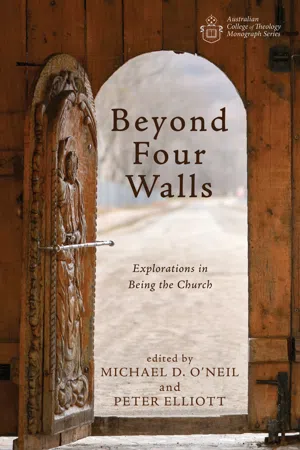
Beyond Four Walls
Explorations in Being the Church
- 260 pages
- English
- ePUB (mobile friendly)
- Available on iOS & Android
eBook - ePub
Beyond Four Walls
Explorations in Being the Church
About this book
The church today is in many places "on the nose." For many people, it stinks. It has passed its "use-by" date and should be relegated to the dustbins of history, and the sooner, the better. Nevertheless, the contributors to this volume believe that the church, in spite of its somewhat checkered history and its many present failures, remains an integral part of God's redemptive purposes being worked out in the world, and that God's call to the church is now what it has always been: to be the faithful people of God, bearing joy-filled witness to the resurrection of Jesus Christ in word, worship, and work, in its corporate life, and in the lives of each of its members. Each chapter in this book explores an aspect of what it means to be the church, both with respect to its own life, and with an eye to its presence and mission in the world.
Information
Topic
Theology & ReligionSubtopic
Christian Church1
Church as Gospel
You probably know that I am from Illinois in the United States, and so I want to introduce you to an Illinoisan expression. When we wonder in Illinois if something is credible and real, practicable and true, we ask “But will it play in Peoria?” If it plays in Peoria, an ordinary blue-collar community in Illinois, it will play everywhere. My claim today is that the proposal being made today about the gospel is the sort of thing that will play in Peoria. My two claims are these: As evangelicals, and even more broadly, we have misdefined the gospel. And second, the church—both the universal and the local—is the gospel. Both of these, of course, need nuances, and I shall proceed now to make my case for both.
The Gospel
An irony in the contemporary (American, at least) evangelical scene is that there’s a genuine battle for the gospel. It’s the one thing we ought to have figured out by now but it’s one of the elements of our faith that genuinely is being debated today. In broad strokes I think I can say there are two poles to this discussion in the US. On the left pole one finds people like Peter Gomes, the well-known preacher at Harvard’s Memorial Church, or Brian McLaren’s The Secret Message of Jesus which was then clarified sociopolitically in Everything Must Change.1 Keeping to a broad brush, the left pole is to one degree or another a social justice or liberation theology gospel, and in this framework the gospel means more or less justice. Justice, I fear, means what the French handed on to moderns: freedom, fellowship, and equality, and tied into them a sense of human rights. I banked on each of these in our trip from Chicago to Perth, and I value these elements of a Western sense of justice, and each of them in some ways flows directly from what the Bible says about justice, but the earliest Christian rock band, Peter, Paul, and Jesus, would simply not recognize this sense of justice as what they meant by “gospel.” These forms of justice may well be good for society today, but they simply aren’t what the word “gospel” means. The essence of liberalism is to colonize the Bible, theology, and the gospel into culture. This left pole is guilty of colonizing the gospel into Western values.
If the left understands the gospel as justice, the right considers it as justification. From John Piper, who asked if Jesus preached Paul’s gospel—and by that wondered if Jesus preached justification by faith alone, to Greg Gilbert’s new book What is the Gospel?, this group of pastors and theologians believe the gospel is justification by faith, and by this they mean justification as understood in the Reformation. Without a hint of reductionism, the essence of this gospel is double imputation and the necessity for the sinner to dig deeply into his or her own dark heart to see the glory of this truth in order truly to be saved or to have comprehended the gospel.2 Still, Gilbert’s book perfectly meshes with the standard understanding of the gospel that one hears in most forms of evangelism, from John Stott and Billy Graham, to Nicky Gumbel: God is creator, God is loving but holy, humans are made in God’s image but are sinners under God’s wrath, Jesus came to die so that wrath can be averted, and all one must do is to believe that message—faith alone—and so attain salvation to spend eternity with God. Gilbert’s approach is more nuanced, but he has four points: God (and love is minimized in his sketch), man as sinner, Christ, and faith. Yes, each of these elements is true and can be found in the Bible but Jesus, Peter, and Paul would not recognize that gospel as their gospel. In other words, I’m unconvinced either of these gospels will play in the Peoria of the New Testament. I am convinced they do play in modern Peorias because both are forms of colonizing the gospel to the agendas of our own culture. Those are strong claims and they will be supported in what follows.
Before I sketch how Jesus and the apostles understood the gospel, I want to make three brief points. The first is that many of us, and I include myself, came to Christ when someone preached that gospel as the gospel. So, whatever I have to say in what follows does not diminish that this gospel has worked, works, and will probably continue to work. Second, this word “works” deserves attention. The correlation of those who respond to that four- or five-step gospel and those who follow Christ as disciples is not high. David Kinnamon, who is now President of the Barna Research organization, showed me some numbers once wherein it was clear that about 90 percent of children who grow up in evangelical homes “make a decision for Christ” but only about 20 percent can be said to be “following Christ” when they are in their thirties. The research doesn’t show this, but does anyone doubt that the gospel those 90 percent heard was more or less the gospel we sketched above? The third point now will begin to scrape the chalkboard: the four-point approach in the standard evangelical gospel is our doctrine of salvation arranged into a compelling, convicting, guilt-producing, rhetorical bundle. What drives this gospel, though, has begun to change in the last decade or so, with a marked decline in the idea that God is the kind of judge who will send someone to suffer consciously in hell for all eternity if they don’t respond to the offer of the good news. What many of us grew up with then was a rhetorically effective bundling of the doctrine of salvation shaped to precipitate decisions that would relieve our deepest angst about God and our eternal state, and what drove that bundle was the threat of judgment and hell. Jesus, then, was sent to give us a chance to escape the wrath of God.
Again, I do not question any of the four points or anything I’ve said about salvation in the previous comments. I believe in God’s judgment, and I believe that Jesus saves us, and I believe that God loves us. But, and here’s the scraping part, this is not what Jesus, or Peter, or Paul meant when they used the word “gospel.” What, then, did they mean?
Leg One: 1 Corinthians 15
To answer this question, we have to ask how we are to answer this question. In good Protestant fashion we have to go to the Bible, and that means we are in search of a text that defines gospel, and happily we’ve got one: 1 Corinthians 15. But when we go to 1 Corinthians 15, something in the text immediately jumps up at us and says “Surprise, surprise!” Why? Because the one text that defines gospel in the entire New Testament tells us that the gospel is neither “justice” nor “justification.” Instead, it tells us that the gospel announces the resolution to a story. To be sure, that story saves, effecting both justification and justice, but what drives the gospel according to 1 Corinthians is neither the injustice of this world that needs to be set aright, nor our sins—Adamic and personal—that need to be forgiven. And neither does it suggest that the problem the gospel resolves is God’s wrath. What drives the justice gospel is social systems gone awry and what drives the justification gospel is personal rebellion leading to guilt, but what drives the apostolic gospel of 1 Corinthians 15 is something else.
I will make seven observations about the apostolic gospel, and I will then suggest that this fresh perspective on the gospel throws piercing light on church praxis and mission in our world today. Rerun: what played in the original Peoria of the New Testament will play as well in modern and postmodern Peorias. But it will require that we make some adjustments in our minds and praxis.
First, a historical claim: before there was a New Testament, before the apostles wrote letters, before the Gospels were written, there was the gospel. When it comes to the Christian faith, in the beginning was the gospel. The gospel created the church, and the Gospels. The gospel created the Epistles, and the gospel created the New Testament, and the canon.
Second, there is dispute about which verses of this text are the gospel. Some say only verses three to five refer to the gospel while others see it extending from verse three through to verse eight. But in light of what we will see of the gospel elsewhere in the New Testament, and all the way to th...
Table of contents
- Title page
- Contributors
- Introduction
- Chapter 1: Church as Gospel
- Chapter 2: Being God’s People Among the Nations
- Chapter 3: Jonah’s Wail
- Chapter 4: The Church as Family in the Teaching of Jesus, and Today
- Chapter 5: Leadership in Apostolic Perspective
- Chapter 6: The Pastor–Teacher and the Church
- Chapter 7: I Am A Woman
- Chapter 8: Living in God’s Mission
- Chapter 9: Trinitarian Apologetics
- Chapter 10: Romancing the Church
- Chapter 11: Cultural Exegesis
- Chapter 12: The Goldilocks Planet—When It’s Just Not Right
- Chapter 13: Atonement and Church
- Chapter 14: The Spirit—Beyond Christ?
- Chapter 15: Transcending Morality
Trusted by 375,005 students
Access to over 1.5 million titles for a fair monthly price.
Study more efficiently using our study tools.
Frequently asked questions
Yes, you can cancel anytime from the Subscription tab in your account settings on the Perlego website. Your subscription will stay active until the end of your current billing period. Learn how to cancel your subscription
No, books cannot be downloaded as external files, such as PDFs, for use outside of Perlego. However, you can download books within the Perlego app for offline reading on mobile or tablet. Learn how to download books offline
Perlego offers two plans: Essential and Complete
- Essential is ideal for learners and professionals who enjoy exploring a wide range of subjects. Access the Essential Library with 800,000+ trusted titles and best-sellers across business, personal growth, and the humanities. Includes unlimited reading time and Standard Read Aloud voice.
- Complete: Perfect for advanced learners and researchers needing full, unrestricted access. Unlock 1.5M+ books across hundreds of subjects, including academic and specialized titles. The Complete Plan also includes advanced features like Premium Read Aloud and Research Assistant.
We are an online textbook subscription service, where you can get access to an entire online library for less than the price of a single book per month. With over 1.5 million books across 990+ topics, we’ve got you covered! Learn about our mission
Look out for the read-aloud symbol on your next book to see if you can listen to it. The read-aloud tool reads text aloud for you, highlighting the text as it is being read. You can pause it, speed it up and slow it down. Learn more about Read Aloud
Yes! You can use the Perlego app on both iOS and Android devices to read anytime, anywhere — even offline. Perfect for commutes or when you’re on the go.
Please note we cannot support devices running on iOS 13 and Android 7 or earlier. Learn more about using the app
Please note we cannot support devices running on iOS 13 and Android 7 or earlier. Learn more about using the app
Yes, you can access Beyond Four Walls by Michael D. O'Neil, Michael D. O'Neil,Peter Elliott, Michael D. O'Neil, Peter Elliott in PDF and/or ePUB format, as well as other popular books in Theology & Religion & Christian Church. We have over 1.5 million books available in our catalogue for you to explore.