eBook - ePub
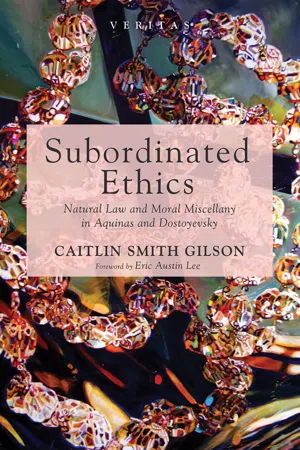
Subordinated Ethics
Natural Law and Moral Miscellany in Aquinas and Dostoyevsky
- 398 pages
- English
- ePUB (mobile friendly)
- Available on iOS & Android
eBook - ePub
About this book
With Dostoyevsky's Idiot and Aquinas' Dumb Ox as guides, this book seeks to recover the elemental mystery of the natural law, a law revealed only in wonder. If ethics is to guide us along the way, it must recover its subordination; description must precede prescription. If ethics is to invite us along the way, it cannot lead, either as politburo, or even as public orthodoxy. It cannot be smugly symbolic but must be by way of signage, of directionality, of the open realization that ethical meaning is en route, pointing the way because it is within the way, as only sign, not symbol, can point to the sacramental terminus. The courtesies of dogma and tradition are the road signs and guideposts along the longior via, not themselves the termini. We seek the dialogic heart of the natural law through two seemingly contradictory voices and approaches: St. Thomas Aquinas and his famous five ways, and Fyodor Dostoyevsky's holy idiot, Prince Myshkin. It is precisely the apparent miscellany of these selected voices that provide us with a connatural invitation into the natural law as subordinated, as descriptive guide, not as prescriptive leader.
Information
Topic
Theology & ReligionSubtopic
Christian Denominations2
New Beginnings: The Place of the Subordinated Ethics
Flood my soul with your spirit and life. Penetrate and possess my whole being so utterly that all my life may only be a radiance of Yours.99
Truly, I say to you, unless you turn and become like children, you will never enter the kingdom of heaven.100
How then do we invoke our access to that subordinated ethics when it appears to require a kind of death in order even to be seen? It requires a reversal of our stance as lover, of our way of envisioning the natural law as imposition, to become the beloved to see this incarnating law as liberation. As Saint Thomas knew and even Anselm suspected: no intermediated demonstration can illuminate the self-evidence of God. The divine’s effulgent self-evidence precedes demonstration in a non-discursive immediacy and/or follows upon it in a sort of “now I see what was always there to be seen” dawning moment. “My mind in the flash of a trembling glance came to absolute Being—That Which Is.”101 The disciples were witnesses not from their own eyes but through Christ’s eyes: Christ breathed on them and they were one in vision.102 If our originary praxis, this un-reflexive love, is the ground needed so that our secondary ethics has a foundation, then the teacher does not teach by disseminating material but by providing the step-back in order to encounter what precedes.103 And this is the deeper meaning both of maieutics and anamnesis: the true teacher is no propagandist in search of intellectual/political disciples but a disciple of truth. Ethics cannot lead, it must abide by its subordination to the Presence, living not as a failed attempt to liken itself to the intellect, but by in-failing—failing (and knowingly so) to catch up to the beauty and the terror of existence. But we do not, for the most part, live by that originary praxis, rather we hand over the will to the intellect in a way in which we also relinquish the unique temporal mode of the will; or we hand the intellect over to the will as self-absorbed ego seeking only its own vanity. And while the intellect must guide the will, it must guide it because the will is distinct and will not surrender its immemorial entrenchment to the gaze of the conceptual or to the emptied content of the futural.104
In order to see what only death can allow us to see, not with our own eyes which construct concepts and distance, we let the image lay bare. Here is one such image: there is a man, an elderly caretaker of the British cemetery in Corfu.105 The cemetery is not far from the seafront center of Corfu and a few steps from the Platia Theotoki or San Rocco square. One takes the same road to the prison as to the cemetery. This man’s father had taken care of the graves before him and his father before. He was well into his eighties but looked more childlike in expression. Work was hard but it was play. It was the same thing every day, tending nature which never relents, never lays down its shovel. Sun and rain, heat and dirt were always on schedule and only death regularly came, regardless of the seasons. The difficulty of years of hard labor did not undermine the fact that for this caretaker it was play, the serious and holy play which Plato knew.106 Play lived within and through the work, becoming indistinguishable from it, together making something more of his nature than merely “naturally supernatural”;107 he became so in union with nature that to others he exceeded nature, he appeared a survivor of its cosmogonic fatalism. But for him this language of survival would be alien, a foreign tongue:
Because children have abounding vitality, because they are in spirit fierce and free, therefore they want things repeated and unchanged. They always say, ‘Do it again’; and the grown-up person does it again until he is nearly dead. For grown-up people are not strong enough to exult in monotony. But perhaps God is strong enough to exult in monotony. It is possible that God says every morning, ‘Do it again’ to the sun; and every evening, ‘Do it again’ to the moon. It may not be automatic necessity that makes all daisies alike; it may be that God makes every daisy separately, but has never got tired of making them. It may be that He has the eternal appetite of infancy; for we have sinned and grown old, and our Father is younger than we.108
The little man so cared for the graves with an incarnate gentleness, creating a beautiful garden with shade and sunlight, that people over time came to look at it. This man, now closer to his own death, had cared for the dead since he was a little boy. One can imagine him as a child running exuberantly through the graves on his way to the town, but running—when he remembered or was chided by his father and grandfather—with a caution as to avoid any disrespect. He received a medal from the British Order of the Realm as an honor for his care of the British expats. He kept it in his pocket proud of it; child proud—never tired of that symbolic kindness which to others is usually given out of a passing generosity, a generosity which, fearing death, seeks immortality, from the monument to the trinket. The old man’s final act is to show us his own grave, set in Arcadia, in a tranquil corner of the cemetery which would give him the vantage to see and continue to care for the rest of the graves after he died. He had tended his own portion of his garden and his name was on the headstone and flowers strewn with grace, growing in order, but a wild order, a mindfulness that nature is always victor.
As death, when we come to consider it closely, is the true goal of our existence, I have formed during the last few years such close relationships with this best and truest friend of mankind that death’s image is not only no longer terrifying to me, but is indeed very soothing and consoling, and I thank my God for graciously granting me the opportunity...of learning that death is the key which unlocks the door to our true happiness. I never lie down at night without reflecting that—young as I am—I may not live to see another day. Yet no one of all my acquaintances could say that in company I am morose or disgruntled.109
In another story, there is a monk living high in the mountains of Greece. He shares his company with numerous other monks who walk the halls of the monastery carved into the façade of a cliff and who pray in the chapel painted over a thousand years prior. This monk casts his eyes upward to the very heights of the chapel. There is painted an order of hierarchy within the dome, residing highest the face of the Pantokrator, next to him Our Lady Theotokos and below surrounding him the apostles and the saints. But we look around and see no other monks, the hallways groan in their echoes, woken periodically from long silence by the same single steps. Our monk comes to show us his companions and we follow him from room to room expecting the next room to be full of life, to find this mythic population, but there are none that we find. The monk takes us out into an open-air hallway, a lookout over the mountains, from there a bell tower up ahead. We curve around the parapet and then, tucked inside, we find a little room and at the other end, an ossuary. The skulls of his brothers are cleaned and placed in honor. The desert image is a garden image:
Lady of silences
Calm and distressed
Torn and most whole
Rose of memory
Rose of forgetfulness
Exhausted and life-giving
Worried reposeful
The single Rose
Is now the Garden
Where all loves end
Terminate torment
Of love unsatisfied
The greater torment
Of love satisfied
End of the endle...
Table of contents
- Title Page
- Foreword
- Preface
- Acknowledgments
- Abbreviations
- Quiet Homes: The Paradox of Freedom
- New Beginnings: The Place of the Subordinated Ethics
- Undiscovered Ends: Dostoyevsky and the Imaging of the Natural Law
- The Wear of Winning: God among the Miscellany: Saint Thomas’s Five Ways
- Postscript: Laughter and the Love of Friends
- Appendix
- Bibliography
Trusted by 375,005 students
Access to over 1.5 million titles for a fair monthly price.
Study more efficiently using our study tools.
Frequently asked questions
Yes, you can cancel anytime from the Subscription tab in your account settings on the Perlego website. Your subscription will stay active until the end of your current billing period. Learn how to cancel your subscription
No, books cannot be downloaded as external files, such as PDFs, for use outside of Perlego. However, you can download books within the Perlego app for offline reading on mobile or tablet. Learn how to download books offline
Perlego offers two plans: Essential and Complete
- Essential is ideal for learners and professionals who enjoy exploring a wide range of subjects. Access the Essential Library with 800,000+ trusted titles and best-sellers across business, personal growth, and the humanities. Includes unlimited reading time and Standard Read Aloud voice.
- Complete: Perfect for advanced learners and researchers needing full, unrestricted access. Unlock 1.5M+ books across hundreds of subjects, including academic and specialized titles. The Complete Plan also includes advanced features like Premium Read Aloud and Research Assistant.
We are an online textbook subscription service, where you can get access to an entire online library for less than the price of a single book per month. With over 1.5 million books across 990+ topics, we’ve got you covered! Learn about our mission
Look out for the read-aloud symbol on your next book to see if you can listen to it. The read-aloud tool reads text aloud for you, highlighting the text as it is being read. You can pause it, speed it up and slow it down. Learn more about Read Aloud
Yes! You can use the Perlego app on both iOS and Android devices to read anytime, anywhere — even offline. Perfect for commutes or when you’re on the go.
Please note we cannot support devices running on iOS 13 and Android 7 or earlier. Learn more about using the app
Please note we cannot support devices running on iOS 13 and Android 7 or earlier. Learn more about using the app
Yes, you can access Subordinated Ethics by Caitlin Smith Gilson in PDF and/or ePUB format, as well as other popular books in Theology & Religion & Christian Denominations. We have over 1.5 million books available in our catalogue for you to explore.