![]()
ONE
THE KLAN ARRIVES
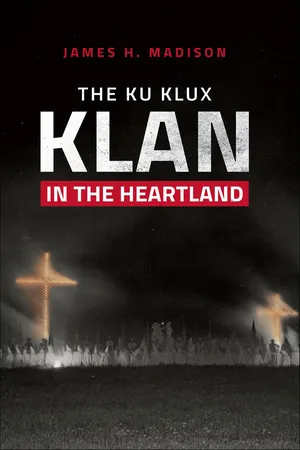
FROM THE OHIO RIVER TO LAKE MICHIGAN, BURNING crosses lit cornfields, hillsides, and courthouse squares. Mysterious robed figures marched—at first only a few, then more. Hoosiers were curious and sometimes frightened, unsure of the meaning and purpose of white robes and fiery crosses. Who was behind the masks? What was the purpose? Why would native-born white Protestants join the Ku Klux Klan?
BURNING CROSSES AND HOODED MARCHERS
With the Christmas season of 1922 came a surging Klan presence. On Christmas Eve, near the state fairgrounds in Indianapolis, a cross burst into flames at exactly midnight. That same night, citizens in Fort Wayne to the north and Bedford to the south saw their first burning crosses. Rumors spread that a cross had burned in every Indiana county that Christmas season. The spectacles continued in early 1923. Crosses burned in Irvington and in Shelbyville on New Year’s Eve, on a hill above French Lick on January 4, and then in Noblesville, Bloomington, Vevay, and Mooresville. In the early months of 1923, every issue of the Klan’s new weekly newspaper, the Indianapolis Fiery Cross, reported on burning crosses.1
Christmas 1922 also brought white-robed men delivering holiday gifts to needy neighbors. Selfless service to others and obedience to the teachings of Jesus was their mission, they said. “The Indianapolis Klan played Santa Claus to more than one hundred worthy but unfortunate families,” the Fiery Cross reported. A dozen trucks distributed “bushel baskets of groceries, candies, shoes and bed clothing.” Included on the delivery route were “several colored and Catholic families,” since “the Klan made no racial nor religious discrimination whatever.” The gift-bearing Klansmen greeted recipients only with the words “Merry Christmas.”2
Klan members also began to visit churches. Robed figures marched up the aisle on Sunday mornings and spoke not a word. Entering an Anderson church in early 1923, they silently presented the minister an American flag and an envelope with cash while the church orchestra played “Onward Christian Soldiers,” after which the congregation stood and sang “America.” At a Methodist church in Carmel, hooded men carrying American flags knelt at the altar and then presented Reverend K. R. Thompson a purse full of cash. In Windfall, in Tipton County, fourteen robed Klansmen joined a Quaker revival service led by Reverend Mildred Miller, who was preaching on 100 percent Protestantism and 100 percent Americanism. In White County, some members of the Chalmers Methodist Church debated whether to accept the Klan’s gift but eventually decided to do so.3
Parades were the grandest spectacles. Two hundred Klansmen with arms folded marched silently though Noblesville in late January 1923, as they did in Portland, in Jay County. Marchers in Frankfort’s first parade that February gathered at the Clinton County fairgrounds to watch a cross set ablaze. Two Klansmen then mounted white horses to lead the procession. The Muncie marching band (soon known as the best Klan band in the state) preceded a massive American flag carried by a dozen Klansmen, which was followed, in turn, by several floats. Hooded marchers carried signs reading “Separation of Church and State,” “Law and Order,” “Protection of Pure Womanhood,” and “Just Laws and Liberty.” The day ended with an initiation of several hundred new members. A parade on Main Street in Richmond in fall 1923 included floats and ten marching bands, fireworks that outlined an American flag and the words “100 Percent,” while overhead an airplane circled trailing an electric cross.4
Parades were often preludes to initiation ceremonies, known in Klan language as “naturalizations.” Some two thousand citizens gathered in the cold night air on Marion’s baseball diamond in November 1922. In the crowd was W. A. Swift, a Muncie photographer whose three surviving photographs tell the story. On a temporary platform in front of a large wooden cross and an American flag, Klan officers stood, arms folded, ceremonial swords at their sides. At 10:00 p.m., a robed Klan band, complete with a tuba player, opened with “Onward Christian Soldiers.” The crowd sang along with the familiar words. Men in white robes and hoods surrounded the initiates, all of whom were white male Protestants. They were warmly dressed, their coat collars turned up against the night air. All wore hats, ranging from workingmen’s cloth caps to businessmen’s fedoras. On command they removed their hats and knelt to take an oath to God and country. Swift’s photographs show youthful initiates mixed with balding men. The newly naturalized Klansmen watched reverently as an officer set fire to a large cross. Flames rose, and the orderly crowd returned to their warm front parlors. The next day, the town’s two newspapers gave detailed accounts of a most exhilarating night.5
Patriotic displays were centerpieces of Klan gatherings. The American flag always flew and was matched with the Christian cross as twin symbols. At an initiation ceremony in Wayne County, new members knelt in front of an altar on which a Bible rested on top of a flag, with a cross above and another flag unfurled nearby. Initiates pledged to “perpetuate our great American country, the most dauntless lineage known to man.”6
Newspapers across the state in 1923 were full of stories about the new organization. The Huntington Herald reported that two newsboys sold five hundred copies of the Fiery Cross to Saturday afternoon shoppers. The Franklin Evening Star informed readers that the Klan provided flowers for a local funeral service. In Columbia City, citizens learned of a new Klan youth organization. A Richmond newspaper announced plans to erect a Klan headquarters building with an auditorium to hold sixty-five hundred people. The Seymour paper reported on Klan cross burnings in nearby towns, but not in Jackson County, leaving people wondering why the Klan was ignoring them. In adjacent Bartholomew County in mid-February, a local reporter noted another cross burning on a hill near the Newbern Christian Church, where Klan members had made a donation, “but the burning of these crosses is becoming frequent in the county and they have ceased to cause undue interest.”7
The grandest Klan spectacle in US history occurred in Kokomo’s Melfalfa Park on July 4, 1923. Thousands of Hoosiers joined visitors from neighboring states to contemplate the evils that threatened the nation and to enjoy old-fashioned summer entertainment of the kind featured at church picnics, county fairs, and summer family reunions. Food and games mixed with speeches and music. In the midst of this “Konklave in Kokomo,” an open-cockpit biplane circled overhead and then landed in a grassy field. Out stepped D. C. Stephenson, shortly to be anointed as Grand Dragon of Indiana. Known to his followers as Steve or “the old man,” he had emerged as showman and salesman extraordinaire, but that Fourth of July, he offered a calm and reasoned speech titled “Back to the Constitution.” Stephenson spoke of the nation’s founding ideals, the decline of democracy, and the rise of corruption and sin. It was a performance carefully designed to display a leader of wisdom, respectability, and charisma. Others spoke in less lofty terms, many of them Protestant ministers. In the evening, a parade of robed men and women featured nine bands and dozens of American flags. Among the floats were those depicting Klansmen protecting young women from black male aggressors, Catholic “papists,” and foreigners. Attendees enjoyed evening fireworks and popular songs and hymns, including “America” and “The Old Rugged Cross.” The long day ended as a sixty-foot cross, wrapped in burlap and soaked with kerosene, sent the fire of Christianity into the summer night.8
By Independence Day 1923, the Klan was at home in Indiana. Local units, called Klaverns, existed in every county, the New York Times reported.9 Klaverns met frequently to conduct serious business that always included a religious program of Bible readings and hymns. Local meetings were also social gatherings of good fellowship with like-minded neighbors. There was singing, especially of “old-fashioned gospel songs,” refreshments, friendly banter, and “wholesome entertainment.” Official guidelines instructed each Klavern entertainment committee to “make the programs snappy” with “all the joy possible.” A Klavern’s many standing committees included budget, civic, religious, entertainment, law enforcement, funerals, welfare, publicity, and education. Among the many Klavern officers were Klaliff, Klokard, Kludd, Klabeek, and Klokann. In a decade in which fraternal and social organizations proliferated, including Rotary, Lions, Masons, and women’s clubs, a Klavern’s organization, ritual, and good cheer were familiar and welcoming. Serving a growing market, vendors offered to sell Klan jewelry, including rings and necklaces with three Ks, and hats and balloons featuring images of fiery crosses.10
Among the social activities were Klan basketball teams, many organized for boys in the Junior Klan. A team composed “of fine red-blooded, native-born, Protestant American boys” formed in Gibson County to prepare for the Klan’s state basketball tournament to be held in the Elwood Armory in April 1924. The two-day affair brought teams from Kokomo, Alexandria, Elwood, Terre Haute, Pendleton, Peru, Anderson, Knox, Princeton, Frankfort, North Vernon, and Logansport. In the state finals, Kokomo beat Elwood, after which the Ohio state champion defeated the Kokomo team. Musical entertainment accompanied the tournament. Local churchwomen prepared the food.11 There was baseball too. A Klan day in Crown Point included a game between the Junior Klan teams from Hobart and Hammond. The St. Joseph County Klan held its annual picnic at Lake Maxinkuckee with a basket dinner followed by “a baseball game between the fat members and the lean members,” with “the heavier Klansmen winning.”12
Indiana Klaverns were linked to a national organization based in Atlanta. There were elaborate rules and pronouncements from the Imperial Wizard and constant demands for money. Klaverns in Indiana did not always give the requisite attention and money to the national office, preferring to concentrate on local issues. Eventually local Klans sensed rivalry, selfishness, and corruption at the top of the organization. In the beginning, however, many felt the power of belonging to a nationwide movement.13
Within a few months, Indiana had become a hotbed of parades, speeches, church services, and Klavern meetings. Thousands joined up. Recruitment brochures spread the word, including on the campus of Indiana University.14 On the officially designated Klan Day at the Indiana State Fair, September 7, 1923, some ten thousand members followed instructions to leave their robes and hoods at home and gather inside the racetrack, where they proudly sang “America” and recited the Lord’s Prayer.15
Not all Hoosiers joined. For some, a chill was upon the state. They wondered who in their family, their church, or their Lions Club belonged. What were they up to? Claude Wickard (who served as US secretary of agriculture during World War II) recalled that in his Carroll County farming community, nearly everyone belonged. His father “resented more than anything else … that he couldn’t go talk to his neighbors openly and freely as he always had.”16
A COMMUNITY OF 100 PERCENT PROTESTANTS
Burning crosses, waving flags, and marching bands offered more than great theater. They were essential steps in building a Klan culture of like-minded citizens. The bonds of an imagined community tied together people from big cities, small towns, and rural crossroads and from factories, downtown offices, and farms. Essential to creating this imagined community, this tribe of like-minded folks, was exclusion of those defined as different. With masterful marketing strategies, the Klan divided Hoosiers into us or them. By creating this rigid binary culture, the Klan left little room for ambiguity. Such twenty-first-century notions as pluralism, multiculturalism, diversity, and inclusiveness were alien. A melting-pot America was anathema. The Klan offered instead a hierarchy of humans. Americans were first in this hierarchy, of course, but some Americans were better than others. The very best were the “100 percent Americans”—those bound together in a triangle of native birth, Protestant religion, and white racial identity.
Klan beliefs were not new. Earlier generations had heard messages of exclusion and intolerance. Many Americans could accept such commonsense notions, deeply rooted in venerable American traditions, but the Klan designed new packaging for old stories to make them more compelling than earlier versions.
Klan critics then and later suggested a contradiction between Christianity’s God of love and the Klan’s intolerance of others. Hoosier Klan members in the 1920s did not see themselves as joining a “hate group.” Nor did they see themselves as “smug and self-righteous,” as one Indiana writer later claimed.17 Rather, their genuine religious faith combined with their cultural values to create confidence in the righteousness of their identity as white Protestants and the justice of their cause. They were convinced that the United States had always been and must always be a Protestant nation. Protestantism and patriotism were opposite sides of the 100 percent American coin. Not all Protestants shared such views. Some remained attached to the Social Gospel reform tradition of the previous generation and to the obligation to reach out to immigrants and the less fortunate, whatever their beliefs. But by the 1920s, this more liberal tradition had waned so that Klan messages were closer to the mainstream than the margin of American Protestantism.18
The Klan built its Indiana house on the rock of Protestant religion. “What church do you go to?” was often the beginning of conversation when meeting a stranger.19 Those who seldom attended were still “cultural Protestants,” swimming in waters similar to faithful churchgoers. In every community, Protestant ministers stood among the leading citizens. Newspapers regularly printed their sermons as well as Sunday scripture lessons.20
White robes clothed Klan members in the symbols of religious belief. White represented the purity of both faith and race. On the front of the robe was a white cross set in a red circle; a red mark in the center of the cross signified a drop of the blood that Christ had shed. A conical white hood included a mask, which not only hid the Klan member’s identity for protection from enemies but also denoted the subservience of the individual to the community. Photographs of Klan gatherings were usually of large groups; shapeless robes hid the bodies, and the faces were unseen behind masks. These like-minded Americans in white robes marched forward together against their enemies.21
The Klan’s ever-present cross proclaimed Christ’s sacrifice to save humankind. The fiery cross was the light of the world, the flame of truth, the purification of sin. It gave unit...