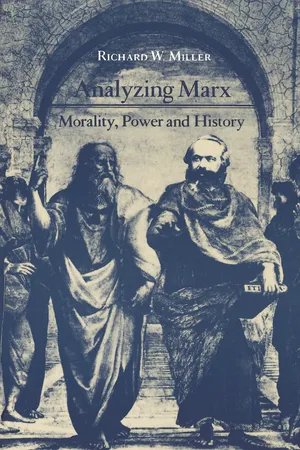
In this book Marx is revealed as a powerful contributor
to the debates that now dominate philosophy
and political theory. Using the techniques of analytic
philosophy to unite Marx's general statements with
his practice as historian and activist, Richard W. Miller
derives important arguments about the rational basis
of morality, the nature of power, and the logic of testing
and explanation. The book also makes Marx's theory
of change useful for current social science, by replacing
economic determinist readings with a new
interpretation in which systems of power relations are
the basis of change.
Part One discusses Marx's criticisms of the moral
point of view as a basis for social choice. The outlook
that emerges is humane but antimoral. Part Two argues
that Marx's concept of the ruling class is a means,
of measuring political power that is ignored yet urgently
needed by present-day social science. Part
Three bases Marx's theory of history on the
dynamics of power, challenging both the standard,
economic determinist readings of the
theory and standard conceptions of science.
- English
- ePUB (mobile friendly)
- Available on iOS & Android
eBook - ePub
About this book
Information
Publisher
Princeton University PressYear
2020Print ISBN
9780691014135
9780691066134
eBook ISBN
9780691219745
Topic
PhilosophySubtopic
Political PhilosophyCHAPTER FIVE
Productive Forces and the Forces of Change
INTRODUCTION
OF THE MANY controversies about what Marx meant, the most intense concerns his general theory of history. In dispute is a special topic within this special topic: what is Marx’s general theory of basic economic change? Clearly, this part of his theory of history is the foundation for all the rest. For Marx, political and ideological institutions and the climate of respectable ideas have their basic features because those features serve to maintain certain economic relations, what he calls “relations of production.” But there is nothing clear about the foundational question of why those relations have their basic features, and why they sometimes change.
The most influential interpretations of Marx’s answers to these questions make Marx a technological determinist. On this view, Marx regarded history as the story of how social arrangements adapt to technological progress, facilitating the productivity of tools and techniques. Above all, the development of relations of production is to be explained as ultimately due to the pursuit of more material goods through improved technology.
There have, of course, been dissenters from this view. But they have not offered any decisive criticism or any plausible alternative. Often, opponents accord a larger role to class struggle than technological determinism allows. But they do so without explaining Marx’s lifelong concern with the development of productive forces as determining the direction of social change. Worse yet, dissenters from the dominant interpretation often dilute Marx’s theory to a thin soup of truisms to the effect that technology influences change and people don’t do much thinking if they cannot eat. Marx’s practice as a historian is surely more distinctive than that, his general remarks more interesting.
The debate over technological determinism is at the center of the two broad topics of this book, the relation between politics and economics in Marx and the relation between Marx and analytic philosophy. The technological determinist interpretation is by far the most plausible of the many readings of Marx that subordinate the political to the economic. It has been encouraged by positivist assumptions, which have until recently dominated analytic philosophy. Or so I shall argue. Because Marx’s historical writings are such a frustrating mixture of fragments of grand theorizing with concrete, elaborate and suggestive narratives, interpreting Marx on history demands, to the highest degree, the style of analytic philosophy, its conceptual resourcefulness, clarity and tolerance for detail.
Refuting a view of such a complex matter as Marx’s theory of history means refuting the best version of it, the specification most likely to be correct if the general approach is valid. In the first half of this chapter, I will construct this most defensible version of technological determinism, and argue that it does not remotely fit Marx’s historical writings.
In the alternative that I will then develop, what I will call “the mode of production interpretation,” basic, internal economic change arises (whenever it does, in fact, take place) on account of a self-transforming tendency of the mode of production as a whole, that is, the relations of production, the forms of cooperation and the technology through which material goods are produced. Because of the nature of the mode, processes that initially maintain its characteristic relations of production eventually produce their downfall. This change need not overcome any barriers to material production. It may do so. Change may be based on developments in the forms of cooperation or in technology, giving access to enhanced productive power to an initially subordinate group, and motivating their resistance to the old relations of production because the latter come to inhibit the further development of that new productive power. But, in this broad mode of production theory, change may also be wholly internal to the relations of production. The patterns of control in the old relations of production may make it inevitable that an initially nondominant group will acquire the power and the desire to overthrow the old relations. Unlike technological determinism, this theory fits Marx’s practice as a historian. Another difference is that it is a defensible theory of history, Marx interpretation to one side.
Admittedly, a somewhat narrower theory is expressed in some of Marx’s general formulations, even though the broader account is entailed by several of his historical explanations. On this narrower account, radical internal economic change is always the result of the first of the two processes that I have sketched, that is, the acquisition of access to increased productive powers by a subordinate group defined by production relations that come to inhibit the further growth of those powers. But even in this narrow theory, Marx is not a technological determinist. The growth of productive powers is not primarily based on an autonomous drive toward technological progress. The enhanced productive powers usually result from changed forms of cooperation, not new technology. The new social relations of production need not be the most productive framework for the development of technology.
For reasons of convenience, I will first develop the narrower mode of production theory, then show why it must be broadened to accommodate the balance of the texts. It will turn out that the standard means of identifying theories in the history of science make the broader theory Marx’s essential one. In short, in Marx’s essential theory, productive enhancement has no primary role among processes of internal change. In the nonessential narrowing toward which he sometimes inclined, productive enhancement still lacks the particular primacy and the technological character assigned it by technological determinism.
In the choice between technological determinism and the mode of production theory, the stakes are high. In politics, the mode of production theory broadens the material preconditions for socialism, while providing a rationale for revolution as the necessary basis for radical change. In the most abstract realms of methodology, the mode of production theory requires and helps to justify departures from conceptions of explanation and confirmation that have, until very recently, dominated the philosophy of science. I will conclude this book with a demonstration that those conceptions rule out the mode of production interpretation in favor of technological determinism, a sketch of an alternative conception of explanation and confirmation and a suggestion as to how the political consequences of the more standard methodology may help to explain its recurrent appeal, from Hume to the present day.
MARX AS TECHNOLOGICAL DETERMINIST
Many technological determinists have obviously not been Marxists. For example, the anthropologist Leslie White claimed that institutions all evolve in such a way as to maximize “the amount of energy harnessed per capita per year.”1 In his theory, political and cultural institutions can adjust to productive needs quite directly, without any priority for social relations of production. Change that is qualitative, structural, or relatively rapid plays no special role.
What specific version of technological determinism could have been Marx’s theory? In effect, the answer to this question has consisted of a technological determinist gloss of a celebrated passage from the Preface to Marx’s book A Contribution to the Critique of Political Economy (1859). In this passage, Marx says that people’s
relations of production correspond to a definite stage of development of their material productive forces. The sum total of these relations of production constitutes . . . the real basis on which rises a legal and political superstructure.
More precisely, this correspondence and support occur in relatively stable social situations.
At a certain stage of their development, the material productive forces of society come in conflict with the existing relations of production. From forms of development of the productive forces these relations turn into their fetters. Then begins an epoch of social revolution. With the change of the economic foundation the whole immense superstructure is more or less rapidly transformed.2
Other statements by Marx suggest a technological determinist interpretation, especially in his polemics against Proudhon in the 1840s. However, the passage from the Preface has played a special role. Every classic, systematic exposition of Marxist technological determinism, from Plekhanov’s The Development of the Monist View of History at the turn of the century to Cohen’s recent Karl Marx's Theory of History: A Defense, constantly returns to the scaffolding of this passage. (I have not quoted every important sentence in it.) This habit makes some of us suspicious. The passage is part of a short autobiographical sketch. It follows a modest introductory sentence: “The general result at which I arrived and which, once won, served as a guiding thread for my studies, can be briefly formulated as follows.” I can think of no other major theorist whose general theory is often reconstructed, in large part, by a close reading of a brief formulation embedded in an autobiographical sketch in a preface to a book that he gladly allowed to go out of print, as superseded by later writings. Still, the central text for technological determinism is one of Marx’s few detailed and general formulations of his theory of history. And it does often sound like a systematic presentation of a technological determinist theory. In the interest of both clarity and fairness, I will construct the most defensible version of the technological determinist interpretation by finding the best reading of this passage in which crucial terms are interpreted in a technological determinist manner.
In technological determinism, “productive forces” are best interpreted as tools, techniques and knowledge by which matter is made usable by human beings—tools, techniques, and knowledge meeting two further constraints. Productive forces must be means to overcome physical obstacles, as against the obstacle of resistance by other human beings. On this reading, a gun used to kill deer for venison is a productive force, but not one used to conquer territory. A foreman’s knowledge of how to cut sheet metal is a productive force, but not his knowledge of how to maintain labor discipline. This restriction is required by Marxist technological determinism, since the productive forces are supposed to be the autonomous technological factor that, on the whole, explains basic changes in social and political processes, not the other way around. Obviously, the development of means of control over other human beings has, to a large extent, been determined by social and political relations of domination and conflict that the technological factor is supposed to explain.
Also, the most defensible technological interpretation must exclude from the scope of productive forces what Marx calls “modes of cooperation” and Cohen calls by the short and evocative phrase “work relations”: relations of cooperation between people engaged in production, defined apart from control over people or means of production. Again, the productive forces must be so restricted, or the claim that they are the autonomous basis for change will be false to history as it obviously is and as Marx obviously sees it. Typically, changes in work relations are due to new relations of dominance. The labor gangs of the Pharoahs, the teamwork in medieval corvée labor on the overlord’s demesne, and the dispersal of craftswork through the “putting-out” system in the preindustrial stage of capitalism are a few examples. Moreover, changed patterns of work-relations rarely involve the development of new ways to produce efficiently, as they would have to if they were instances of technological progress. Virtually all work-relations are already depicted on the walls of ancient Egyptian tombs.
In the Preface, “the sum total of. . . relations of production” are said to be the basis for political and ideological institutions. Much else is said of them: they find a legal expression in property-relations; productive forces are normally at work within them; they may inhibit the productive forces; an era of social revolution is required to transform them fundamentally. To play these roles, the relations of production are best construed as relations of control over people, labor-power, raw materials or productive forces within the process of material production. People’s positions in the network of relations of production define their class. For example, if some people control productive forces and the use for a contracted period of the laborpower of others, while the others sell their labor-power because they lack control of substantial productive forces or raw materials, the former are capitalists, the latter proletarians.
By sharply separating relations of production from productive forces, in this way, Marxist technological determinists can pursue a highly attractive goal of their approach to Marx, the description of general empirical laws in which sufficient causes for change among relations of production are specified in a noncircular way. Though this goal, I shall argue, must be given up, it provides an important motive for maintaining the technological determinist interpretation of Marx’s general view in spite of its distance from most of his specific historical explanations.
In the Preface, a network of relations of production is said to change when it fetters the “development of the productive forces.” In interpreting this metaphor of fettering, any defensible version of the technological determinist interpretation will have to depart from a strict and literal reading of the Preface. Marx says, there, “No social order ever perishes before all the productive forces for which there is room in it have developed.” If we take this to be Marx’s strict and settled view, production relations fetter productive forces only when they exclude all further improvements in productivity. A theory of history that insists on this fettering must deny, for example, that feudalism was ever overthrown so long as it permitted any improvement in productivity. The implication for capitalism is just as conservative: capitalism will never change until it is incapable of any improvement in the productive forces. The implication concerning feudalism is historically absurd, as Marx is well aware. The implication concerning capitalism flies in the face of Marx’s view that capitalist competition will always stimulate some technological progress, together with the fact that Marx was a socialist.3
Marx’s extreme statement is an exaggeration to be understood in its political context. It reflects his polemics against Proudhon and the utopian socialists, who studied industrial development only to condemn it and would not realistically assess the material requirements of modern workers’ needs. A more moderate standard for fettering is available, which fits Marx’s practice much more closely. On this interpretation, the network of relations of production fetters productive forces when some alternative network would better promote the further development of those forces. Following Cohen’s usage I will borrow Marx’s concise label in the Preface for a whole network of relations of production, namely, an “economic structure.” A defensible technological determinist reading of the Preface should understand the claim about fettering, metaphor and hyperbole to one side, as the claim that a basic type of economic structure only lasts so long as it is optimal for the development of the productive forces. It perishes when productive forces would develop more productively in a new structu...
Table of contents
- Cover Page
- Title Page
- Copyright Page
- Dedication
- Contents
- Note on References and Acknowledgments
- Introduction
- Morality
- Power
- History
- Index
Trusted by 375,005 students
Access to over 1.5 million titles for a fair monthly price.
Study more efficiently using our study tools.
Frequently asked questions
Yes, you can cancel anytime from the Subscription tab in your account settings on the Perlego website. Your subscription will stay active until the end of your current billing period. Learn how to cancel your subscription
No, books cannot be downloaded as external files, such as PDFs, for use outside of Perlego. However, you can download books within the Perlego app for offline reading on mobile or tablet. Learn how to download books offline
We are an online textbook subscription service, where you can get access to an entire online library for less than the price of a single book per month. With over 1.5 million books across 990+ topics, we’ve got you covered! Learn about our mission
Look out for the read-aloud symbol on your next book to see if you can listen to it. The read-aloud tool reads text aloud for you, highlighting the text as it is being read. You can pause it, speed it up and slow it down. Learn more about Read Aloud
Yes! You can use the Perlego app on both iOS and Android devices to read anytime, anywhere — even offline. Perfect for commutes or when you’re on the go.
Please note we cannot support devices running on iOS 13 and Android 7 or earlier. Learn more about using the app
Please note we cannot support devices running on iOS 13 and Android 7 or earlier. Learn more about using the app
Yes, you can access Analyzing Marx by Richard W. Miller in PDF and/or ePUB format, as well as other popular books in Philosophy & Political Philosophy. We have over 1.5 million books available in our catalogue for you to explore.