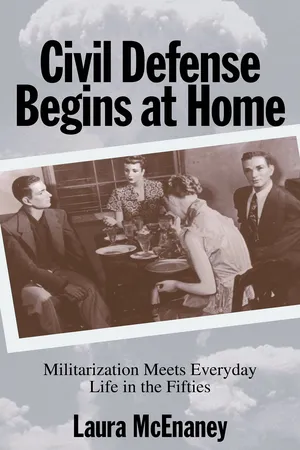
Dad built a bomb shelter in the backyard, Mom stocked the survival kit in the basement, and the kids practiced ducking under their desks at school. This was family life in the new era of the A-bomb. This was civil defense. In this provocative work of social and political history, Laura McEnaney takes us into the secretive world of defense planners and the homes of ordinary citizens to explore how postwar civil defense turned the front lawn into the front line. The reliance on atomic weaponry as a centerpiece of U.S. foreign policy cast a mushroom cloud over everyday life. American citizens now had to imagine a new kind of war, one in which they were both combatants and targets. It was the Federal Civil Defense Administration's job to encourage citizens to adapt to their nuclear present and future.
As McEnaney demonstrates, the creation of a civil defense program produced new dilemmas about the degree to which civilian society should be militarized to defend itself against internal and external threats. Conflicts arose about the relative responsibilities of state and citizen to fund and implement a home-front security program. The defense establishment's resolution was to popularize and privatize military preparedness. The doctrine of "self-help" defense demanded that citizens become autonomous rather than rely on the federal government for protection. Families would reconstitute themselves as paramilitary units that could quash subversion from within and absorb attack from without.
Because it solicited an unprecedented degree of popular involvement, the FCDA offers a unique opportunity to explore how average citizens, community leaders, and elected officials both participated in and resisted the creation of the national security state. Drawing on a wide variety of archival sources, McEnaney uncovers the broad range of responses to this militarization of daily life and reveals how government planners and ordinary people negotiated their way at the dawn of the atomic age. Her work sheds new light on the important postwar debate about what total military preparedness would actually mean for American society.
eBook - ePub
Civil Defense Begins at Home
Militarization Meets Everyday Life in the Fifties
- 240 pages
- English
- ePUB (mobile friendly)
- Available on iOS & Android
eBook - ePub
About this book
Trusted by 375,005 students
Access to over 1.5 million titles for a fair monthly price.
Study more efficiently using our study tools.
Information
Topic
GeschichteSubtopic
Nordamerikanische GeschichteCHAPTER ONE
The Dilemmas of Planning and Propaganda
IN JANUARY 1951, the midwestern states had just survived a series of harsh winter storms, and the Federal Civil Defense Administration received official status as an independent agency. There was, of course, no obvious connection between these two events, but civil defense planner John Bradley saw one immediately. He penned a memo to his boss saying the snow-storms were more than merely bad weather—they were a harbinger for unprepared citizens of the nuclear age. The question raised by the storms, he said, was “how self-sufficient would the average urban home be following an atomic attack?” Bradley asked and answered his own query with an admonition that would soon become litany in civil defense planning circles: “We have, as yet, developed little bomb consciousness,” for postwar Americans had rebuilt their lives “on an assumption of peace” and in doing so had “lost ground” in the Cold War.1
Raising America’s “bomb consciousness,” however, required more than simple analogies between winter snowstorms and nuclear firestorms. The FCDA and its predecessor agency, the National Security Resources Board (NSRB), embraced Bradley’s view that Americans had too quickly assumed a peaceful future, but how to reorient public life around readiness remained a daunting question. As nuclear technology in the 1950s developed farther and faster than either defense planners or civilians could comprehend, a home front defense program seemed at least a partial answer. Yet the creation of a civil defense system became quickly entangled with a larger set of philosophical and political conflicts about the degree to which Cold War security priorities should structure and permeate civil institutions and relationships. Indeed, political debates about the relationship between civil society and national security proved just as vexing for FCDA planners as did scientific and logistical matters. As the militarization of foreign policy proceeded apace, the question of how civil institutions and civilians themselves would accommodate the national security mandate remained an open one.
The most fundamental planning dilemmas centered on the management, funding, and implementation of civil defense—that is, who would run it, pay for it, and actually do it? Adapting civil defense to the nuclear age first necessitated a concrete definition of how national security would look on the home front: military rule or civilian control of a mighty military? In an era when U.S. military prowess was credited with saving the world, a military-controlled preparedness effort seemed logical. Yet many planners and politicians, including Presidents Truman and Eisenhower, worried that military supervision of civil defense might presage military governnance of civil society entirely. Most policymakers expressed a considerable liberal impulse to limit the powers of the military, but they still insisted on a kind of quasi-military character to the program. Funding, too, presented a complex problem. If civilian-run and ostensibly about self-protection, should civil defense be paid for by civilians directly or through government taxation and spending? Policymakers pondered the possibility that citizens might feel either entitled to government assistance or resentful of its absence, and thus funding issues became enmeshed with larger political controversies seemingly disconnected from the world of security planners: citizen entitlements, “big government,” and the New Deal state.
Perhaps the variable human psyche itself presented the most difficult planning dilemma. The FCDA enlisted an army of psychiatric professionals to help predict and mold human responses to air attack, but despite planners’ faith in the scientific method, survey results never gave them what they really wanted—confidence, or maybe even a guarantee, that Americans would duck and cover when the sirens sounded. Nevertheless, FCDA planners mounted a sophisticated public relations campaign to “sell” civil defense. This campaign, too, presented its own subset of difficulties. How to exalt the military’s strength while conveying home front vulnerability? How to garner taxpayer support for nuclear weaponry while preaching self-help survival? How to invoke the bomb’s deadly peril while emphasizing survivability? What emerged from the early planning years, then, was less a specific civil defense plan than a prolonged national debate about the proper scope and character of Cold War militarization.
CREATING A DEFENSE BUREAUCRACY
The story of the FCDA’s emergence in the 1950s is inextricably linked to the development of a foreign policy increasingly dependent on nuclear weapons. Diplomatic historians have already shown how an uneasy U.S.-Soviet wartime alliance, or “shotgun marriage,” as Walter LaFeber puts it, deteriorated into an economic and military standoff with far-reaching consequences for global and U.S. domestic politics. Between 1946 and 1948, Truman and Stalin, each with his own set of fears and aspirations about the shape of the postwar world, jockeyed for position to direct European and Asian recovery.2 As Melvyn Leffler has argued, the United States’ monopoly on atomic power until 1949 “constituted a shield behind which the nation could pursue its diplomatic goals.” Nuclear preponderance enabled American officials to rebuild Europe and Asia according to their own interests, to cooperate less and act with a kind of confidence “to do things they might otherwise have hesitated to do” if they had thought their actions would lead to war.3
But that monopoly ended in August 1949 with the successful Soviet test of an atomic bomb, and Truman and his advisers worried deeply about the symbolic and practical meaning of this development. In one sense, they feared less the Soviet Union’s immediate atomic capability than the “diplomatic shadows” cast by it; now their diplomatic latitude seemed more constricted. They worried about whether European allies would continue to cooperate with the American vision of postwar reconstruction, and whether the Soviets would expand their own postwar goals and act more aggressively to accomplish them. Furthermore, if the Soviets now had the technology to destroy, or at least cripple, the American industrial core—the basis of America’s power during and after World War II—the consequences could be dire. As Leffler sums it up: “The Soviet possession of the atomic bomb symbolized that U.S. strategic superiority might be at an end, that its warmaking capabilities would be at risk, and that the fundamental source of its superior power was no longer impregnable.”4
Truman and his advisers decided that more and bigger nuclear bombs would enable them to maintain military and thus diplomatic advantage, and Eisenhower remained faithful to this axiom. But this militarization of diplomacy, as Michael Sherry has argued, “proceeded in confusing fits and starts” and should not be mistaken for a coherent and well-defined process.5 There were deep divisions at all levels of the security bureaucracy about how best to pursue containment. Yet despite the interagency rivalries and jealousies and the constant tinkering with organization charts, a national security state emerged, spawning a whole range of agencies, including one dedicated to civil defense.
The new national security state was a massive bureaucracy, or as Daniel Yergin puts it, “a state within a state.” It was also a cluster of ideas about foreign and domestic affairs. Because “national security” guided the spirit and purpose of civil defense, a brief detour is necessary to probe its meanings. First adopted by scholars and journalist Walter Lippmann in 1945, the term “national security” quickly gained currency among military and State Department officials who found it a more accurate descriptor than “national defense” to describe the close relationship between domestic politics, foreign policy, and military affairs. It explained all global developments as potential threats to U.S. interests, expressed hostility toward communism or nationalism, and exalted military readiness. The term’s appeal was its simplicity and flexibility; it was a “commanding idea” that could explain American diplomatic objectives and justify actions taken abroad and at home to achieve them. Its elasticity—and ambiguity—enabled its wide application in Cold War political culture, for its meaning shifted depending on who was deploying the term and in what context. In the 1950s alone, it was used in service of anticommunist purges in federal employment and to bolster reformist calls for expanded civil rights. And despite its official and quasi-military tone, national security was a term and ideology comfortably invoked well outside the formal political realm to discuss anything from hygiene to neighborliness. As Yergin aptly points out, national security in the postwar period was “not a given, not a fact, but a perception, a state of mind.”6
As the first postwar agency to coordinate civil defense, the National Security Resources Board was the first to define what national security would look like for nuclear-age citizens. Civil defense was only one part of the Board’s responsibilities, so it initially took a backseat to other concerns. In 1948, a small NSRB staff set its attention on the problem of defending life, property, and industry against a weapon the United States itself had created. Planners depended on a series of military studies to guide them, all of which had concluded that, with modest adaptations, World War II–style civil defense practices could provide protection from far more technologically sophisticated weapons. The studies further recommended that Truman establish a separate agency devoted solely to developing a civil defense program.7With the somewhat shaky confidence of atomic monopoly and no immediate diplomatic threat, Truman supported only “peacetime planning and preparation” for civil defense, not full-scale mobilization; he wanted “to minimize the program without completely abandoning it.”8
In September 1949, however, Truman did an about-face when he learned that the Soviets had exploded an atomic bomb. Civil defense planning went from low-key to frenetic. Throughout the fall of 1949, politicians, scientists, and citizens from all points of the political spectrum began to pressure the administration for something more than mere studies. Anxious to display his anticommunist credentials and military toughness, a young Congressman John F. Kennedy warned that the slowness of civil defense planning made the United States vulnerable to an “atomic Pearl Harbor.”9 (Interestingly, this foreshadowed his later bellicose statements regarding a “missile gap.”) Joining Kennedy in his call for action was Senator Brien McMahon, chairman of the powerful Joint Committee on Atomic Energy, who announced a series of public hearings on civil defense. The pressure on Truman to take decisive action only increased in the summer of 1950, when Korea emerged as the next site for Cold War confrontation. Adding to the tensions surrounding Soviet nuclear capability and compounding apprehensions about the “loss of China,” the Korean War seemed to policymakers a possible prelude to a much larger military conflict.10
The triple threat of Soviet atomic power, Chinese communism, and Asian war generated enough momentum to create an entirely new agency dedicated to civil defense. NSRB chairman Stuart Symington, a former Democratic Missouri senator and Secretary of the Air Force, told Truman that the time had passed when a military and civilian mobilization could be organized “with relative leisure.”11 In July 1950, he expanded the NSRB’s civil defense planning staff and demanded yet another proposal be presented to Truman by September. The report, officially entitled “United States Civil Defense” (unofficially called the Blue Book), proposed three basic steps: the passage of civil defense legislation, the establishment of a civil defense administration outside the NSRB, and the appointment of an administrator to run it. Truman approved the plan, submitted it to Congress, and in the final months of 1950, conscious of escalating Chinese participation in Korea, Congress passed the civil defense legislation with relative haste. The resultant Federal Civil Defense Act transferred civil defense responsibilities from the NSRB to a newly created Federal Civil Defense Administration situated in the executive branch. It required the FCDA to be headed by a civilian—not military—administrator, and Truman selected Millard Caldwell, a former Democratic congressman and governor of Florida, for the job. Caldwell’s support of segregation while in political office briefly stalled his nomination, but Truman and the Senate defended him and he assumed his post in January 1951.12
The civil defense expansion from a small office space in the NSRB to its own agency closely mirrored the string of foreign policy crises of 1950. This would not be the first time that such flashpoints would invoke references to Pearl Harbor and cries to “do something” about U.S. vulnerability. Civil defense owed its existence to such moments, and it would be sustained over the long haul by policymakers’ decisions to pursue diplomacy through nuclear buildup. It now fell to the FCDA to translate high-level atomic diplomacy into a populist language of national security that could motivate Americans to embrace readiness as a way of life.13
CIVILIAN VERSUS MILITARY CONTROL
Although it might have seemed logical to put a military man in charge of civil defense, particularly during a shooting war, the selection of a civilian in early 1951 to head the FCDA reflected a commitment to civilian control of a paramilitary program. The hesitance of politicians and policymakers to put the Department of Defense in charge of civil defense can be read in different ways. On one hand, it reflected an uneasiness about the extent of military control in a national security state, a sentiment first expressed in the battle between scientists, the military, and elected officials over the control of nuclear technology. It betrays, perhaps surprisingly, a genuine liberal tendency to impose limits on the military’s power even as the United States pursued total military readiness. On the other hand, it can be read as another case of policymakers minimizing the dangers of nuclear war by masking its military and paramilitary dimensions; with a civilian in charge, nuclear war (both the threat of and the actual event) looked more like a manageable civilian problem, something comparable to the survival of a natural disaster like a blizzard. Still, the sentiments against military control cannot be dismissed so easily; Truman, Eisenhower, elected officials, and NSRB and FCDA planners all embraced civilian leadership of civil defense. Critics of military rule—cold warriors, all of them—argued that a military-run civil defense program was antidemocratic and antithetical to the “American way of life.”
The first round of debates regarding civilian versus military control emerged out of the internecine struggle to govern the uses of new atomic technologies. As early as 1944, the War Department had laid plans for “a permanent Manhattan Project with continued military control.”14 The May-Johnson Bill, introduced in the fall of 1945, proposed a commission that granted the military wide latitude in the management of atomic policy. This rankled scientists, who wanted the freedom to pursue research without security restrictions, as well as various Truman administration officials, who grew anxious about the subordination of executive power to a military-controlled body. Bipartisan political pressure, along with lobbying from notable scientists, ultimately persuaded Truman to endorse civilian control of a new Atomic Energy Commission (AEC). Throughout the fifties, the military still enjoyed great influence on the AEC through its liaison committee, but an ideological commitment to civilian authority remained strong among both De...
Table of contents
- Cover Page
- Title Page
- Copyright Page
- Dedication
- Contents
- Acknowledgments
- Introduction
- Chapter One: The Dilemmas of Planning and Propaganda
- Chapter Two: Living Underground: The Public Politics of Private Shelters
- Chapter Three: The Nuclear Family: Militarizing Domesticity, Domesticating War
- Chapter Four: Raising Women’s Bomb Consciousness
- Chapter Five: “Equal in Suffering”: Race, Class, and the Bomb
- Conclusion
- Notes
- Bibliography
- Index
Frequently asked questions
Yes, you can cancel anytime from the Subscription tab in your account settings on the Perlego website. Your subscription will stay active until the end of your current billing period. Learn how to cancel your subscription
No, books cannot be downloaded as external files, such as PDFs, for use outside of Perlego. However, you can download books within the Perlego app for offline reading on mobile or tablet. Learn how to download books offline
Perlego offers two plans: Essential and Complete
- Essential is ideal for learners and professionals who enjoy exploring a wide range of subjects. Access the Essential Library with 800,000+ trusted titles and best-sellers across business, personal growth, and the humanities. Includes unlimited reading time and Standard Read Aloud voice.
- Complete: Perfect for advanced learners and researchers needing full, unrestricted access. Unlock 1.5M+ books across hundreds of subjects, including academic and specialized titles. The Complete Plan also includes advanced features like Premium Read Aloud and Research Assistant.
We are an online textbook subscription service, where you can get access to an entire online library for less than the price of a single book per month. With over 1.5 million books across 990+ topics, we’ve got you covered! Learn about our mission
Look out for the read-aloud symbol on your next book to see if you can listen to it. The read-aloud tool reads text aloud for you, highlighting the text as it is being read. You can pause it, speed it up and slow it down. Learn more about Read Aloud
Yes! You can use the Perlego app on both iOS and Android devices to read anytime, anywhere — even offline. Perfect for commutes or when you’re on the go.
Please note we cannot support devices running on iOS 13 and Android 7 or earlier. Learn more about using the app
Please note we cannot support devices running on iOS 13 and Android 7 or earlier. Learn more about using the app
Yes, you can access Civil Defense Begins at Home by Laura McEnaney in PDF and/or ePUB format, as well as other popular books in Geschichte & Nordamerikanische Geschichte. We have over 1.5 million books available in our catalogue for you to explore.