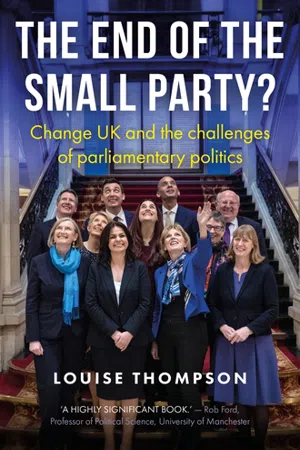
For a brief moment in 2019 Britain's politics looked like it might be transformed. Just when it seemed that the divisions within and across British political parties over Brexit could not get any more intense, 7 Labour and 3 Conservative MPs broke away to form The Independent Group (TIG) – later Change UK. This is the first book to explore the meteoric lifespan of that party, within the wider context of the experiences of other small political groupings in the House of Commons. Ultimately, it shows why the party failed and disbanded after just a few months. Timely and thoroughly researched, Louise Thompson's book takes us deep inside the struggles facing MPs who leave behind the comforts of the large political parties. Drawing on interviews with current and former politicians, it explores the practicalities of being a small party MP in the Commons. What challenges face you? Who can you turn to? And just how can you make an impact? Crisply written for the non-specialist reader, this fascinating book opens a window onto the perilous world of parliamentary politics.
eBook - ePub
The end of the small party?
Change UK and the challenges of parliamentary politics
- 160 pages
- English
- ePUB (mobile friendly)
- Available on iOS & Android
eBook - ePub
About this book
Information
Chapter 1
Three days in February
At nearly three o’clock in the morning on Friday 13 December 2019, the General Election results for the constituency of Luton South were declared. Gavin Shuker, who had been the local MP since 2010, had lost his seat, winning just 3,893 votes. It was a huge fall from the 28,000 votes he had received in the 2017 General Election. Shuker was still the same constituency MP he had been since 2010, working assiduously for the people of Luton South. But he had changed his party identity. First elected to parliament as a Labour MP, he had left the party earlier that year, forming a new independent grouping with ten other MPs in the Commons which would later become a fully fledged political party, Change UK. Shuker left Change UK, along with several of his colleagues, in the summer of 2019 and stood as an independent in the General Election which followed. Just five minutes after the results of Luton South were announced, Shuker's former Change UK colleague Chris Leslie would also lose his seat in Nottingham East. They would be followed over the next couple of hours by Anna Soubry, Angela Smith, Sarah Wollaston, Chuka Umunna, Mike Gapes and Luciana Berger – all former Conservative and Labour MPs who were now standing under a different banner. Just a few days later Change UK was disbanded, with its leader Anna Soubry explaining that their lack of a parliamentary voice had forced them to ‘take stock’.1 This marked the end of a turbulent journey for the party's former MPs, who had battled to create and maintain a small political party in a majoritarian political system. The party's impact on the political landscape may have been minor, but its story provides an excellent case study of the electoral and parliamentary difficulties facing small political parties in contemporary British politics.
To understand the story of Change UK and the challenge for small parties more widely we must go back to the morning of Monday 18 February 2019. It was the start of a normal week in contemporary British politics. Edging ever closer to a no-deal Brexit, Prime Minister Theresa May was fighting a continuing struggle with the House of Commons on the one hand, and the European Union on the other, as she sought to pass her Brexit deal through parliament. For several months, parliament and government had been engaged in something of a battle of brinkmanship as MPs tried desperately to regain control of a Brexit which many felt was too harsh, while the Prime Minister tried almost as vigorously to resist attempts to undermine her position and a negotiated deal of which she was overtly proud. All of this was being played out predominantly in the House of Commons chamber, through debates which stretched out into the late evening and seemingly endless rounds of voting on amendments, motions and amendments to motions. MPs were growing increasingly weary of traipsing through the division lobbies and of sitting through debates in which no new avenues were being explored, but things showed no sign of being resolved any time soon.
The setting for this particular Monday, though, would be very different and, for journalists who had spent weeks watching the green benches of the House of Commons chamber for the first flicker of movement on Brexit, it was probably a welcome relief. The announcement of a press conference just down the river, a few minutes from parliament, had started the rumour mill churning in earnest. It had been something of an open secret in the Palace of Westminster that a group of MPs had been planning on leaving the Labour Party, but it was unclear which MPs were involved and whether we were about to witness statements by a few disgruntled Labour backbenchers or the birth of a new political party. With a complete lack of information on any of the finer details, a sense of anticipation was building among the crowd of journalists who were waiting in the conference room. Those assisting with the press conference had worried that attendance would be poor, reducing the size of the room to prevent any empty chairs. They needn't have worried. The press in attendance began to feed everything they could see onto social media; most notably the presence of seven chairs and a stool on the stage. A covered sign was on the centre of the podium, underneath which the word ‘independent’ could just about be read. Shortly after 11 a.m. seven Labour MPs – Luciana Berger, Ann Coffey, Mike Gapes, Chris Leslie, Gavin Shuker, Angela Smith and Chuka Umunna – walked into the room to begin their press conference. They had rehearsed this scene to ensure that nothing would go wrong.2 Though Chuka Umunna was widely seen as the leader of this splinter group, it was Liverpool Wavertree MP Luciana Berger who first took to the podium. She announced the resignation of all seven MPs from the Labour Party in what was a ‘painful’ but necessary decision.
As each MP came to the podium in turn they provided their own personalised take on why Jeremy Corbyn's Labour Party could no longer be their political and parliamentary home. Berger, Coffey and Gapes would cite their belief that the Labour Party was ‘institutionally anti-semitic’. Chris Leslie described how the party had been ‘hijacked by the machine politics of the hard left’, something which was echoed by Angela Smith. One of these MPs explained to me that his departure had been a long time coming; he had known within a day of Commons business after the 2017 General Election that he would not be a Labour MP by the end of that parliament.3 The question had not been ‘if’ he should leave the party, but ‘when’. It was clear that each MP had their own individual reasons for coming to this decision, but what bound them all together was the shared belief that the Labour Party had changed beyond recognition and was no longer the party which they had previously supported, joined, campaigned for and ultimately been elected under. Their reasons for leaving went even further than this, though. Umunna's broad contention that ‘politics is broken’ set the tone for the press conference and in many ways summed up the general political and parliamentary mood. In interviews and statements released over the next few days, the MPs went on to express a feeling of frustration not just with the Labour Party and its leadership, but also with traditional party politics, as they did so pressing for some kind of alternative. Just what that alternative was, however, was not yet clear.
The former Labour MPs were casting aside their party label, but what were they to become? A company called Gemini A Ltd had been established the previous month with Gavin Shuker as its director. Berger announced that they would sit in the Commons as a grouping called The Independent Group. We must make an important distinction here about what this title means. When MPs leave the political party from which they were elected to parliament there are really only two options available. They can leave one party to join another, in what is known in parliamentary terminology as ‘crossing the floor’, or they may leave a party and continue to sit in the Commons as an ‘independent’ MP. The term ‘crossing the floor’ harks back to a time when there were only two dominant political forces in the political system. To leave one party and join another would mean physically walking from one side of the House of Commons chamber to the other. One would leave the party of government and join the party of opposition, or vice versa. In the context of an increasingly multi-party system, an array of parties now exist for an MP to move to. Some, like Shaun Woodward in 1999, have moved from the Conservative Party to the Labour Party and gone on to serve in ministerial office. Others, such as Douglas Carswell and Mark Reckless in 2014, have left a party of government to join a very small party. Carswell called a by-election in his constituency of Clacton, standing as a UK Independence Party (UKIP) candidate and being returned triumphantly with almost 60 per cent of the vote; the biggest by-election success in history. The first UKIP MP to sit in the House of Commons, he was joined the following month by former Conservative Party colleague Mark Reckless, who had similarly resigned his seat, being returned as a UKIP MP following another successful by-election in Rochester and Strood.
The ‘independent’ label is given to all MPs who are not aligned to an established political party. Independent MPs in the Commons are not a formal grouping. They have no leadership, do not necessarily share ideological outlooks and do not sit or vote together as a coherent and organised entity. Their paths to becoming an independent MP are notably diverse. Until the February 2019 press conference, most MPs sitting as independents in recent parliaments had left their parties not for principled ideological or political reasons, but because of personal misconduct. Indeed, of the 18 instances of MPs leaving a political party to serve as an independent from the start of the 2015 Parliament to January 2019, 14 had done so for alleged or proven cases of misconduct. This included allegations of sexual impropriety, financial or expenses fraud, racist or sexist remarks and, in the case of former Labour MP Fiona Onasanya, a criminal conviction.4
If an MP has been forcibly removed from the party rather than leaving voluntarily, they may choose to designate themselves as an Independent Labour or Independent Conservative MP, indicating that their political beliefs continue to align with their former party. We saw this in 1994 when a group of ten Conservative MPs lost the party whip for failing to support John Major's Government in a confidence motion. These MPs are often allowed back into the fold. Ann Winterton, for instance, served a short stint as an Independent Conservative MP in 2004 following offensive remarks made while serving as a Shadow minister, but was allowed to re-join the party and its parliamentary group when she apologised just a few weeks later. In the 2017 Parliament, independent MPs leaving their party for reasons other than misconduct included Frank Field – who decided not to continue as a Labour MP in August 2018, citing a ‘culture of nastiness’ in the party – and Stephen Lloyd, who left the Liberal Democrats in December 2018 in order to give himself the freedom to go against his party's line on Brexit and vote in favour of the Prime Minister's Brexit deal. The February 2019 announcement by the seven Labour MPs was something different. Although clear that they were not (yet) establishing a new political party, they intended to work together as a formal ‘group’ of independents. Those involved with the planning had anticipated that the group would spend time in this non-party mode while they prepared the foundations and infrastructure required for the launch of a fully fledged political party. While parliament itself would designate them only as independent MPs on its official record (alongside the collection of nine existing independent MPs referred to above), they would create a more formal structure of cooperation and organisation between themselves from the very start. In the early days this meant a very basic group website, streamlined personal websites bearing the group name, regular appearances as the ‘magnificent seven’, as they were styled by the press, and the use of the WhatsApp messaging system to communicate and ensure some semblance of cohesion within parliament.
At first sight the chances of success for the group may have seemed low. Berger highlighted at their first press conference how very different they all were in terms of constituency, age and experience in both the Labour Party and in the Commons. Ann Coffey had been a member of the party for 41 years while others like Berger and Umunna were relative newcomers, serving in the Commons only since 2010. All were MPs for English constituencies, but their constituencies stretched from Liverpool (Berger), Stockport (Coffey) and Penistone and Stocksbridge (Smith) in the north, to Umunna's Streatham and Gapes’ Ilford constituencies in the south. Most held very safe Labour seats, winning their seats in the 2017 General Election with over 60 per cent of the vote. Luciana Berger was the most impressive in this respect. She had won Liverpool Wavertree with a massive 79 per cent of the vote; Chuka Umunna was not far behind, holding his Streatham seat with just over 68 per cent. Angela Smith was the most vulnerable in these terms. Although she won her seat on 45.8 per cent of the vote, her Conservative rival had been only 1,300 votes behind. They also spanned several generations. At 72, Ann Coffey was almost twice the age of Luciana Berger and Gavin Shuker, both of whom were 37 when they left the party. Coffey had served as a Shadow minister at a time when Shuker and Berger were still in secondary school. If they were a diverse mix of MPs they at least had their former party affiliation in common.
The disparate nature of The Independent Group would increase even more over the next couple of days. On the afternoon of Tuesday 19 February Joan Ryan, long-standing Labour MP for Enfield North and former government minister under Tony Blair, announced that she too would be leaving the party and joining The Independent Group. Her announcement was a ‘complete surprise’.5 There was speculation that three Conservative MPs – Heidi Allen, Anna Soubry and Sarah Wollaston – had gone underground and were not responding to messages from their party whips. Heidi Allen had a reputation within Westminster for being a forceful campaigner but was relatively unknown outside the Commons. Anna Soubry and Sarah Wollaston had a bigger public profile; the former was a former government minister and vocal critic of Theresa May during Brexit negotiations; the latter was a regul...
Table of contents
- Cover
- Half-title page
- Title page
- Copyright page
- Dedication
- Contents
- Preface
- 1 Three days in February
- 2 Finding their feet
- 3 Establishing and resourcing a new parliamentary party
- 4 Making their voice heard
- 5 Whither the two-party system?
- Bibliography
- Index
Trusted by 375,005 students
Access to over 1.5 million titles for a fair monthly price.
Study more efficiently using our study tools.
Frequently asked questions
Yes, you can cancel anytime from the Subscription tab in your account settings on the Perlego website. Your subscription will stay active until the end of your current billing period. Learn how to cancel your subscription
No, books cannot be downloaded as external files, such as PDFs, for use outside of Perlego. However, you can download books within the Perlego app for offline reading on mobile or tablet. Learn how to download books offline
Perlego offers two plans: Essential and Complete
- Essential is ideal for learners and professionals who enjoy exploring a wide range of subjects. Access the Essential Library with 800,000+ trusted titles and best-sellers across business, personal growth, and the humanities. Includes unlimited reading time and Standard Read Aloud voice.
- Complete: Perfect for advanced learners and researchers needing full, unrestricted access. Unlock 1.5M+ books across hundreds of subjects, including academic and specialized titles. The Complete Plan also includes advanced features like Premium Read Aloud and Research Assistant.
We are an online textbook subscription service, where you can get access to an entire online library for less than the price of a single book per month. With over 1.5 million books across 990+ topics, we’ve got you covered! Learn about our mission
Look out for the read-aloud symbol on your next book to see if you can listen to it. The read-aloud tool reads text aloud for you, highlighting the text as it is being read. You can pause it, speed it up and slow it down. Learn more about Read Aloud
Yes! You can use the Perlego app on both iOS and Android devices to read anytime, anywhere — even offline. Perfect for commutes or when you’re on the go.
Please note we cannot support devices running on iOS 13 and Android 7 or earlier. Learn more about using the app
Please note we cannot support devices running on iOS 13 and Android 7 or earlier. Learn more about using the app
Yes, you can access The end of the small party? by Louise Thompson in PDF and/or ePUB format, as well as other popular books in History & Modern British History. We have over 1.5 million books available in our catalogue for you to explore.