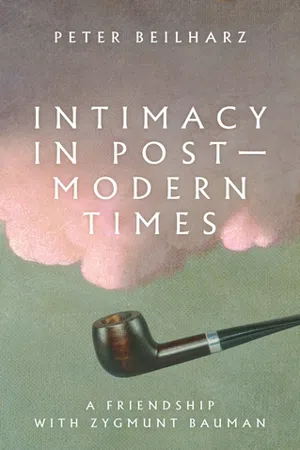
Zygmunt Bauman was one of the most important social theorists of recent decades. He did major work on the Holocaust, the postmodern and much else, up to fifty-eight books in English on almost as many topics. In this book, Australian sociologist Peter Beilharz, Bauman's collaborator for thirty years, recounts the details of their relationship, simultaneously charting the changes that have occurred in academic life from the 1980s to today. Friendship was one of the bonds that made Bauman and Beilharz's intellectual collaboration possible. Though the two were worlds apart in terms of biography and place, their work together was defined by a certain kind of intimacy. Separated by a generation, they collaborated for a generation together. This book follows their story in touching detail while puzzling over Bauman's rich yet contested legacy.
- 240 pages
- English
- ePUB (mobile friendly)
- Available on iOS & Android
eBook - ePub
About this book
Information
Part I
Itineraries and archives
Chapter 1
First decade
I began to travel to Leeds to work with Zygmunt Bauman in 1992. At that time, of course, neither of us knew that we would work together or become friends for all those years. My annual visits to the United Kingdom came, literally, to follow on annual visits to the United States, where I joined in the annual proceedings of the American Sociological Association (ASA). Other Australians also think like this: once you travel out, given the distances and costs, both financial and personal, it is usually worth travelling on, with a round-the-world air ticket or whatever else. I was attracted to what was continental in American sociology, and had a strong sense of curiosity about the United States and Europe. So the weeks away each year seemed continuous, even though the cultures and geographies I encountered were diverse. Transatlantic was an interesting canopy, alongside Pacific and Indian Oceans for me. I would fly into LAX from Melbourne, join in the ASA and visit some other cities – always an eye opener, for there was no such thing quite as coherent as ‘America’, and some of its bits were also elsewhere, beyond the borders. Then I would fly out from the East Coast to London or Manchester and travel on to Leeds. This would involve changes in climate and culture, but the conversation with my friends at ASA and then in Leeds was continuous. The world of critical theory, like everything else, was subject to uneven development, yet it also all seemed to fit to me.
There is also, of course, this longer story. What did I take into my friendship with Zygmunt Bauman? What was surprising was how much we already had in common, when we finally met up. We immediately entered the same conversation, notwithstanding the radical differences between us in terms of the existing experience of time and place that we each carried.
There was always life for me before Bauman. I met Bauman before Bauman; but there was also a Beilharz before Bauman. There were always books and ideas in my life, not in my family home but accessible nearby. So long as I can remember, from my late teens on I have been drawn to the library and to the archive, though the older I get the physically harder the long day of institutional confinement becomes. The library I first met in primary school. The Croydon Public Library was full of treats, including a nicely illustrated quarto volume on sex, which my mother made me return pronto. There was also an elevated shelf called ‘Know Ledge’, which I took in my innocence to be other materials beyond classification. Perhaps some knowledge was beyond classification, as Bauman would later come to argue. Libraries were, in any case, exotic and challenging places, full of intrigue and endless fascination. Public libraries can still have this kind of energy; I am less sure about university libraries, which these days look to me like what we used then to call coffee lounges, places to snooze or canoodle.
Then there was the archive. Probably I first met the idea of the archive in 1971, year 12 of high school, when our Australian history teacher, the labour historian N. W. Saffin, would share with us the primary materials he was using in Melbourne’s La Trobe Library. I was 17; he was in his 50s. Saffin’s big project was to write his five-volume history of the Victorian working class in our home state in Australia, named, as was much else in this empire, after Queen Victoria. His masterwork was not to be completed; on his own death, I placed it in the archives of the University of Melbourne. Yet it was an inspired teaching device, this use of the archive, which was to return to me later. He taught by archival example. While the caricature image of gold mining in the colony, for example, was single operatives with single tents and individual spades, he would unfold maps and floorplans in class to show how company mining worked. It was an industrial mode of production. The way of thinking pointed to Marx. Under his influence, and as a sign of the times, I became interested in socialism and the labour movement and their ideas. After college I began an impossible project on the history of Australian labour and Trotskyism – impossible because, as I later remarked to the novelist Kate Grenville, it was a history of holes (her father had lived in one of these holes).
My research, my doctoral dissertation and my first book finally took on Trotskyism as a way of thinking, a language or what we would these days call an imaginary.1 I worked under and then alongside the extraordinary historian and theorist Alastair Davidson, whose significance I appraise elsewhere, in another book, Alastair Davidson: Gramsci in Australia (2020), and in my own companion collection of essays, Circling Marx: Essays 1980–2020 (2020). Alastair taught me to pay attention to text, but also to archive. He understood a great deal about communism, but we discovered more together. Trotskyism remained, inevitably, a theoretical but also an archival challenge, whether the focus was on the organization of the movement or on its ideas. So I mined new archives, for my doctoral dissertation at the Houghton Library at Harvard for Leon Trotsky, the Dunayevskaya papers at Wayne State in Michigan and everything else I could find locally or have posted from further afield, this still being a time of letters and packages. I read the entire English-language international Trotskyist literature on microfilm and microfiche and a swathe of doctoral dissertations across the field. Alastair taught me a working principle now rendered redundant by the contemporary explosion of knowledge; he taught me that you should read everything. This was what might confer the right to speak. I became a collector. As my interests spread throughout the fields of socialism, my archives also expanded. Books! Pamphlets! Papers! Photocopies! Stuff everywhere.
For my second book, Labour’s Utopias, I discovered the extraordinary collections of the International Institute of Social History (IISH) in Amsterdam. Amsterdam became a regular port of call for me. I also worked on G. D. H. Cole’s papers at Nuffield, and on the Passfield papers at the LSE. Although by this stage I had been much influenced by historians, from Alastair Davidson to Stuart Macintyre, Ian Britain and Alan MacBriar, I had also come to the conclusion – perhaps under the influence of debates about the canon in Marxist circles – that in this kind of research the unpublished works had a secondary status to the published, at least for public thinkers of this kind –Trotsky, the Webbs, the Coles, Kautsky or Bernstein (I would never give up Marx’s Grundrisse, unpublished or not). I had established a working strategy for myself. First, to read all the published work, and to privilege it as the public face of the discourse, in the realm of public life; then, second, to read the unpublished papers in light of the patterns of thinking that had already become apparent to me. As much as I liked archives, I did not want to be an archive rat, a scholar who did the 16 metres of papers required for a dissertation, leaving the next length for the next labourer to follow. I wanted also to see the light of day, to sit in the Oosterpark after my day at the Amsterdam Institute, or in the Museum Tavern after a day in the British Library, wondering what Marx would have said, complaining about his carbuncles, or what he had to drink, waiting for dinner or the revolution.
But there were always treats, and you could surreptitiously run your finger over the signature of Weber or Keynes in the archives, or, in Amsterdam, check out the originals of The German Ideology. There were wonderful tips from people called librarians, who had extreme associative capacities, and were always keen for you to connect. And sometimes, as later in my research, you would blush or even cry at what had come to pass between these flesh and blood actors in the archives, in their love and guilt and pride and sorrow. For there is often intimacy in the archives, even after they have been edited by different hands, censored and classified and catalogued and filed away in those uniform and serried ranks of file boxes.
By this stage my sustained archival activity had likely peaked. I had taken over from Ágnes Heller, the leading student of Georg Lukács, teaching sociology at La Trobe University in Melbourne from 1988, and remained there until the tectonic plates shifted in 2014. The lineage seemed preposterous: Lukács – Heller – me?? But I had been taught already to enter open doors, and I always encouraged my students and friends to do likewise. For the first time now, at La Trobe, I had access to research funds. This is a vital part of my Bauman story, as I began now to travel annually, first for archives, then – as mentioned above – to the annual proceedings of the ASA. This, of course, was with more archives thrown in: those at the Hoover Institute, at Stanford, and much further work at the Houghton Library, in Cambridge, Massachusetts, later again. At the same time, I found myself designated a theorist, partly by choice or curiosity, partly because it was my teaching brief, a term of my employment – this even though I was begat by historians. From Ágnes, for example, I inherited her course on socialist ideas. This meant a step away from the archives, and in the direction of the library. But I also became an advocate of archives within sociology, publishing postcards on my enthusiasms in local journals such as Labour History, and arguing publicly and privately for the project of historical sociology. In my short experience, archives had become sources of immense possibility, though they were almost certainly underworked and often, for that reason, likely to become politically vulnerable in new times. Why not just throw the shit out? Or, at best, why not just digitize it? Such were the public controversies about to open, on the future of libraries and the death of the book, as I laboured in those archives.
Meanwhile, I was teaching a lot (teaching first year as well as second/third and running the fourth year honours programme at La Trobe), writing a lot, supervising up to a dozen postgraduates at a time, learning to write journalism and adopting its best tricks, writing for the dailies and journals, and writing … books, adding to the pile. And I had since 1980 been editing a journal called Thesis Eleven, another fine and steep learning curve, which may, as I now calculate, have taken up fully a decade of my life across 40 years of real time. Much energy was spent in the critique of ‘New’ Labor in Australia, which had arrived in 1983. The postmodern had also arrived: I wrote books out of books on Postmodern Socialism (1994) and on Zygmunt Bauman (2000), and I returned to the archives to write books on the great Antipodean art historian Bernard Smith and, later on, the mother of Australian sociology, Jean Martin.2
The vast majority of this work was researched and written at La Trobe University between 1988 and 2014. La Trobe when I arrived was paradise. Big; too big? Thirty-eight lecturers and above when I began, it was liberal and tolerant, rich and diverse, taking in sociology and anthropology and looking to work the crossovers between them wherever possible. Much of this time was privileged, though when decline later set in it was serious, and the restructures that followed were brutal – as they are. There was staff attrition and non-replacement, and an increase in teaching loads at Bundoora and in the regions – a qualitative increase in non-basic work, defined here as that in addition to teaching, research and writing. There came to be hostility towards sociology as we practised it. This is, of course, a picture of a now lost world, already beyond recognition to those who have come to university life more recently. Ergo its privilege. But, as I shall indicate in these pages, there was no shortage of busyness. We were working like fury, teaching, writing, researching, organizing, editing journals such as Thesis Eleven – the latter, in effect, all voluntary or weekend labour (or Sunday labour, as our subbotniks were already laboured for the university): ‘Weekend? What’s a weekend?’
Into the second decade of the new century our kind of work in critical theory or critical sociology had been redefined by our superiors as non-core business, surplus to requirement. Universities had been reconfigured as business enterprises. The writing on the wall said quit or be sacked. At this point, closer to my sixties, I was exhausted. Along this path I had become a professor, which surprised my family as much as it did me. I had set out to become a high school teacher, like Saffin. I wanted to spread the word, or the light – or, at least, the enthusiasm. In those last years at La Trobe it seemed clear: I could dig in, and be the last professor, or possibly be sacked. So I left, with a disabling sense of unfinished business, taking voluntary redundancy. (If you check the internet, you can find Bauman talking about the word and its referent: ‘Re–dun–dan–cy!’) Yet this was, to repeat, again, a privileged life. The last time I saw George Ritzer, at my final ASA meeting in Denver, 2012, he asked me the right question. How many good years did you have at La Trobe? I did the maths, and said: ‘Fifteen.’ Well, there you go!
Yet what I could accept, bitterly, about my own career exit I could not accept at an institutional level. Across the path of a generation there was something dramatic going on here, something like the structural and cultural transformation of the university. Across three decades the life of the university was transformed beyond recognition. The image of the liberal arts education was subsumed into that of vocationalization: institutions promising unreal offers of meal tickets to young folk, who paid big money for the prospect. There were more and more managers, and more and more teaching and learning units, fewer and fewer teachers. There was the hegemonic monster of PowerPoint. There was more speed, less or no student reading, a turn away from the library as a place of books. As Marx famously put it in Das Kapital, there was more quantity and less quality, more and more commodification and rationalization. Rankings and metrics, endless self-promotion; this is what the lazy or frustrated describe as the neoliberal university, though it may, rather, actually be a symptom of the speed of late modern times. All this presents us with a serious intellectual challenge, if we are to avoid nostalgia, perfectly defined by David Lowenthal as memory with the pain cut out.3 It is an issue to which I shall return, as the transformation of the university coincides directly with what Bauman wanted to call ‘liquid modernity’.
But, by this point, the personal message was clear: it was time for me to go. I had unfinished business in teaching and research, and still depended on their synergies. I still had a vampyric need of students, who always kept me on my toes, kept me thinking – as they still do, though now at Sichuan University, where I am currently professor of critical theory, and there is some need still for my type of skill set, or what we used to call ‘intellectual culture’. At La Trobe, as sociology declined, resources also evaporated. I could no longer afford to travel to the ASA proceedings. Travel support had seriously diminished, and then it disappeared, and I was depleting personal funds here in a way that I could no longer justify. This was a loss, because the ASA had become an annual source of replenishment and renewal of friendship for me. In those better years I could do business with friends from both sides of the Atlantic, talent-spot for Thesis Eleven, and at my own expense I would visit places and cities I had never dreamed of experiencing. I had developed a plan to visit at least two smaller cites after each ASA meeting, which invariably occurred in bigger cities because of the number of attendees – up to 6,000 souls – and the ASA’s commitment to using unionized hotels. This was a routine that was both personally fruitful and institutionally productive. It fed directly into my own teaching and productivity. There was much to learn in the big cities – LA, New York, Chicago – but, as Ihab Hassan insisted to me, the mid-size cities – such as his own, Milwaukee – were also indicative of another America.
But now the gig was up. It was time to leave La Trobe and my vocation. The point had arrived at which I would no longer call myself a sociologist, though sociology in general was always a decent default position if somebody asked what I did – more like a question of where you had come from. Other doors opened elsewhere, in terms of disciplines and places, in cultural studies at Curtin University in Western Australia, at the Stellenbosch Institute of Advanced Study in South Africa and in critical theory at Sichuan University in Chengdu with Fu Qilin. None of this was on the horizon when I left La Trobe in 2014. These were complete surprises to me. After La Trobe I thought it was over.
I was no longer a working sociologist after I left La Trobe, and no longer knew who I was, except in the past tense. In my last years there I was no longer able to initiate new research. I went part-time at La Trobe for years, looking to buy some research time, or at least some recovery time. I was constantly exhausted, and distracted by what other people insisted were urgencies or institutional imperatives. Each working day now began with a full in tray, and complaints for what could be construed as administrative tardiness. We achieved a great deal, grew Thesis Eleven through new generations, organized all kinds of events and visits, both home and away, across Australia and its regions, New Zealand, the Philippines, Singapore, Thailand, India, South Africa, Mozambique, China, the United States, Canada, Denmark and the United Kingdom. Our purpose was to promote cultural traffic and always to connect, to struggle against the follies of isolation that seemed to strike so many individual scholars, our friends who imagined that loneliness was a constitutive part of the scholarly co...
Table of contents
- Cover
- Half Title
- Title Page
- Copyright Page
- Dedication
- Contents
- Illustrations
- Preface
- Beginning
- Part I Itineraries and archives
- Part II Ways of going on
- Part III Talking the days
- Ending
- Acknowledgements
- Bibliography
- Index
Trusted by 375,005 students
Access to over 1.5 million titles for a fair monthly price.
Study more efficiently using our study tools.
Frequently asked questions
Yes, you can cancel anytime from the Subscription tab in your account settings on the Perlego website. Your subscription will stay active until the end of your current billing period. Learn how to cancel your subscription
No, books cannot be downloaded as external files, such as PDFs, for use outside of Perlego. However, you can download books within the Perlego app for offline reading on mobile or tablet. Learn how to download books offline
Perlego offers two plans: Essential and Complete
- Essential is ideal for learners and professionals who enjoy exploring a wide range of subjects. Access the Essential Library with 800,000+ trusted titles and best-sellers across business, personal growth, and the humanities. Includes unlimited reading time and Standard Read Aloud voice.
- Complete: Perfect for advanced learners and researchers needing full, unrestricted access. Unlock 1.5M+ books across hundreds of subjects, including academic and specialized titles. The Complete Plan also includes advanced features like Premium Read Aloud and Research Assistant.
We are an online textbook subscription service, where you can get access to an entire online library for less than the price of a single book per month. With over 1.5 million books across 990+ topics, we’ve got you covered! Learn about our mission
Look out for the read-aloud symbol on your next book to see if you can listen to it. The read-aloud tool reads text aloud for you, highlighting the text as it is being read. You can pause it, speed it up and slow it down. Learn more about Read Aloud
Yes! You can use the Perlego app on both iOS and Android devices to read anytime, anywhere — even offline. Perfect for commutes or when you’re on the go.
Please note we cannot support devices running on iOS 13 and Android 7 or earlier. Learn more about using the app
Please note we cannot support devices running on iOS 13 and Android 7 or earlier. Learn more about using the app
Yes, you can access Intimacy in postmodern times by Peter Beilharz in PDF and/or ePUB format, as well as other popular books in Philosophy & Philosopher Biographies. We have over 1.5 million books available in our catalogue for you to explore.