When the Declaration of Independence was signed by a group of wealthy white men in 1776, poor white men, African Americans, and women quickly discovered that the unalienable rights it promised were not truly for all. The Nineteenth Amendment eventually gave women the right to vote in 1920, but the change was not welcomed by people of all genders in politically and religiously conservative Kentucky. As a result, the suffrage movement in the Commonwealth involved a tangled web of stakeholders, entrenched interest groups, unyielding constitutional barriers, and activists with competing strategies.
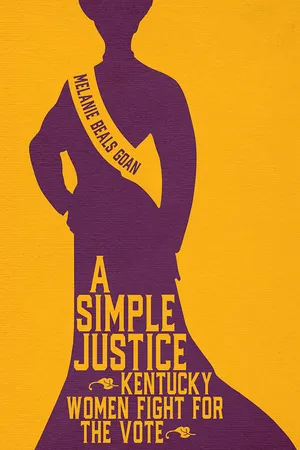
In A Simple Justice, Melanie Beals Goan offers a new and deeper understanding of the women's suffrage movement in Kentucky by following the people who labored long and hard to see the battle won. Women's suffrage was not simply a question of whether women could and should vote; it carried more serious implications for white supremacy and for the balance of federal and state powers—especially in a border state. Shocking racial hostility surfaced even as activists attempted to make America more equitable.
Goan looks beyond iconic women such as Susan B. Anthony and Elizabeth Cady Stanton to reveal figures whose names have been lost to history. Laura Clay and Madeline McDowell Breckinridge led the Kentucky movement, but they did not do it alone. This timely study introduces readers to individuals across the Bluegrass State who did their part to move the nation closer to achieving its founding ideals.
- 296 pages
- English
- ePUB (mobile friendly)
- Available on iOS & Android
eBook - ePub
About this book
Information
Publisher
The University Press of KentuckyYear
2020Print ISBN
9781985901520
9780813180175
eBook ISBN
9780813180205
1
The He-Women Come
To get to Kentucky from the North, one must cross the Ohio River. At its widest point near downtown Louisville, the Ohio River spans but a mile. A good swimmer could easily traverse it in less than an hour. But what it represents is much greater. In the antebellum period, it was a transportation lifeline for a developing frontier. When the Northwest Territory banned slavery, it became the escape route to freedom; slaves risked their lives and those of their children to cross. Coming out of the Civil War, the Ohio River resembled a scar, cutting through a wounded nation.
Even though Kentucky never seceded from the Union, Americans saw the Ohio River as the place where the North ended, and the Southland began—and for good reason. In its frontier days, Kentucky started out more west than south, but that, like so much, changed with the War. It has famously been said that Kentucky waited until after the Civil War to secede. Many of its white citizens, who signed on to defend the Union at the outset, grew bitter as the War turned into a fight to end slavery. They felt deceived, as their postwar choices indicate. In the years to follow, they celebrated the Lost Cause, they embraced the Democratic Party, and they went on a crusade to build Confederate monuments.1
When it came down to it, Kentuckians by and large whistled Dixie. They respected southern values, particularly the region’s commitment to patriarchy and white supremacy. Like their neighbors further south, many bristled as calls for black voting rights and woman’s rights challenged the patriarchal order that they viewed as natural and sacred. Upholding patriarchy was “not just an isolated, idiosyncratic whim of nostalgic Southerners,” historian Marjorie Spruill Wheeler reminds, it was “part of an intense, conscious, quasi-religious drive to protect the South against the ‘ravages’ of Northern culture during a period of massive and often unwelcome political, social, and economic change.” Woman’s rights would be a tough sell in a region turned upside down by the War and its aftermath.2
In 1926, in his classic history of Kentucky during the Civil War and “Readjustment” (the border state equivalent of Reconstruction), E. Merton Coulter acknowledged the woman’s rights movement’s difficult start. It is unclear who believed the concept more ridiculous, Coulter, or his nineteenth-century subjects. Suffrage was imported by “dissatisfied Yankee women … whose names were forgotten when marriage licenses were being issued,” he scoffed. These interlopers were only able to attract attention, he claimed, because they sold woman suffrage on its ability to counteract “negro suffrage.” Dismissive though he was, he was astute enough to recognize that woman suffrage was never just a gender issue, it was always a race issue too.3
Writing just six years after the American electorate expanded to include women, Coulter still saw the movement as a bit absurd. Radical, unwomanly, and imported, suffrage did not mesh well with Kentucky’s conservative values. “The seeds were being sown, but nothing but rocky ground awaited them in Kentucky,” Coulter reported.4
Woman suffrage would not be an easy sell in Kentucky by any means, but some of these seeds were destined to take root. The Commonwealth was not an infertile field as Coulter claimed, but rather became active ground for northern suffrage organizers both before and after the Civil War. Crossing the Ohio River was a key step in their plan to make suffrage into a truly national, and they hoped a winning, movement.
Lucy Stone, known for having a voice like a silver bell, was one of the first northerners to cross into Kentucky to sow woman’s rights seeds in 1853. Stone was used to going against the grain, and she was undaunted by the challenges her visit to Louisville was sure to bring. Tackling the South was like carrying the “war into Africa,” one of her suffrage colleagues later noted. Stone was up for the challenge.5
Stone attended the Oberlin Collegiate Institute, one of the nation’s first interracial and coeducational institutions, but even a progressive college like Oberlin was not prepared to take on the likes of young Lucy, who suffered through a stormy career there. She studied to be a schoolteacher, but she could not bear it that male teachers earned higher salaries than equally qualified women. She decided instead to become a public orator. The meeting hall would be her classroom, the nation her students.6
The Massachusetts Anti-Slavery Society hired Stone as a lecturer in 1848. When she began mixing women’s rights with abolition, however, her sponsors balked. Stone reminded leaders of the society that she had been a woman before she became an abolitionist and continued to do as she pleased. By the 1850s, she was recognized as one of the most famous women in America, a distinction that did not make her embarrassed family any happier about her career choice.7
It was not easy work. She became accustomed to hostile crowds. Some audience members signaled their displeasure by throwing rotten fruits and vegetables. Others pelted her with “coarse and ribald speech.”8
Stone expected to witness the same hostility or worse from southern audiences. Her message was sure to rub white southerners wrong in two directions: an abolitionist and a proponent of women’s rights would face an uphill battle here, she assumed. Kentuckians had heard that some women were complaining about the limitations of their sex, but they had yet to see these complaints delivered in person.
Louisville was abuzz weeks before Stone arrived in November 1853. If her subject matter was not intriguing enough, her clothing choices guaranteed that she would get plenty of attention. Newspapers announced that she would be sporting the Reform Dress, also known as the “Bloomer costume” in honor of its popularizer Amelia Bloomer, or the “Turkish Trousers” in reference to its construction. The Bloomer looked normal from the waist up, but below that point, it was thoroughly unconventional, with its short full skirt, layered over a long set of pantaloons. Less about fashion and more about freedom of movement and healthy living, bloomers allowed the wearer to shed her “spine destroying” dresses, corsets, and layers of petticoats. The Louisville Daily Courier first took note of the trend in May 1852, noting that women, including “seven ladies of respectable appearance,” had been spotted wearing Bloomer dresses in Philadelphia. The following spring, Bloomers were available for sale in Louisville, but whether they found wearers is anyone’s guess.9
The thirty-five-year-old Stone not only donned the Bloomer costume (and continued to do so for four long years, even after her beleaguered colleagues went back to long skirts), she kept her hair cut short, clipped at the chin, and tucked behind her ears, giving her a startling boyish look. Nineteenth-century white women rarely wore short hair unless they lost it to illness or were inmates of the poorhouse and fending off lice. Short hair made a bold statement.10
Louisville residents bubbled with curiosity. What would Stone look like and what would she say? George D. Prentice, editor of the Louisville Daily Courier and one of the first to greet the city’s guest, provided his readers a sneak peek. He praised “Miss Lucy” for her “beauty” as well as her “force” and her “eloquence.” His compliments came, not by accident, in that order since a southern gentleman was conditioned to measure women according to appearance. Prentice had expected a manly, irrational “Abolition agitator,” but instead he encountered an attractive woman who presented a subject “chock full of common sense.”11
When planning her Louisville stop, Stone questioned whether any listeners would show up, but with the Daily Courier’s ample coverage, she had no need to worry. Three talks were scheduled over four nights in Masonic Hall. All were astonished, even Miss Stone, by the size of the first night’s audience, Prentice reported. The weather was terrible—rainy, sloppy, and muddy, a challenge especially for “long skirted ladies,” who one suspects may have wished they too had embraced the Bloomer fad—but they came anyhow.12
In her first two talks, Stone chose to cover topics that were close to the hearts of conservative southerners: the Bible and marriage. She titled her last talk “The Social and Educational Disabilities of Woman,” gently nudging her listeners out of their comfort zones. When the ladies of Louisville requested that Miss Stone “favor them with an afternoon lecture,” a reprise of her Bible exegesis, she happily complied. The press gave “full and friendly reports” after each talk, allowing many more than the thousands that filled the lecture hall to hear her message.13
In late November, Stone moved on to Indianapolis, satisfied with a job well done. The South had not been so scary after all. The Daily Courier sent her off with a jaunty but dismissive couplet, suggesting that while he remained a paragon of hospitality and chivalry, Prentice had no intention of accepting the cause Stone peddled: “Her dress is somewhat scanty / But her tongue is somewhat long; Her heart is right they tell us / But we know her head is wrong.”14
Stone’s work in Louisville was part of a one-two punch delivered to Kentucky that year. The month before, upriver in Maysville, Lucretia Mott similarly introduced the idea of women’s rights when she spoke on “Human Freedom” at the courthouse. A cordial though skeptical observer noted that though a “Radical,” she was an “old girl of talent.” Kentuckians were willing to hear women’s rights advocates out, but their messages would be slow to sink in.15
Having heard the Declaration of Independence recited so often, modern observers forget how truly revolutionary its words were and are. When the US founders proclaimed, “We hold these truths to be self-evident, that all men are created equal, that they are endowed by their Creator with certain unalienable Rights, that among these are Life, Liberty, and the pursuit of Happiness,” they turned existing worldviews completely on their heads. In the eighteenth century, most Europeans assumed that some individuals were chosen to rule, and all others were destined to be ruled. Hereditary monarchy was the prevailing form of government. The American Revolution and the Enlightenment that fueled it led to a political reimagining of spectacular proportions.
The birth of American democracy transformed the world, but it also raised troubling inconsistencies and quickly revealed its imperfections. Historian Anna-Lisa Cox concedes “While the men that signed the Declaration may not have had the imagination or courage to envision a nation where all men were truly free and equal, others around them were acting on these ideals, their imaginations sparked by a new way of thinking about people and societies.”16 Inspired poor white men, African Americans, and even women took the promises at face value and set out to claim the blessings of liberty that the new nation so boldly promised. They quickly discovered, however, that the promises of equality had limits.
The great American experiment—and that is exactly what it was, a risky venture in no way predestined for success—was bold on paper but more restricted in practice. It was hard to tamp down the fear that the whole thing would implode. After all, ancient Athens was the model of democracy and look how it had ended. Throwing off British control through military action was just the first step. The gritty work of putting revolutionary ideals into practice would take much longer. The real revolution would be written in ink, not blood.17
What kind of government would be created and who would have a say in it? Much was at stake.
Many today might be surprised to learn that the US Constitution, so thoughtfully framed—some would say divinely inspired—does not grant anyone the right to vote. The Constitution and even the Bill of Rights are silent on the topic, only vaguely guaranteeing to every state “a Republican Form of Government.” State suffrage laws, rather than federal standards, determine the franchise, even in national elections.
The omission, political historian Allan J. Lichtman argues, was a “consequential mistake.” Only through constitutional amendment could the federal government protect voting rights. These amendments—the Fifteenth Amendment dealing with race, the Nineteenth Amendment concerning sex, and the Twenty-Sixth Amendment addressing age—are all framed negatively, stipulating what states cannot do, not what they must do.18
In part, the failure to identify who could and could not vote reflected a respect for established procedure. Largely built on imported British common law, American voting traditions predated the Constitution. Requirements varied from state to state, but most typically only enfranchised propertied white males. Owning property signaled that a voter had a stake in society and could exhibit independent judgment without fear of manipulation. And in a period when most Americans earned their living off the land, this requirement made sense. But in the wake of the Revolution new states began to drop property requirements and to rethink who deserved a voice.
During the heady days after the Revolution, with high-minded rhetoric still echoing in Americans’ ears, states rewrote their constitutions. More white men gained voting rights, and in some cases, states even added women and black men to the voting rolls. The frontier especially identified itself as a progressive place that nurtured freedom. For example, when Kentucky became the fifteenth state added to the Union in 1792, it allowed all males over the age of twenty-one, property owners or not, to vote. Freed black men could even cast ballots at first, but they lost that right when the state rewrote...
Table of contents
- Cover
- Half title
- Title
- Copyright
- Dedication
- Contents
- Introduction
- 1. The He-Women Come
- 2. Jars of Clay
- 3. To Frankfort
- 4. Woman Triumphant
- 5. How Do You Spell Equality?
- 6. Rescission
- 7. All Women Cannot Be Heroes
- 8. Louisville Awakens
- 9. Meeting New Work with New Methods
- 10. The Pink Tea Stage
- 11. Working for Peace
- 12. Ignis Fatuus
- 13. Twenty-Four
- 14. An Instrument to Help Humanity
- Epilogue
- Acknowledgments
- Notes
- Further Reading
- List of Abbreviations
- Index
Trusted by 375,005 students
Access to over 1.5 million titles for a fair monthly price.
Study more efficiently using our study tools.
Frequently asked questions
Yes, you can cancel anytime from the Subscription tab in your account settings on the Perlego website. Your subscription will stay active until the end of your current billing period. Learn how to cancel your subscription
No, books cannot be downloaded as external files, such as PDFs, for use outside of Perlego. However, you can download books within the Perlego app for offline reading on mobile or tablet. Learn how to download books offline
Perlego offers two plans: Essential and Complete
- Essential is ideal for learners and professionals who enjoy exploring a wide range of subjects. Access the Essential Library with 800,000+ trusted titles and best-sellers across business, personal growth, and the humanities. Includes unlimited reading time and Standard Read Aloud voice.
- Complete: Perfect for advanced learners and researchers needing full, unrestricted access. Unlock 1.5M+ books across hundreds of subjects, including academic and specialized titles. The Complete Plan also includes advanced features like Premium Read Aloud and Research Assistant.
We are an online textbook subscription service, where you can get access to an entire online library for less than the price of a single book per month. With over 1.5 million books across 990+ topics, we’ve got you covered! Learn about our mission
Look out for the read-aloud symbol on your next book to see if you can listen to it. The read-aloud tool reads text aloud for you, highlighting the text as it is being read. You can pause it, speed it up and slow it down. Learn more about Read Aloud
Yes! You can use the Perlego app on both iOS and Android devices to read anytime, anywhere — even offline. Perfect for commutes or when you’re on the go.
Please note we cannot support devices running on iOS 13 and Android 7 or earlier. Learn more about using the app
Please note we cannot support devices running on iOS 13 and Android 7 or earlier. Learn more about using the app
Yes, you can access A Simple Justice by Melanie Beals Goan in PDF and/or ePUB format, as well as other popular books in History & North American History. We have over 1.5 million books available in our catalogue for you to explore.