eBook - ePub
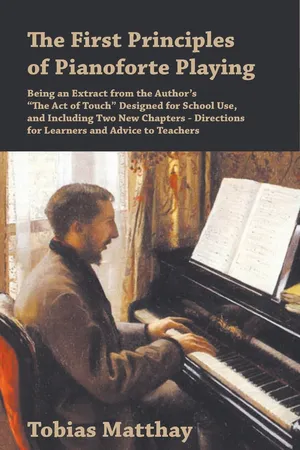
The First Principles of Pianoforte Playing
Being an Extract from the Author's "The Act of Touch" Designed for School Use, and Including Two New Chapters - Directions for Learners and Advice to Teachers
- 142 pages
- English
- ePUB (mobile friendly)
- Available on iOS & Android
eBook - ePub
The First Principles of Pianoforte Playing
Being an Extract from the Author's "The Act of Touch" Designed for School Use, and Including Two New Chapters - Directions for Learners and Advice to Teachers
About this book
"The First Principles of Pianoforte Playing" is a vintage guide to playing the piano. Originally designed as an introductory text intended for use in secondary schools, it presents the most elementary principles in a way that can be understood by the beginner. This volume is highly recommended for those with a practical interest in playing pianoforte or piano. Contents include: "Directions and Definitions for Learners", "General Directions", "Summary – Reminder of Main Points", "Extract from 'The Act of Touch", "The Act of Playing", "On Rhythm", "Piano Talent", "As to Self Consciousness and Nervousness", etc. Tobias Augustus Matthay (1858 – 1945) was an English pianist, composer, and teacher. He was taught composition while at the Royal Academy of Music by Arthur Sullivan and Sir William Sterndale Bennett, and he was instructed in the piano by William Dorrell and Walter Macfarren. Other notable works by this author include: "The Act Of Touch In All Its Diversity: An Analysis And Synthesis Of Pianoforte Tone Production" (1903), "The First Principles of Pianoforte Playing (1905)" and "Relaxation Studies" (1908). Many vintage books such as this are increasingly scarce and expensive. It is with this in mind that we are republishing this volume now in an affordable, modern, high-quality edition complete with a specially-commissioned new biography of the author.
Trusted by 375,005 students
Access to over 1.5 million titles for a fair monthly price.
Study more efficiently using our study tools.
Information
Subtopic
MusicPART I.
INTRODUCTORY.
PREFACE TO “THE ACT OF TOUCH.”
ABILITY to understand and feel Music, and ability to communicate such perceptions to others by means of an instrument, are two totally distinct accomplishments. They have often been confused, owing to the fact, that it is impossible to achieve a really satisfactory musical performance without their happy combination.
To become pianoforte players, we must learn Music, and must acquire Taste, but we can only succeed in expressing what we feel, musically, by means of the physical act of key-depression. In short, the purely physical act of playing consists solely of an ACT of Touch,—an act of Tone-production. All the gradations of Agility (fleetness of finger), Duration (staccato and legato), as well as all the contrasts of Tone-inflection depend solely and directly on the nature of this act; and it is therefore upon our expertness in the ART of Touch that the whole superstructure of Pianoforte-playing rests. The Art of Touch may indeed be concisely defined as: command over the Means of Expression.
This Art thus forms the very Foundation (the Elements or Rudiments) of Pianoforte-playing; and it can no more be a “gift” (as so often supposed) than is the art of articulate Speech itself; for it can be acquired by every person of average intelligence. Its precise place in the scheme of Pianoforte Education need not here be further dilated upon, since Part I. is devoted to that purpose; and the reader is referred to the Summary of this Part, on page 40.
A performer can indeed prove himself to be musical only to the extent of his command over touch variety. It is the constant flow of note to note touch-inflections that forces one to realize that a performer is a sentient being. And it is just this Art of Touch, that will for ever defy mechanical imitation; and will for ever render the simplest performance, coloured by human fingers, immeasurably superior to the most complex one obtained by mechanical agency, however perfect the machine.
Although it is only thus, by perfecting himself in the Art of Touch, that the player can obtain the means of expressing his musical sensibilities, yet until within quite recent years the paramount necessity of studying this problem had not begun to dawn upon teachers, artists, and students.
As the true fundamentals of this Art remained practically unrecognized, no serious attempt could be made to give direct instruction in it. True, it was recognised that the musically endowed evinced a “finer touch” than did others less endowed; but this, it was assumed, was owing solely to some occult influence over the keyboard, the possession of which enabled the favoured ones to produce tone of a better quality and of finer gradations;—and there is some half-truth in this, for it is certain that the possession of a musical ear, and a strong wish for musical expression, will undoubtedly compel the player to experiment at the keyboard, until he does sooner or later discover for himself at least some of the mechanical Means that will conduce to success. True, also, that the more serious teachers have insisted upon the necessity of good quality and variety of Touch. But even the greatest, so far, have relied almost exclusively upon empirical methods, or upon the force of Example. Or they have insisted upon what is after all a mere accompaniment of good touch, i. e.: Position and Movement—thus placing “the cart before the horse.” True it is, moreover, that the necessity of rationally studying this problem has lately made itself keenly felt, especially in America. How pressing this need is, becomes only too painfully evident, when one has to teach those who have already formed wrong muscular-habits, and when one is compelled to witness the ineffectual struggles of many even of the musically endowed in the Examination-room, and Concert-room, who, were they not thus handicapped by faulty habits (acquired through ignorance of these Rudiments) could give free vent to the powers of perception and imagination evidently latent in them!
Obviously the only way to succeed in the attempt rationally to learn and teach the Act of Touch in all its immense variety, is, first to discover through ANALYSIS how the successful players obtain their effects, and then to test such Analysis, by observing whether the act of touch, built up in accordance with such analysis, does give the anticipated tonal-results.
Having thus determined the structure of all varieties of touch, and the permits to Agility, we ought then to be in a position directly to help ourselves and others towards their acquisition.
The Means of Touch-variety or Key-treatment having thus been analysed, it follows that all who will take the trouble to master the subject—all who will take the trouble to understand the requirements of Key and Muscle, and will take the trouble to form these into physical and mental habits—will be able to acquire the language of Expression. Everyone may thus be enabled to gain power of Agility and Colouring; and even the musically endowed, may, by directly acquiring a tone-palette (or Touch-palette) thus save years of time, which would otherwise be wasted in futile experiments, and in forming bad habits.
As I have now for a great number of years applied such Analysis and Synthesis of Touch in my daily work of teaching, doing so always with increasing directness, and mainly ascribe such success as I have had as a teacher (and my pupils, also, as teachers) to the resulting ability to point out the immediate causes of the observed faults, and the direct means of their correction—to the ability to show explicitly HOW to command the physical fulfilment of each interpretative and technical detail, I have long been urged to render this knowledge more widely accessible, and the present little work is the result.
In endeavouring to place the many unfamiliar facts and new ideas before the reader, there was however this dilemma to face: that innumerable prejudices and fallacies would have to be combated, and that to do this would render the treatise too elaborate for the Schoolroom; whereas, to limit it to direct information in its concisest form (as required for the Schoolroom) might render its teachings liable to misconception, and unacceptable to the prejudiced.
To overcome this difficulty, the work has been laid out in four Parts, as follows:—Part I, is purely introductory, and purposes to show the relation the study of Touch bears to the general problems of Pianoforte-education. This is followed by the practical Parts, II to IV. Part II, “The instrumental aspect of Key-treatment,” demonstrates the nature of the mechanical difficulties to be overcome,—what are the requirements of the key, and how the key must be treated for each kind of effect. Part III, “The muscular-aspect of Key-treatment,” exhibits the muscular difficulties of the problem, and their solution—the muscular means we must adopt, to fulfil the key’s requirements. Finally, Part IV deals with the positional aspect of the subject—the postures and movements which must, or may, accompany correct key-treatment. Each of these practical Parts consists first of a Preamble, giving a general idea of the matter to be dealt with, followed by a number of chapters, providing explanatory details; each of these chapters being followed by a RECAPITULATION, and each of the Parts again by a SUMMARY; the concluding chapter of the work, moreover, giving a Glossary of the whole. A system of Notes accompanies the text, and Appendices, which follow each Part, give further opportunity for detailed instruction.
In this way, the close enquirer may obtain full information in the chapters, while the less advanced student can be referred to these Recapitulatories and Summaries. These, in fact, form a work complete in itself,—a digest or extract, designed for school use. This Digest or Extract, is intended for publication in a separate form later on, to render it more easily available for such purpose.
The work, it will be seen, is entirely explanatory. It has nothing to do with any particular system of exercises or studies, etc. The Student can apply its teachings at any stage of his progress, since it applies in all cases, whatever the system of teaching or exercises adopted in other respects.
The Artist can learn from it the reason of his greater or lesser success technically, and how further to improve his powers of Expression. The Teacher will find it useful at every step; and finally the Critic can find in it a basis for his technical opinions.
This work may presently be followed by an extra Part—Part V, giving certain exercises for acquiring Muscular-discrimination, which have been found useful in direct teaching.
Coming now to the end of the years of labour expended on this little volume, the late Professor TYNDALL’S words recur to me: “The ease with which an essay is read, is often a measure of the laboriousness with which it has been written;”—and in concluding, I can only express the hope that my readers may find some measure of correspondence between my labour in this instance, and its result!
I must also here take the opportunity of thanking the many kind friends who have encouraged me in my self-imposed task, and to acknowledge the valuable help given me in the revision of the proofs, etc., by Mrs. Kennedy-Fraser, of Edinburgh, and others.
TOBIAS MATTHAY.
HAMPSTEAD, LONDON,
July, 1903.

NOTES TO PART I.

“ON LISTENING”
NOTE I.—For § 2, Chapter II., page 11. It is so very easy not to “listen” properly; but instead, merely to hear. In the latter case, the only result can be, that we simply hear that which our automatic centres happen to play; whereas, by listening—outwardly and inwardly, we shall perhaps succeed in “doing” that which our inner ear directs.
Our eyes can give us a similar difference of experience; for we may look at a page, a picture, or a scene, and fancy we “see”; and yet all the while, we are not even trying to perceive. A fact we shall immediately discover, if we try to reproduce that page, picture, or scene!
It is the same, if we wish to communicate an idea. Unless we ourselves definitely try to see that thought, we shall certainly be unable to communicate it.
We can neither paint, draw, nor write successfully, unless we have an inner picture we wish to fulfil through the implement in our hands.
In fact, a keen—but unconscious—analysis of the thing that is to appear, has all the while to precede the “doing.” To the extent that such analysis is efficient, to that extent only can the Artist “see” or “feel,” as he puts it,—he himself being naturally unaware of his own mental processes. To communicate the thing seen, he must have the power of execution; he must have the knowledge and experience that will unconsciously guide him to choose the exact combinations of colours and shapes, that will render his Conceptions—facts of the Imagination—into physical Actuality.
It is customary to quiz a novice, experimenting with a gun, and to assert, that having aimed most carefully, he after all closes his eyes before pulling the trigger!
It is however no exaggeration to assert that ninety-nine out of every hundred Piano students act analogously at their instrument! Even if they do go so far as to think of the actual key they mean...
Table of contents
- Cover
- Title
- Copyright
- Tobias Matthay
- Preface
- Contents
- Directions and Definitions for Learners
- Extract From “The Act of Touch.”
- Part I:—Introductory
- Part II:—Instrumental Aspect of Key-Treatment
- Part III:—Muscular Aspect of Key-Treatment
- Part IV:—On Position
- Advice to Teachers and Self-Teachers
- Appendix
Frequently asked questions
Yes, you can cancel anytime from the Subscription tab in your account settings on the Perlego website. Your subscription will stay active until the end of your current billing period. Learn how to cancel your subscription
No, books cannot be downloaded as external files, such as PDFs, for use outside of Perlego. However, you can download books within the Perlego app for offline reading on mobile or tablet. Learn how to download books offline
Perlego offers two plans: Essential and Complete
- Essential is ideal for learners and professionals who enjoy exploring a wide range of subjects. Access the Essential Library with 800,000+ trusted titles and best-sellers across business, personal growth, and the humanities. Includes unlimited reading time and Standard Read Aloud voice.
- Complete: Perfect for advanced learners and researchers needing full, unrestricted access. Unlock 1.5M+ books across hundreds of subjects, including academic and specialized titles. The Complete Plan also includes advanced features like Premium Read Aloud and Research Assistant.
We are an online textbook subscription service, where you can get access to an entire online library for less than the price of a single book per month. With over 1.5 million books across 990+ topics, we’ve got you covered! Learn about our mission
Look out for the read-aloud symbol on your next book to see if you can listen to it. The read-aloud tool reads text aloud for you, highlighting the text as it is being read. You can pause it, speed it up and slow it down. Learn more about Read Aloud
Yes! You can use the Perlego app on both iOS and Android devices to read anytime, anywhere — even offline. Perfect for commutes or when you’re on the go.
Please note we cannot support devices running on iOS 13 and Android 7 or earlier. Learn more about using the app
Please note we cannot support devices running on iOS 13 and Android 7 or earlier. Learn more about using the app
Yes, you can access The First Principles of Pianoforte Playing by Tobias Matthay in PDF and/or ePUB format, as well as other popular books in Media & Performing Arts & Music. We have over 1.5 million books available in our catalogue for you to explore.