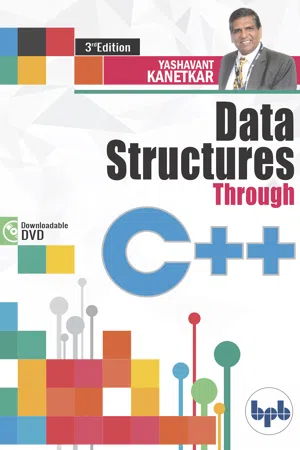
Learn the fundamentals of Data Structures through C++There are two major hurdles faced by anybody trying to learn Data Structures: Most books attempt to teach it using algorithms rather than complete working programs.A lot is left to the imagination of the reader, instead of explaining it in detail.This is a different Data Structures book. It uses C++ language to teach Data Structures. Secondly, it goes far beyond merely explaining how Stacks, Queues and Linked Lists work. The readers can actually experience (rather than imagine) sorting of an array, traversing of a doubly-linked list, construction of a binary tree, etc. through carefully crafted animations that depict these processes. All these animations are available on the Downloadable DVD. In addition, it contains numerous carefully-crafted figures, working programs and real-world scenarios where different data structures are used. This would help you understand the complicated operations being performed on different data structures easily. Add to that the customary lucid style of Yashavant Kanetkar and you have a perfect Data Structures book in your hands. KEY FEATURES• Strengthens the foundations, as a detailed explanation of concepts are given • Focuses on how to think logically to solve a problem• Algorithms used in the book are well explained and illustrated step by step• Help students in understanding how data structures are implemented in programs WHAT WILL YOU LEARN• Analysis of Algorithms, Arrays, Linked Lists, Sparse Matrices• Stacks, Queues, Trees, Graphs, Searching and Sorting WHO THIS BOOK IS FORStudents, Programmers, researchers, and software developers who wish to learn the basics of Data structures.AUTHOR BIOYashavant KanetkarThrough his books and Quest Video Courses on C, C++, Java, Python, Data Structures,.NET, IoT, etc. Yashavant Kanetkar has created, molded and groomed lacs of IT careers in the last three decades. Yashavant's books and Quest videos have made a significant contribution in creating top-notch IT manpower in India and abroad. Yashavant's books are globally recognized and millions of students/professionals have benefitted from them. Yashavant's books have been translated into Hindi, Gujarati, Japanese, Korean and Chinese languages. Many of his books are published in India, USA, Japan, Singapore, Korea and China. Yashavant is a much sought after speaker in the IT field and has conducted seminars/workshops at TedEx, IITs, IIITs, NITs and global software companies. Yashavant has been honored with the prestigious "Distinguished Alumnus Award" by IIT Kanpur for his entrepreneurial, professional and academic excellence. This award was given to top 50 alumni of IIT Kanpur who have made significant contribution towards their profession and betterment of society in the last 50 years. In recognition of his immense contribution to IT education in India, he has been awarded the "Best.NET Technical Contributor" and "Most Valuable Professional" awards by Microsoft for 5 successive years. Yashavant holds a BE from VJTI Mumbai and M.Tech. from IIT Kanpur. Yadhavant's current affiliations include being a Director of KICIT Pvt Ltd. And KSET Pvt Ltd.His Linkedin profile: linkedin.com/in/yashavant-kanetkar-9775255
eBook - ePub
Data Structures Through C++
Experience Data Structures C++ through animations
- English
- ePUB (mobile friendly)
- Available on iOS & Android
eBook - ePub
About this book
Information
Subtopic
Programming AlgorithmsIndex
Computer ScienceChapter 01
Analysis of Algorithms
Justifying the means
Why This Chapter Matters?
The dictum “ends justify the means” doesn't hold good in Computer Science. Just because we got the right answer (end) does not mean that the method (means) that we employed to obtain it was correct. In fact, the efficiency of obtaining the correct answer is largely dependent on the method employed to obtain it. Hence scientific analysis of performance of the method is very important.
The method of solving a problem is known as an algorithm. More precisely, an algorithm is a sequence of instructions that act on some input data to produce desired output in a finite number of steps. An algorithm must have the following properties:
(a) Input - An algorithm must receive some input data supplied externally.
(b) Output - An algorithm must produce at least one output as the result.
(c) Finiteness - No matter what the input might be, the algorithm must terminate after a finite number of steps. For example, a procedure which goes on performing a series of steps infinitely is not an algorithm.
(d) Definiteness - The steps to be performed in the algorithm must be clear and unambiguous.
(e) Effectiveness - One must be able to perform the steps in the algorithm without applying any intelligence. For example, the step—Select three numbers which form a Pythagorean triplet—is not effective.
Why Analyze Algorithms?
Multiple algorithms may exist for solving a given problem. To determine which algorithm is more efficient than others, we need to analyze the algorithms. This analysis is done by comparing the time and/or space required for executing the algorithms. In this chapter we would analyze algorithms on the basis of time. We would carry out space based analysis in later chapters.
While doing time based analysis of algorithms we do not use conventional time units like seconds or minutes required for executing the algorithms. There are two reasons for this.
(a) A worse algorithm may take less time units to execute if we move it to a faster computer, or use a more efficient language.
(b) We are interested in relative efficiency of different algorithms rather than the exact time for one.
So instead of time units we consider the number of prominent operations that are carried out by the algorithm. For example, in a searching algorithm we would try to determine the number of comparisons that are done to search a value in a list of values. Or in an algorithm to add two matrices, we might determine the number of arithmetic operations it performs.
Once we identify the prominent operations in an algorithm, we try to build a function that relates this number of operations to the size of the input. Once these functions are formed for algorithms under consideration, we can compare them by comparing the rate at which the functions grow as the input gets larger. This growth rate is critical since there are situations where one algorithm needs fewer operations than the other when the input size is small, but many more when the input size becomes larger.
Thus analysis of algorithms gives us a scientific reason to determine which algorithm should be chosen to solve the problem.
What to Consider, What to Ignore?
It is very important to decide which operations to consider and which operations to ignore while analyzing an algorithm. For this we must first identify which is the significant time consuming operation(s) in the algorithm. Once that is decided, we should determine which of these operations are integral to the algorithm and which merely contribute to the overheads. There are two classes of operations that are typically chosen for the significant operation—comparison or arithmetic.
For example, in Searching and Sorting algorithms the important task being done is the comparison of two values. While searching the comparison is done to check if the value is the one we are looking for, whereas in sorting the comparison is done to see whether values being compared are out of order.
The arithmetic operations fall under two groups—additive and multiplicative. Additive operators include addition, subtraction, increment, and decrement. Multiplicative operators include multiplication, division, and modulus. These two groups are cou...
Table of contents
- Cover Page
- Title Page
- Copyright Page
- Dedication
- About the Author
- Acknowledgements
- Table of Contents
- Introduction
- 1. Analysis of Algorithms
- 2. Arrays
- 3. Linked Lists
- 4. Sparse Matrices
- 5. Stacks
- 6. Queues
- 7. Trees
- 8. Graphs
- 9. Searching And Sorting
- Index
- How to use the Downloadable DVD
Trusted by 375,005 students
Access to over 1.5 million titles for a fair monthly price.
Study more efficiently using our study tools.
Frequently asked questions
Yes, you can cancel anytime from the Subscription tab in your account settings on the Perlego website. Your subscription will stay active until the end of your current billing period. Learn how to cancel your subscription
No, books cannot be downloaded as external files, such as PDFs, for use outside of Perlego. However, you can download books within the Perlego app for offline reading on mobile or tablet. Learn how to download books offline
Perlego offers two plans: Essential and Complete
- Essential is ideal for learners and professionals who enjoy exploring a wide range of subjects. Access the Essential Library with 800,000+ trusted titles and best-sellers across business, personal growth, and the humanities. Includes unlimited reading time and Standard Read Aloud voice.
- Complete: Perfect for advanced learners and researchers needing full, unrestricted access. Unlock 1.5M+ books across hundreds of subjects, including academic and specialized titles. The Complete Plan also includes advanced features like Premium Read Aloud and Research Assistant.
We are an online textbook subscription service, where you can get access to an entire online library for less than the price of a single book per month. With over 1.5 million books across 990+ topics, we’ve got you covered! Learn about our mission
Look out for the read-aloud symbol on your next book to see if you can listen to it. The read-aloud tool reads text aloud for you, highlighting the text as it is being read. You can pause it, speed it up and slow it down. Learn more about Read Aloud
Yes! You can use the Perlego app on both iOS and Android devices to read anytime, anywhere — even offline. Perfect for commutes or when you’re on the go.
Please note we cannot support devices running on iOS 13 and Android 7 or earlier. Learn more about using the app
Please note we cannot support devices running on iOS 13 and Android 7 or earlier. Learn more about using the app
Yes, you can access Data Structures Through C++ by Yashavant Kanetkar in PDF and/or ePUB format, as well as other popular books in Computer Science & Programming Algorithms. We have over 1.5 million books available in our catalogue for you to explore.