Designed to provide an insight into the Blockchain in depth concept. Key Features
Book provide the in depth and up to date information about the technology.
Learn about Blockchain 1.0 to Blockchain 4.0
To Trace and link the DNA of Blockchain paradigm to real world entities.
To discuss comprehensively the relation of Blockchain to the cutting edge technologies today
To discuss the role of the leading global technology organizations in promoting the blockchain ecosystem
Focus on the impact of blockchain technology on the human resources function through a comprehensive case study.
Trace the origin of internet to Blockchain of the future & written like a story to make the Blockchain concept well understood in the right perspective and context of digital world's challenges
Description Insightful & Conceptual coverage of Internet & Blockchain evolution, Bitcoin, Ethereal, Hyper-ledger, R3 Cora, Auxledger, GDPR, Cybersecurity, Consensus, Mechanisms, Enterprise applications, Global Developments, BAAS platforms, Disruptions across various countries, functional areas along with solution architectures. What You Will Learn
Learn about Blockchain 1.0 to Blockchain 4.0
DAOs & ICOs-Facilitating Entrepreneurship
Birth of Enterprise Blockchain
Malware Attacks and the Cyberthreat.
IoT, DMADV, Blockchain as a Service.
Who This Book Is For
This book unfolds "Blockchain" in its true essence with no prefixes to it. Right sized for everyone who wants to hit the first mile on Blockchain.
This book will surely be a treasure for all those who are eager to know the disruptive impact & possibilities of this amazing paradigm.
Table of Contents
Introduction- How it started. Rise of Blockchain Religion
Whodunnit - Unravelling the Mystery of bitcoin's Origin
Blockchain - Some FAQs What is Blockchain? Some fundamentals
Its 'Data' Stupid! - The Rising Power of Data Exponents
The Rise of Digital Marketing: How it all Started
Customer Relationship Management (CRM)
Big Data Analytics & its Implications to organisations
Machine Learning & Artificial Intelligence: Automating the Future
Internet of Things- The booming penetration
Malware attacks and the cyberthreats
Risks of centralization & single points of failure
General Data Protection Regulations and their Implications
Blockchain- An introduction
Bitcoin & The Blockchain - The inception of the 'BigBang'
Key features and benefits of Blockchain
Ethereum- The State Machine
DAOs & ICOs- Facilitating Entrepreneurship
Blockchain Certified LLPs to Boost Entrepreneurship
Blockchain Platforms for Web 2.0 Applications
The Birth of Enterprise Blockchain
Hyperledger Project - Fabric, Sawtooth - Versatile and Empowering
Enterprise Blockchain Platforms- A brief look at options
DMADV: Lean Six Sigma inspired approach to architect a BCT Solution
Scaling up the Blockchain Project
Blockchain as a Service- Various platforms available
Blockchain Applications in Action- Case study
Blockchain use cases- Enterprises, Government, NGOs
Blockchainified Future- A Vision for progressive enterprises
Maneuvering in the World of GDPR
A safer and secure world with Blockchain based solutions
Annexure 1: Blockchain Glossary
Annexure 2: Big Data Analytics - Applications Across Global Enterprises
Annexure 3: Prominent Blockchain Based Applications and DAOs
Annexure 4: Consensus Models- A Practical Comparison
Annexure 5: Enterprise Blockchain Applications- Top use cases x Blockchain The Untold Story
Annexure 6: Corda Key Concepts
Annexure 7: Example of a Blockchain Technical White paper
Annexure 8: More on 3 Cs of Blockchain-Consensus, CIA & CAP.
Annexure 9: Concepts addressed in the book
Testimonials
About the Author Srinivas Mahankali is an Alumnus of IIT Madras and IIM Bangalore with over 25 years of corporate experience including CXO level experiences as head of Indian and Multinational IT Organisations. As a continuous learner, SM pursued professional courses in Capital Markets, Digital Marketing, Blockchain, BigData, Data Science, Lean Six Sigma and continues to pursue many other learning opportunities to keep himself abreast of the changing times! SM is always challenged to unravel the 'Why' of great organisations and is a big proponent of 'Execution Excellence. linkedin: linkedin.com/in/srini-ults
Introduction - How it started Rise of Blockchain Religion
1969 was a land mark year for the world. It was the year in which Internet was born.
In response to the launch of Sputnik by Russia, in 1957, US President Dwight Eisenhower created the ARPA agency, now known as DARPA (Defense Advanced Research Projects Agency) under the leadership of JCR Liklider, to regain the technological lead in the arms race& also protect America against a space based nuclear attack from Russia. Liklider evangelized within the IPTO about the potential benefits of a country-wide communications network and the ARPANET went live in October, 1969. By collaborating with academic, industry, and government partners, DARPA formulates and executes research and development projects to expand the frontiers of technology and science, often beyond immediate U.S. military requirements
On 29th October 1969, the first communications was made over a 50 Kbps AT&T line October, 1969, the first communications were between Leonard Kleinrock's research center at the University of California at Los Angeles, and Douglas Engelbart's center at the Stanford Research Institute and a two node ARPANET was born.
Thus, internet as we know today, came into existence as an outcome of the constructive competition between the two super powers of the post-World war-2 era, USA & Russia
The first networking protocol used on the ARPANET was the Network Control Program. In 1983, it was replaced with the TCP/IP protocol invented by Robert Kahn, Vinton Cerf and others which quickly became the most widely used network protocol in the world.
The birth of the Internet was facilitated by the confluence of many technologies and owes its existence to a collective vision of many visionary technologists. Some of them are outlined below:
• Vannevar Bush was the first to envision the benefits of Information Technology by describing, "memex" automated library system.
• Norbert Wiener the inventor of Cybernetics (the science of control and communications in the animal and machine) inspired the research to extend human capabilities through technology.
• The 1956 Dart mouth Artificial Intelligence conference inspired the world to seriously consider leveraging the Technology for the benefits of humanity.
• Marshall McLuhan envisioned a global village interconnected by an electronic nervous system.
The two node ARPANET born in October 1969 metamorphosed to connect, first the Universities around North America, and then to the research facilities in Europe through EUnet as the 'Internet' as we know today.
The use of the Internet exploded after 1990, causing the US Government to transfer management by first opening up to the world on April 30th 1993 as 'World Wide Web' and later to independent organisations to manage the entire eco-system.
The adoption of the World wide web grew exponentially through the late 1990s and the early 21st century with the development and adoption of cutting edge technologies like Digital marketing, Customer Relationship Management, Enterprise Resource Planning, Internet of Things, Artificial Intelligence , Machine learning, Robotics and the like. They helped the citizens of the world to dramatically improve their productivity and quality of life, but also gave rise to a number of side effects that intruded into the privacy of their lives and threatened security of the digitally influenced lifestyles.
This has resulted in the world searching for ways to protect themselves from the negative impacts of the technological advancements that exposed their vulnerabilities due to the oligopolistic tendencies of the digital giants exposed to the 'Internet villains' that focused on cyberattacks and unauthorized information leaks.
Blockchain that came into existence on 3rd January 2009 through the launch of the cryptocurrency by name bitcoin, promises to offer answer to many of these problems.
Many people in the world still think, Blockchain is nothing but Bitcoin! Such is the impact that bitcoin has created on people and systems across the world. It is 'Disruption' at the very best indeed! Shaking the very roots of convention and centralization, being mystical, yet building trust, being process driven, yet boosting entrepreneurial culture, being mostly limited to 'Transactions and States' yet impacting every possible business one can think of , not being run by any 'owner' but still creating enormous value and economic activity, the story of Blockchain without us ever knowing who it is, who started it all, is nothing but a Whodunnit Mystery that continues to impact us in many ways. While it is unknown, that who is the inventor of the Blockchain, it is indeed heartening to note the collective power of the giant 'centralized' organisations like Microsoft, IBM, Cisco, Intel, Oracle, Huawei, Amazon, SAP throwing their weight behind this movement even though this could disrupt their business models in many ways!
The birth of the Blockchain, through the birth of bitcoin coincided with the inception of the Big Data and the growing power of & vexation against the powers of centralization.
By putting the power back in the hands of the individual users and also the connected devices, while protecting their identities to a large extent, Blockchain has spurred an era of empowered customers and entrepreneurs while promising to mitigate the risk to the organizations.
Blockchain being a new domain, is rapidly growing in adoption across the world in the form of crowd funding & launch of cryptocurrencies, aided by the increasing trend towards 'Decentralization, Open source technologies and Cloud computing enabled Pay as you use approach' sweeping the world.
While currently there is no structured program across the global educational system, offering Blockchain related courses, this rapidly growing field has to be learnt through experience, where new approaches are discovered every day while old myths, approaches and realities are challenged.
It is important to learn about the Blockchain paradigm in the context of the various technologies that are operating in tandem and to understand the impact of Blockchain beyond the use of cryptocurrencies, currently dominated by bitcoin.
It is important to explain this concept in a way which facilitates proper understanding by all concerned including the users and enterprises who are supposed to fund its adoption, not just those technologists who are executing these projects.
Most importantly, we need to examine the potential impact of Blockchain, beyond the bitcoin!
Those who can embrace the change, are able to harness the enormous powers that a well-conceived and executed Blockchain platform can offer, while the rest could well transition their way into the oblivion.
Embrace the new paradigm and welcome to the new religion!
In this book, we traverse the technological journey of the world from the birth of the Internet to the future of Blockchain. Hope you enjoy the journey.
CHAPTER 2
Whodunnit- Unravelling the Mystery of Bitcoin's Origin
"The Times 3/Jan/2009 Chancellor on the verge of second bailout for banks"
-Satoshi Nakamoto - Genesis Block
Who do you think is the real Satoshi Nakamoto? A question plaguing millions of people across the world. It is indeed a Brilliant work of A Genius digital currency specialist, Cryptographer, Mathematician, Computer Programmer, A Super Grand Master of Chess, Marketer, A Passionate Activist against Centralization & Excessive Regulation and above all, someone who has no need for a Million Bitcoins available in his account, no need for the associated fame in return for the Anonymity that is needed to stand by the values of the Cryptocurrency he invented or someone who has the capacity to command respect from , employ/ work with all such persons combined for a cause?!
Let us examine the key suspects:
Satoshi Nakamoto, the name used by the unknown person or people who designed bitcoin and created its original reference implementation. As a part of the implementation, they also devised the first Blockchain database. In the process they were the first to solve the double-spending problem for digital currency. Incidentally, Hal Finney is the neighbour of a person by name 'SATOSHI NAKAMOTO' who did not have any clue about the technology aspects of Bitcoin, when interrogated.
Harold Finney was a cypher punk advocating the use of cryptography for the world's benefit, and said: "It seemed so obvious to me: 'Here we are faced with the problems of loss of privacy, creeping computerization, massive databases, more centralization - and David Chum offers a completely different direction to go in, one which puts power into the hands of individuals rather than governments and corporations. The computer can be used as a tool to liberate and protect people, rather than to control them'. "He was an early bitcoin user and received the first bitcoin transaction from Bitcoin's creator Satoshi Nakamoto. Finney lived in the same town for 10 years that Dorian Satoshi Nakamoto lived (Temple City, California), adding to speculation that he may have been Bitcoin's creator. Finney denied that he was Satoshi Nakamoto.
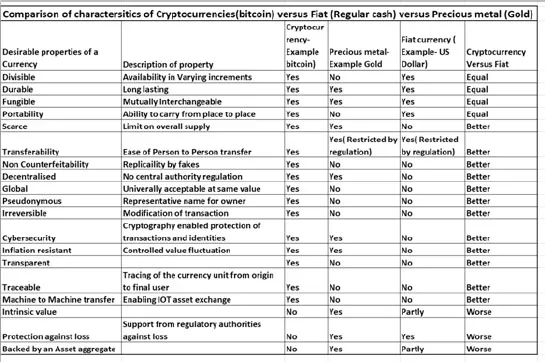
Let us examine the properties of Cryptocurrencies like Bitcoin with respect to other forms of value exchange like Fiat currencies and Gold.
Ae we know, the traditional concept of currency, which is traditionally used by all world citizens should have the following desirable characteristics
Wei Dai is a computer engineer and cypherpunk best known as creator of money and the developer of the Crypto++ library. Dai is listed as inventor on U.S. patents 5724279 and 6081598 which were assigned to Microsoft.
Mr. Dai worked in the Cryptography Research Group at Microsoft Corporation in Redmond, Washington. While at Microsoft, he was involved in the study, design and implementation of cryptosystems for specialized applications. Prior to joining Microsoft, Mr. Dai was a programmer with Terra Sciences of Acton, Massachusetts. Mr. Dai holds a Bachelor of Science degree from the University of Washington in computer science, with a minor in mathematics. "Dai has made numerous contributions to the field of cryptography and has identified critical Cipher Block Chaining (CBC) vulnerabilities affecting SSH2 and the browser exploit against SSL/ TLS known as BEAST (Browser Exploit against SSL/TLS).
Nick Szabo is a computer scientist, legal scholar and cryptographer known for his research in digital contracts and digital currency. He was graduated from the University of Washington in 1989 with a degree in computer science. In 1998, Szabo designed a mechanism for a decentralized digital currency he called "bit gold". Bitgold was never implemented but has been called "a direct precursor to the Bitcoin architecture. Research by financial author Dominic Frisby provided circumstantial evidence but, as he admits, no proof that Satoshi is Szabo. Speaking on RT's Keiser Report, he said "I have concluded there is only one person in the whole world that has the sheer breadth but also the specificity of knowledge and it is this chap...". In an email to Frisby, in July 2014, Szabo said "Thanks for letting me know. I'm afraid you got it wrong doxing me as Satoshi, but I am used to it".
At this juncture it is important to review the various options used as currency for value exchange among global citizens available today. The currency that we use, must have the following desirable characteristics:
(i) Scarcity: Limited supply of units represented by a common symbol (Example-$)
(ii) Fungibility: Interchange ability of unit is represented by the same symbol.
(iii) Divisibility: Ability to be divided into fractional units for varying transaction sizes.
(iv) Durability: The representative single unit should be available across time periods.
(v) Transferability: The units can be transferred from person to person into respective accounts.
In the real world today, Gold and US Dollar are seen as the standards for value transfer representing Precious metal and Fiat currency respectively.
Bill Gates, the co-founder of Microsoft has once famously said, 'Bitcoin is better than money'.
The differences between the various forms of value transfer are given in the table below:
It can be easily observed that, Bitcoin though having some limitations over a fiat currency like US Dollar, scores better across a range of desirable characteristics of a currency. No wonder, Bill Gates, went on to remark that 'Bitcoin is exciting because, it shows how cheap it can be. Bitcoin is better than currency in that you don't have to be physically in the same place and of course, for large transactions, currency can get pretty inconvenient.'
Let us look at some of famous quotes that are relevant to our discussion:
The crypto boom is like the dotcom bubble but that's not a bad thing: 'Selling crypto now is like selling Apple in 2001'- Yoni Assia, the CEO of eToro, a social trading platform that supports a range of cryptocurrencies. Business Insider , Oscar WilliansGrut- 18th June 2018
Some notable quotes by VitalikButerin, Co-founder, Ethereum are worth taking note of.
"The industrial revolution allowed us, for the first time, to start replacing human labour with machines.
Whereas most technologies tend to automate workers on the periphery doing menial tasks, Blockchains automate away the center. Instead of putting the taxi driver out of a job, Blockchain lets the taxi drivers work with the customer directly.
There are definitely a lot of banks that are interested in private Blockchains. In some cases, they are happy with public Blockchains as well. The opposition to just doing things on a public Blockchain is definitely smaller than some of...
Table of contents
Title Page
Copyright
Dedication
Preface
Disclaimers
Acknowledgement
Inspiration for the Second edition
Table of Contents
1. Introduction- How it started. Rise of Blockchain Religion
2. Whodunnit - Unravelling the Mystery of bitcoin's Origin
3. Blockchain - Some FAQs What is Blockchain? Some fundamentals
4. Its 'Data' Stupid! - The Rising Power of Data Exponents
5. The Rise of Digital Marketing: How it all Started
6. Customer Relationship Management (CRM)
7. Big Data Analytics & its Implications to organizations
8. Machine Learning & Artificial Intelligence: Automating the Future
9. Internet of Things- The booming penetration
10. Malware attacks and the cyberthreats
11. Risks of centralization & single points of failure
12. General Data Protection Regulations and their Implications
13. Blockchain- An introduction
14. Bitcoin & The Blockchain - The inception of the 'BigBang'
15. Key features and benefits of Blockchain
16. Ethereum- The State Machine
17. DAOs & ICOs- Facilitating Entrepreneurship
18. Blockchain Certified LLPs to Boost Entrepreneurship
19. Blockchain Platforms for Web 2.0 Applications
20. The Birth of Enterprise Blockchain
21. Hyperledger Project - Fabric, Sawtooth - Versatile and Empowering
22. Enterprise Blockchain Platforms- A brief look at options
23. DMADV: Lean Six Sigma inspired approach to architect a BCT Solution
24. Scaling up the Blockchain Project
25. Blockchain as a Service- Various platforms available
26. Blockchain Applications in Action- Case study
27. Blockchain use cases- Enterprises, Government, NGOs
28. Blockchainified Future- A Vision for progressive enterprises
29. Maneuvering in the World of GDPR
30. A safer and secure world with Blockchain based solutions
31. Annexure 1: Blockchain Glossary
32. Annexure 2: Big Data Analytics - Applications Across Global Enterprises
33. Annexure 3: Prominent Blockchain Based Applications and DAOs
34. Annexure 4: Consensus Models- A Practical Comparison
35. Annexure 5: Enterprise Blockchain Applications- Top use cases
36. Annexure 6: Corda Key Concepts
37. Annexure 7: Example of a Blockchain Technical White paper
38. Annexure 8: More on 3 Cs of Blockchain-Consensus, CIA & CAP
39. Annexure 9: Concepts addressed in the book
40. Testimonials
Trusted by 375,005 students
Access to over 1.5 million titles for a fair monthly price.
Study more efficiently using our study tools.
Frequently asked questions
Yes, you can cancel anytime from the Subscription tab in your account settings on the Perlego website. Your subscription will stay active until the end of your current billing period. Learn how to cancel your subscription
No, books cannot be downloaded as external files, such as PDFs, for use outside of Perlego. However, you can download books within the Perlego app for offline reading on mobile or tablet. Learn how to download books offline
Perlego offers two plans: Essential and Complete
Essential is ideal for learners and professionals who enjoy exploring a wide range of subjects. Access the Essential Library with 800,000+ trusted titles and best-sellers across business, personal growth, and the humanities. Includes unlimited reading time and Standard Read Aloud voice.
Complete: Perfect for advanced learners and researchers needing full, unrestricted access. Unlock 1.5M+ books across hundreds of subjects, including academic and specialized titles. The Complete Plan also includes advanced features like Premium Read Aloud and Research Assistant.
Both plans are available with monthly, semester, or annual billing cycles.
We are an online textbook subscription service, where you can get access to an entire online library for less than the price of a single book per month. With over 1.5 million books across 990+ topics, we’ve got you covered! Learn about our mission
Look out for the read-aloud symbol on your next book to see if you can listen to it. The read-aloud tool reads text aloud for you, highlighting the text as it is being read. You can pause it, speed it up and slow it down. Learn more about Read Aloud
Yes! You can use the Perlego app on both iOS and Android devices to read anytime, anywhere — even offline. Perfect for commutes or when you’re on the go. Please note we cannot support devices running on iOS 13 and Android 7 or earlier. Learn more about using the app
Yes, you can access Blockchain by Srinivas Mahankali in PDF and/or ePUB format, as well as other popular books in Economics & Banks & Banking. We have over 1.5 million books available in our catalogue for you to explore.