![]()
Chapter 1
WRITTEN AT THE TIME, REMEMBERED FOR ALL TIME
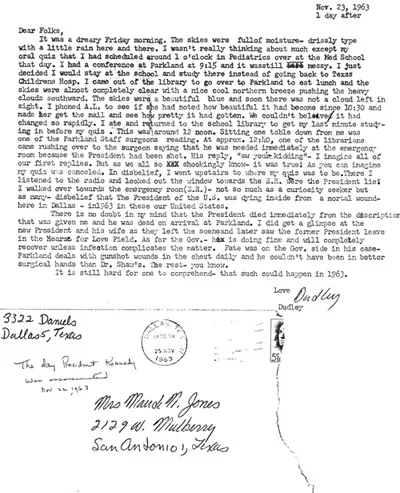
“I just came from Parkland and I wanted to write this while I remember how it really is,” wrote Kenneth Farrimond to his girlfriend, Susan. His freshman medical school classmate, Jed Rosenthal, began his letter, “Ma—Enclosed is an account of what happened today. . . . I was there—I felt him die.” Dudley Jones, another medical student, ended his letter to his folks with what we all thought, “It is still hard for one to comprehend, that such could happen in 1963.”
These three young men had a sense of their own history, and sufficient maturity to pull themselves together enough to communicate eloquently with their loved ones. Their letters are reproduced in this chapter in their entirety, and, as with most other of the forty eyewitness reports, parts of them appear in other chapters as well. I thank Farrimond, Rosenthal, and Jones for their thoughtfulness in sharing them with posterity.
An original copy of the Parkland Papers of November 1963, which contains the remarkable office memorandum written a few days after the assassination (and also reproduced here in its entirety), was sent to me by Charles Raney. He was kind enough to give me his perfectly preserved copy of the Dallas Morning News published twenty-five years after that fateful November day.
Jed Rosenthal, MD
Friday, November 22, 1963
Ma—
Enclosed is an account of what happened today. The way I saw it and the way I feel about it. I would like to keep this letter. I am writing it now because I know I will not be able to express how it affected me later on. I only wish I could write better and therefore express more correctly my feelings. This has upset me and angered me considerably. I am just going to let my mind go on paper.
Sorry I won’t be there for Thanksgiving—I shall really miss it. So long for now.
Love, Jed
Dallas, Texas, November 22, 1963
I still cannot believe what has happened today. The president of the United States, the leader of our country, the symbol of freedom to the world has been shot down—is dead—murdered.
Had I not been in Dallas at Parkland Hospital where he died, I do not think that I would realize what has happened. But I was there—I felt him die. I can think of only one other time when I was so emotionally upset—the day Dad died.
Ace, Kenneth, Fritz Barton, and Hank Bradley, all students at Southwestern Medical Center, were sitting in the apartment discussing radical groups in the United States. The John Birch Society was under fire—whether or not it is basically a group of patriotic people who have attracted a radical following, or is it in essence a radical dangerous group. We had discussed General Edwin Walker’s activities. All of us thought that he would be under heavy surveillance today while the president was in Dallas. All of us, though not agreeing with the president’s domestic policies, did agree that no one should picket his visit to Dallas, or in any way embarrass him by demonstrations or jeers during his stay here. He is the leader of our country and should be treated with the greatest respect. If you do not agree with his points of view, fine. Support and vote for someone else—but don’t degrade the president. I repeat we all felt very strongly about this. We were all hoping that we would get to see the president as he passed by the medical school on his way to Love Field.
It was now around 12:45. We were getting ready to go back to school. John Carnet (another student) came in and shouted, “The president has been shot! He is being taken to Parkland Hospital.” We could tell by the look on his face that this unfortunately was not a bad joke. Kenneth and I raced to his car (I didn’t notice where the others were) and started for school. On the way out I noticed Maurice, the colored cook at the Phi Chi house, standing by the stairs crying. I knew now that the report was true—that President Kennedy had been shot.
Kenneth and I reached school within five minutes, parked the car and ran over to the emergency exit at Parkland. The president, along with Governor John Connally, had just been taken into the hospital. By this time about 150 people had gathered outside the emergency room. The car in which the presidential party had been riding was by the loading dock. The bouquet of roses that Mrs. Kennedy had received was lying on the blood-stained floor of the special Continental convertible, whose bubble top had not been used because the president didn’t think it necessary—it was too fine a day!
The crowd had heard no news as to the condition of the president or governor. It was rumored that the president had been shot in the head. The faces of the crowd were confused, worried, some tear-stained. Everyone was saying some type of prayer.
A police car arrived and two large cartons marked “human blood” were carried into the hospital. About this same time two priests entered the hospital. There still was no news. A while later the priests came out. Reporters swarmed around them. They gave no news, but it was evident that last rites had been administered and our president was dying. However, there was no definite news and therefore still rays of hope. These were soon crushed when a man (presumably a doctor) announced that the president of the United States was dead. The time, a little after
1:00 p.m.
Some people started crying and sobbing uncontrollably—others like myself just stood there dazed, fighting back the tears. No one moved for a minute or so. Then cameras started snapping all around and reporters began questioning members of the presidential motorcade. It was a scene of confusion and disbelief. People were in fact questioning if this all was really happening or was it just a horrible dream, or imagination. These questions were soon answered as a hearse pulled up and a large ornate bronze-colored casket was carried into the hospital.
Lyndon Johnson and his wife came out of the emergency room door surrounded by Secret Service men. They were rushed into a waiting car. We later learned that the car drove immediately to Love Field and the presidential jet. Lyndon Johnson was met there by Sarah T. Hughes, a federal district judge, and Mr. Johnson was sworn in as president. The great plane that brought one president to Texas was to take a different president back to Washington.
Mrs. Kennedy and the body of her husband were still in the hospital. The crowd was waiting for her to come out with the casket containing the president’s body. I had no desire to see Mrs. Kennedy at this terrible time. I think grief is a very private, personal thing. Kenneth, Ace and I went back to the apartment and started to watch the endless newscasts. No one said very much.
I cannot believe that there could be in this, the most wonderful nation that has ever existed, a person so twisted in mind and spirit that he could commit this hideous crime. It is indeed a black, black day.
It is hard to believe that this man who earlier this morning was in such good spirits and health no longer lives, that he was dastardly shot down in the physical, mental and political prime of his life. Only last week I very much enjoyed the so human pictures of him and little John in Look magazine.
The government of the United States will not slow down. Tomorrow will come and other tomorrows will follow it. There is already a new president, the 36 th, Lyndon Johnson. I have great faith in President Johnson. I believe that as president he will give our country the same excellent leadership he did as Majority Leader of the Senate. I am sure right now the country is earnestly behind him. The entire world is shocked and is looking at America to see what will happen. This is a grave and serious time, but I am sure that President Johnson will rise to the occasion. We will show the world again what “kind of stuff” American people are made of.
Now all the people of these United States are united regardless of race, color or creed in a common grief. I only hope that when this grief wears off, the common union of all men will remain.
Jed
Kenneth Farrimond, MD
(his letter to his girlfriend, Susan)
November 22, 1963
Dear Susan,
I just came from Parkland and I wanted to write this while I remember how it really is.
At noon a bunch of us were talking politics here in the apartment when John Carnet [class of ’67 who dropped out after freshman year] came in and said the president had been shot and taken to Parkland Hospital. I didn’t really believe it—still don’t—not today, not in Dallas. John, Jed [Rosenthal ’67], Ace [Wallace Moore ’67] and I went immediately to the school and walked over to the hospital emergency entrance.
His car was still there—with blood stains on the back seat and Jackie’s bouquet of yellow roses on the floor. The confusion was unreal. Not many people, but nobody knew anything except that he was shot. A doctor or intern that one boy knew came out a backdoor and told us there was no hope—that he was dying fast.
By this time people had gathered. Sen. Yarborough stood near us crying and talking to the press. He kept saying “it was terrible.” Police and secret service people were all over the place but they didn’t seem to know what to do. We could go anyplace.
People from the motorcade were all over the place, and everybody’s story was different—except all had heard three shots. Everyone, police included, milled around like lost animals awaiting a slaughter. Over and over I heard “God damn!” or “My God!” or just simply “No!” Stories ranged from “dead-on-arrival” to “slightly wounded.” We knew more than anyone. Then a loud speaker said from somewhere, “The president is dead.”
Some people cried but most looked like they still couldn’t believe it—I know I couldn’t. A minute later a big off-white Cadillac hearse pulled up with what appeared to be a huge bronze casket in the back.
All this time I had been sort of wandering around. I happened back upon the doctor from the emergency room. He was saying that apparently one shot had entered the back of Kennedy’s head and got out the front of his neck. From the position of the entry wound brain damage must have been gigantic. Bleeding was profuse. They did a tracheotomy immediately and gave oxygen and blood—but no luck. The president died right there in the emergency room where I’ve worked on people myself, and Connally was taken straight to the trauma surgery since his wound wasn’t so bad.
People began wandering off like stray cattle. A minute later L.B.J. came out surrounded by secret service men and rushed off in a Ford. He was white as a ghost and a couple of the secret service men were holding him up it looked like. Then the crowd really began to leave.
John Hugh, another freshman, came up—he was really shook. He’d just finished eating lunch at the hospital and was coming through the emergency room when the president’s car drove up. He watched them unload the body and take it into the pit (emergency room operating theaters). He said that the president had his he...