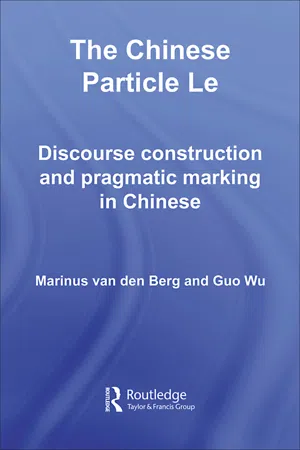
Ever since the start of Chinese linguistic studies, the description of the Chinese particle LE has remained elusive. The classification has evolved from a listing of sentences and the discussion of contrastive pairs to a more context and discourse-oriented analysis. The development in recent years of inferential models and situation semantics has opened the way for a renewed study of the use of the Chinese particle LE. This book discusses the Chinese data from a 'mental space' perspective and finally reveals the role so-called Chinese 'sentence LE' plays in the construction and maintenance of discourse.
eBook - ePub
The Chinese Particle Le
Discourse Construction and Pragmatic Marking in Chinese
- 304 pages
- English
- ePUB (mobile friendly)
- Available on iOS & Android
eBook - ePub
The Chinese Particle Le
Discourse Construction and Pragmatic Marking in Chinese
About this book
Information
1 Introduction
This study is a functional analysis of the various uses of the particle le in Chinese. With functional we want to indicate that we look at language as a function of the human capacity to interact with others. This functional approach allows the distinction of three interaction or communication-related modules: cognition, grammar and pronunciation. Of these three, we see cognition as the dominant module. Without a cognitive base that is developed in interaction with the environment and with others, communication is not possible. This is true both for animals and for humans (Searle 1995; Tomasello 2003). The Chinese particle le we see as directly related to the organisation of this cognitive base, which is shared across members of a group and which is called ‘common-ground structure’ in this study (see Clark 1996). The central question of our study therefore is the relationship between the particle le and common ground structure. We will try to answer in a precise way how this relationship must be seen. However, in order to do so we will have to provide more information as to what we consider to be the human cognitive base and its various operations. We will do so in Chapter 3, where it will become manifest that our thinking is strongly influenced by the theory of mental models developed by Johnson-Laird (1983, 1993), as well as by recent developments in the study of language use (Clark 1996).
The goal of this study is to provide a comprehensive description of the various uses of the Chinese particle le based on empirically relevant data. Our purpose is to define the core function of the Chinese particle le in the context of an original theory of language use, and explain why the particle le is used in the way it is in Chinese. Explanation implies the identification of what causes the use of the particle le (cf. Craik [1943] 1967). This implies the construction of an explanatory model that involves both cognitive organisation and verbal interaction (cf. Huang 1994; Johnson-Laird 1983; Schiffrin 1987; Wu 1998). Our contribution is in particular directed at the theory of language use (cf. de Saussure [1917] 1967; Clark 1996; Lambrecht 1994; Wu 1998). We intend to demonstrate that the concept of linear processing, as used in ‘sentence’- and ‘syntax’-oriented grammars, is fundamentally inadequate, and that continuous interaction between background knowledge and linguistic indexing is the normal way of ‘using language’. We will further argue that linguistic theory, if it is to be taken seriously, needs to take actual language behaviour as the source of its modelling (cf. Gu 1999). The Chinese data discussed in this book suggest that a three-level model of cognitive organisation and language processing is required (cultural common ground, personal common ground, and distribution of information), and we will hypothesise that such modelling is a language/cognition universal.
In the rest of this chapter we will first further discuss what we consider to be two main issues in the analysis of the particle (1.1). We will follow that (1.2) with a general characterisation of the particle’s function (Chao 1968). Thereafter we will discuss some of the factors that complicate the analysis (1.3). In the next section of this chapter we present our method of data collection and data analysis (1.4), and will finish with a discussion of the rationale behind the organisation of the book (1.5).
1.1 Main focus
For the Chinese particle le, we can rely on a wide range of observations and analyses (see Chapter 2) and start from a well-ploughed field of study. Our criticism is on two points in particular: the validity of the data used and the limitations of sentence-based theorising. We therefore paid much attention to the empirical validity of our data (see also the section on ‘Method’, pp. 14–16), and developed a theory of language use incorporating psychological concepts of ‘cognitive functioning’ and ‘joint activities’. Our approach recognises cognitive organisation, social interaction, and communicative intent as crucial elements of understanding the uses of the particle le (Clark 1996; Johnson-Laird 1983; Tomasello 2003). We argue that a shared cognitive base is necessary for effective communication. This shared cognitive base takes the form of a mental model that is current and traces real-time situational developments (Craik [1943] 1967; Johnson-Laird 1983, 1993). Embedded models can be called on to understand discourse guided configurations (cf. Pike 1954). It is models like this that form the basis for formulating an explanation for the phenomenon under study, the uses of the Chinese particle le in various discourse types.
Given this methodical and theoretical orientation and the many valuable previous studies, the central focus in our approach is to the why and when of using the particle le in Chinese. The ‘why’ question defines the ‘core function’ of the particle, its role in verbal interactions. The ‘when’ question directs the particle’s use in various situational and discourse contexts. These questions were left out of most or all previous studies. Our view is that if background knowledge is not recognised as a crucial component in language processing, linguistic theorising is empirically not validated. Explanatory claims outside a cognitive theory of ‘language use’ are by necessity limited in scope and therefore often misleading, as we will amply illustrate. The data chapters in this study will demonstrate in detail the concepts we feel are necessarily involved in an empirically valid analysis. This view further helps to clarify why so far no compelling analysis of the uses of the particle le has been advanced.1
In our approach we will also make use of recent insights into the study of language use. Following Clark (1996), we will identify ‘shared background knowledge’ as ‘common ground’. We will discuss this concept in some detail in Chapter 3. In that chapter, too, we will discuss ‘action theory’ and formulate a hypothesis detailing the nature of indexing with the particle le, which is supported by psychological research of human interaction. We follow Clark in recognising speaking as a ‘joint activity’, which is brought forward via ‘participatory acts’. These acts jointly constitute ‘joint action’. The Chinese particle le, we will argue, signals a co-ordination point, which indicates that co-ordination is needed, or in a feedback move that co-ordination is established now. When a need for co-ordination is signalled that is done under the assumption that the addressee can solve the projected co-ordination issue ‘immediately’, given the ‘information’ that is being provided in the utterance (participatory act) marked with the particle le.
By identifying the function of the Chinese particle le as ‘common ground co-ordination’, we claim to have answered the ‘why’ question of its use. The second question to react to is the when question. In a piece of discourse, there are several places at which the particle le can be used, and the question then is what determines the choice of a speaker to use it at one particular place and not at others. This latter question was central in the study of the form LE in Chinese by Vincent Chang (1986). He was the first to draw attention to uses of le in narrative discourse, and that study provides the background for our focus on when to use the form LE in wider contexts. We refer to the next chapter for discussion of his work.
1.2 Y.R. Chao’s characterisation
In the first fundamental and comprehensive analysis of Chinese grammar, Y.R. Chao (1968) provided a wide-ranging analysis of the particle le (and of the homophonous verbal suffix -le). He identified seven different uses for the particle. In his analysis the particle indicates a new situation, a command in response to a new situation, progress in a story, an isolated event in the past, a completed action as of the present, a consequent clause to indicate situation, ‘obviousness’ (Chao 1968: 798–800). We will discuss each of these distinctions in detail in the next chapter. At this point we like to make three observations:
- a new situation implies a change from a previous situation,
- there is wide variety of uses, and
- it is seemingly impossible to relate the various uses listed in a sensible way.
In almost all studies the particle le has been associated with the projection of a ‘new situation’. We use the term ‘projection’ to indicate that the change of situation is projected by the situation participant deciding to act as speaker at that point in the situation or discourse. The change does not have to take place at the time of speaking. When a speaker projects ‘it’s raining’, this can be said when it starts raining. However, it can also be said after the fact in order to bring that piece of information to the attention of the addressee. This can be done to remind him about the changed situation and thereby allow him to prepare for it. Also, a new situation always implies a change from a ‘previous situation’. It is therefore that in several studies the idea of ‘context’ was introduced in order to make clear that the particle le can only be used in relation to something else (cf. Li and Thompson 1981). In one relatively recent study (Bisang and Sonaiya 1997) the ‘previous situation’ is redefined as a ‘pre-constructed domain’, and the use of the particle le is explained through a mechanism of either ‘conformation’ or ‘confrontation’ with that domain. We will come back to this in the next chapter. Our position regarding the notion ‘new situation’ is that ‘context’ and ‘pre-constructed domain’ represent the common ground speaker and addressee hold at the time of speaking, and the question then becomes which pieces of information are projected when the particle le is used and why the particle is used in such a situation.
In the listing of seven different uses of phrase le or particle le, ‘new situation’ is only one of the distinctions. The notion ‘new situation’ can also be seen as applicable in cases when there is ‘excess over some expected norm’. Chao groups these uses together under ‘change to something new’ and refers to it also as ‘inchoative le’. This inchoative le is perceived as being different from the other uses. The uses ‘progress in a story’ and ‘isolated event in the past’ seem to be unrelated to inchoativity. How then can the presence of the particle le be explained and why is it used? Progress in a story and isolated event in the past can be formulated without the particle le. Is this also a ‘change to something new’? If so, it cannot be so as objective fact outside of context, but only as speaker projection.
The diverse uses of the particle le seem to deny in the first instance the possibility of a central or core function. However, the search for such a unifying function remains crucial in order to avoid making the language model open to random choices. In the search for a core function, we will use notions from common-ground theory and action theory (Chapter 3) in order to be able to understand the ‘why’ question of using the particle le. What motivates speakers to use the particle le in certain situations and at certain points in conversational exchanges? We identified this in section 1.1 as a need for common-ground co-ordination. This identification also must allow us to predict the positions in an exchange or discourse where the particle le is needed. Before tackling the task of making these claims pervasive, first we will look at some other problems that complicate the analytic situation.
1.3 Related problems
In addition to the diverse uses which have no clear internal relationship, we encountered four more problems. In certain instances the use of the particle le seems necessary. Is this a syntactic constraint? Second, in Chinese we have both a word -le and a phrase le (Chao 1968: 692). Are these two le’s related and if so how? Third, apart from wide variation in use across settings (section 2.1), there is also variation across individuals as to the use or nonuse of the particle le (Chang 1986). How can this be explained? Fourth, there are serious discrepancies as to the level at which the particle is analysed. Is the particle le a sentence marker, an attitude marker, a speech act marker, a discourse marker, or something else? In the following we will address these issues one by one.
1.3.1 Syntactic constraints?
Within grammar studies, a distinction can be made between semantic and syntactic forces. The second distinction focuses on agreed-upon rules for ordering grammatical sequences. Since in the foregoing discussion we assumed that the Chinese particle le is a ‘common ground co-ordination device’, it follows that it cannot be under the control of a syntactic rule. However, examples (1) and (2) seem to suggest a syntactic motivation for the presence of the particle le:
(1) [walking on the street / in the office]
Xia yu le
descend rain le
‘It’s raining (now)’.
Xia yu le
descend rain le
‘It’s raining (now)’.
(2) [child to father during a car ride]
Wo e le I hungry le
‘I am hungry (now)’.
Wo e le I hungry le
‘I am hungry (now)’.
And indeed in these instances the particle le must be used. One cannot use these phrases without the particle le – or at least it is difficult or almost impossible to do. We therefore either need to accept that in certain instances uses of the particle le are controlled by syntax, or we must give an explanation for the presence of the particle le in pragmatic terms. We opt for the latter possibility. What we need to demonstrate therefore is that in all instances the particle le requests or affirms common ground coordination. We will try to demonstrate that all uses of the particle le can be formulated within this pragmatic framework, and that no syntac...
Table of contents
- Cover Page
- Title Page
- Copyright Page
- Illustrations
- Preface
- Acknowledgements
- 1: Introduction
- 2: Previous studies
- 3: The particle Le and the study of language use
- 4: The historical development of the particle le
- 5: Action-picture stories
- 6: Children’s stories
- 7: Conversations
- 8: Discussion
- 9: Theoretical implications
- Notes
- References
Trusted by 375,005 students
Access to over 1.5 million titles for a fair monthly price.
Study more efficiently using our study tools.
Frequently asked questions
Yes, you can cancel anytime from the Subscription tab in your account settings on the Perlego website. Your subscription will stay active until the end of your current billing period. Learn how to cancel your subscription
No, books cannot be downloaded as external files, such as PDFs, for use outside of Perlego. However, you can download books within the Perlego app for offline reading on mobile or tablet. Learn how to download books offline
Perlego offers two plans: Essential and Complete
- Essential is ideal for learners and professionals who enjoy exploring a wide range of subjects. Access the Essential Library with 800,000+ trusted titles and best-sellers across business, personal growth, and the humanities. Includes unlimited reading time and Standard Read Aloud voice.
- Complete: Perfect for advanced learners and researchers needing full, unrestricted access. Unlock 1.5M+ books across hundreds of subjects, including academic and specialized titles. The Complete Plan also includes advanced features like Premium Read Aloud and Research Assistant.
We are an online textbook subscription service, where you can get access to an entire online library for less than the price of a single book per month. With over 1.5 million books across 990+ topics, we’ve got you covered! Learn about our mission
Look out for the read-aloud symbol on your next book to see if you can listen to it. The read-aloud tool reads text aloud for you, highlighting the text as it is being read. You can pause it, speed it up and slow it down. Learn more about Read Aloud
Yes! You can use the Perlego app on both iOS and Android devices to read anytime, anywhere — even offline. Perfect for commutes or when you’re on the go.
Please note we cannot support devices running on iOS 13 and Android 7 or earlier. Learn more about using the app
Please note we cannot support devices running on iOS 13 and Android 7 or earlier. Learn more about using the app
Yes, you can access The Chinese Particle Le by M.E. van den Berg,G. Wu in PDF and/or ePUB format, as well as other popular books in Languages & Linguistics & Languages. We have over 1.5 million books available in our catalogue for you to explore.