Following the emancipation of the serfs in 1861, and again during the Gorbachev and Yel'tsin eras, the issue of individual legal rights and freedoms occupied a central place in the reformist drive to modernize criminal justice. While in tsarist Russia the gains of legal scholars and activists in this regard were few, their example as liberal humanists remains important today in renewed efforts to promote juridical awareness and respect for law. A case in point is the role played by Vladimir Solov'ev. One of Russia's most celebrated moral philosophers, his defence of the 'right to a dignified existence' and his brilliant critique of the death penalty not only contributed to the development of a legal consciousness during his lifetime, but also inspired appeals for a more humane system of justice in post-Soviet debate. This book addresses the issues involved and their origins in late Imperial legal thought. More specifically, it examines competing theories of crime and the criminal, together with various prescriptions for punishment respecting personal inviolability. Charting endeavours of the juridical community to promote legal culture through reforms and education, the book also throws light on aspects of Russian politics, society and mentality in two turbulent periods of Russian history.
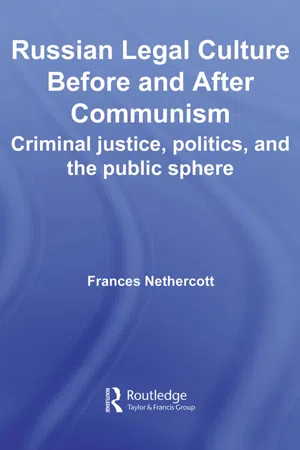
eBook - ePub
Russian Legal Culture Before and After Communism
Criminal Justice, Politics and the Public Sphere
- 224 pages
- English
- ePUB (mobile friendly)
- Available on iOS & Android
eBook - ePub
Russian Legal Culture Before and After Communism
Criminal Justice, Politics and the Public Sphere
Table of contents
- Cover Page
- Title Page
- Copyright Page
- Acknowledgements
- Note on Transliteration
- Abbreviations
- Introduction
- 1 Fathers and Sons of Legal Reform
- 2 Reforming Criminal Law (1864–1903)
- 3 Theorizing Crime and Punishment
- 4 Solov’ev as a Philosopher of Law
- 5 Criminal Justice in the Age of Revolution (1900–1917)
- 6 Rehabilitating Law: Criminal Justice After Communism
- Afterword: Post-Soviet Legal Culture and Pre-revolutionary Models
- Notes
- Select Bibliography
Trusted by 375,005 students
Access to over 1.5 million titles for a fair monthly price.
Study more efficiently using our study tools.
Frequently asked questions
Yes, you can cancel anytime from the Subscription tab in your account settings on the Perlego website. Your subscription will stay active until the end of your current billing period. Learn how to cancel your subscription
No, books cannot be downloaded as external files, such as PDFs, for use outside of Perlego. However, you can download books within the Perlego app for offline reading on mobile or tablet. Learn how to download books offline
Perlego offers two plans: Essential and Complete
- Essential is ideal for learners and professionals who enjoy exploring a wide range of subjects. Access the Essential Library with 800,000+ trusted titles and best-sellers across business, personal growth, and the humanities. Includes unlimited reading time and Standard Read Aloud voice.
- Complete: Perfect for advanced learners and researchers needing full, unrestricted access. Unlock 1.5M+ books across hundreds of subjects, including academic and specialized titles. The Complete Plan also includes advanced features like Premium Read Aloud and Research Assistant.
We are an online textbook subscription service, where you can get access to an entire online library for less than the price of a single book per month. With over 1.5 million books across 990+ topics, we’ve got you covered! Learn about our mission
Look out for the read-aloud symbol on your next book to see if you can listen to it. The read-aloud tool reads text aloud for you, highlighting the text as it is being read. You can pause it, speed it up and slow it down. Learn more about Read Aloud
Yes! You can use the Perlego app on both iOS and Android devices to read anytime, anywhere — even offline. Perfect for commutes or when you’re on the go.
Please note we cannot support devices running on iOS 13 and Android 7 or earlier. Learn more about using the app
Please note we cannot support devices running on iOS 13 and Android 7 or earlier. Learn more about using the app
Yes, you can access Russian Legal Culture Before and After Communism by Frances Nethercott in PDF and/or ePUB format, as well as other popular books in History & Russian History. We have over 1.5 million books available in our catalogue for you to explore.