While the connections between science fiction and race have largely been neglected by scholars, racial identity is a key element of the subjectivity constructed in American SF. In his Mars series, Edgar Rice Burroughs primarily supported essentialist constructions of racial identity, but also included a few elements of racial egalitarianism. Writing in the 1930s, George S. Schuyler revised Burroughs' normativeSF triangle of white author, white audience, and white protagonist and promoted an individualistic, highly variable concept of race instead. While both Burroughs and Schuyler wroteSF focusing on racial identity, the largely separate genres of science fiction and African American literature prevented the similarities between the two authors from being adequately acknowledged and explored. Beginning in the 1960s, Samuel R. Delany more fully joined SF and African American literature. Delany expands on Schuyler's racial constructionist approach to identity, including gender and sexuality in addition to race. Critically intertwining the genres of SF and African American literature allows a critique of the racism in the science fiction and a more accurate and positive portrayal of the scientific connections in the African American literature. Connecting the popular fiction of Burroughs, the controversial career of Schuyler, and the postmodern texts of Delany illuminates a gradual change from a stable, essentialist construction of racial identity at the turn of the century to the variable, social construction of poststructuralist subjectivity today.
- 240 pages
- English
- ePUB (mobile friendly)
- Available on iOS & Android
eBook - ePub
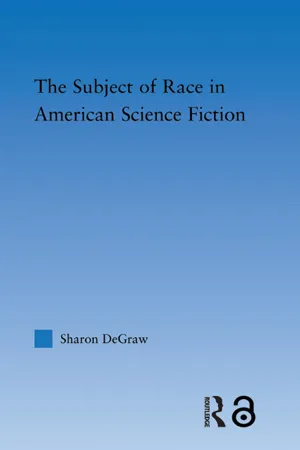
The Subject of Race in American Science Fiction
About this book
Trusted by 375,005 students
Access to over 1.5 million titles for a fair monthly price.
Study more efficiently using our study tools.
Information
Chapter One
Burroughs
IN THE BEGINNING
The genre of science fiction is widely considered to have started with Mary Shelley’s Frankenstein, published in Great Britain in 1818. However, as Robert Scholes and Eric Rabkin note in a brief history of science fiction, “When Mary Shelley wrote Frankenstein, science fiction had neither a name or any recognition as a separate form of literature [and t]his situation lasted for a century” (7). Such generic ambiguity and critical retrospection mark the field of science fiction studies. In a more comprehensive history of science fiction, Edward James highlights the sharp rise in English language texts dealing with the future from the 1850s onward. He states that “[t]hroughout the [19th] century, most of the respected (male) writers of fiction in the United States had dabbled in what we could call science fiction” (Science 33)1. However, “[s]f was first named, and first became a genre, in the science fiction magazines published in the United States before the Second World War” (E. James, Science 66). In such a literary context, early writers of science fiction were not consciously writing within the genre. In fact, many wrote with other genres in mind. For example, when Edgar Rice Burroughs began his writing career in the 1910s, he wrote adventure fiction for all-fiction magazines. We simply classify many of his texts as science fiction from a contemporary critical vantage point. ERB merits special attention from Edward James because he is “probably the most influential of the writers who began in the pulps” (Science 45). Given the lack of generic formation before the first decades of the twentieth century, it is not surprising that “[m]any of the important names in the early science fiction magazines had already written science fiction for several years in the general fiction pulps” (ibid). The science fiction texts were simply published alongside other popular adventure tales—the westerns of Zane Grey, the African adventures of H. Rider Haggard, and the northern stories of Jack London, for example.2
In the United States, the combination of a “fin de siecle” feeling (E. James, Science 31), an increase in literacy, and a growing interest in “science and technology” led first to the inclusion of science fiction in cheap, all-fiction pulp magazines and then the increasing specialization of these magazines up through the 1930s (Scholes and Rabkin 35). In his book, The Creation of Tomorrow: Fifty Years of Magazine Science Fiction, Paul Carter chronicles the rise of the pulps and their association with science fiction. Carter begins the first chapter with Hugo Gernsback because he founded and edited Amazing Stories, “the first periodical in the world devoted solely to science fiction” (4). In addition, as the editor of several pulp magazines in the 1920s and 1930s, Gernsback had a formative effect on the evolution of the genre. As Edward James asserts, “The creation of specialist science fiction magazines was a recognition of the existence of a genre, and once that genre was named, in the late 1920s—first as ‘scientifiction,’ and then as ‘science fiction’—we get our first attempts at definitions. It is no coincidence that the first definitions came with the coiner of those names, Hugo Gernsback” (Science 52). Both Carter and James emphasize Gernsback’s scientific positivism and the tremendous influence of the “Gernsback-Sloane-Tremaine-Campbell [editorial] guidelines” on science fiction (Carter 18). Education of the public, progress, and extrapolation were all key components of the editors’ focus on science. However, despite this scientific emphasis and attempts to define the genre accordingly, science fiction has always had a dual nature in which the fictional format is equally important as the science. Gernsback, for example, suggested that the ideal science fiction text would be one quarter science and three quarters romance (E. James, Science 52). In this context, Carter notes that some science fiction writers “were simply impatient at the necessity for interrupting their storylines to get the science straightened out. They were, after all, writing for cash for magazines published as men’s-adventure pulps in which fast action was the sine quo non” (19). Edgar Rice Burroughs was one such writer. He serves as a representative early science fiction writer in his incredible output and the multi-generic aspect of his work. Due to the generic ambiguity of early science fiction—its lack of theoretical definition and roots in other literary genres—Burroughs combined adventure fiction, romance, and science fiction, often in one text. In fact, despite giving Burroughs a prominent place in their histories of the science fiction field, both Carter and James oppose ERB to Gernsback’s scientific focus. Edward James asserts that “[t]here was little or no pretence at scientific correctness in Burroughs” (Science 45–6), and he follows the lead of Brian Aldiss, another science fiction historian, in labeling Burroughs’ work as escapist and thought-stifling (Trillion 164–5).
While the debate over the definition and generic boundaries of science fiction continues to this day,3 a strong uniformity of perspective existed in other key areas of the early science fiction field. First, a single, highly individualistic action hero took center stage in the majority of the texts due to the literary roots of American science fiction in adventure fiction. This heroic protagonist was almost always male and of Anglo descent. The protagonist’s textual dominance, heroic nature, and representative status all combined to convey the normalcy and universalism of the Anglo male perspective. The hero represented not only his country and/or race, but also ideal manhood and the entire human race (in opposition to aliens).4 Many times the protagonist also narrated the story, obscuring even the possibility of competing perspectives. Within western culture, explorers and adventurers were historically white males. However, the gender and racial/national origin of the protagonist stemmed from that of the authors, editors, and readers of early science fiction as well. In effect, a triangle of racial and gender similarity existed, composed of the protagonist, the authors and editors, and the audience.
The science fiction authors and editors are the second element in this Anglo male triangle. Female authors were the exception in the science fiction field up through the 1960s due to the general sexism existing in patriarchal western culture, the professional fields, and the publishing industry. More specifically, the strong exclusion of women from the sciences and the overwhelmingly male audience of adventure fiction and science fiction promoted male authorship. Paul Carter notes that, prior to 1940, author C. L. Moore “stood virtually by herself” in the science fiction field (180). As most writers promote their own values and beliefs, and these are usually grounded in their personal identity and experiences, the uniformity of perspective between the male authors of science fiction and their protagonists should not be surprising. John Taliaferro, for example, calls Burroughs’ protagonists “his fictional alter-egos” (22) and explores the connections between Burroughs’ pride in his “Anglo-Saxon lineage” and the similar background of his protagonists (19). Taliaferro also links the personal beliefs of Burroughs to the larger cultural context of early twentieth-century America: “All of his plots [… ] boil down to survival of the fittest [… ]. Burroughs, like so many of his contemporaries, believed in a hierarchy of race and class” (19). Like their readers, the science fiction authors were heavily influenced by the Anglocentric, patriarchal society in which they lived. Not only did they cater to the masculine ideals of their young, male audience, but also the authors held similar ideals due to the shared culture. In addition, the large and continuous output required of authors by the pulp magazines hindered the creation of less stereotypical characters. Few authors had the time or motivation to move beyond generic formulas or to question accepted social norms. Furthermore, some science fiction editors actively promoted an Anglo male protagonist. For example, Isaac Asimov describes the influential editor of Astounding magazine, John Campbell, as “tak[ing] for granted, somehow, the stereotype of the Nordic white as the true representative of Man the Explorer, Man the Darer, Man the Victor” (qtd. in Carter 77). The close gender and racial correlation between the science fiction triangle of editors and authors, protagonists, and readers fostered the universality of the Anglo male perspective.
As they tried to sell their material, science fiction authors and editors catered to an overwhelmingly young, male audience. In the chapter Paul Carter devotes to the “Feminine Mystique in Science Fiction,” he acquiesces with Joanna Russ’ characterization of the typical science fiction reader as an adolescent boy, at least in the early years (Carter 173). Even as Carter points out the general aging of science fiction readers by the end of the 1940s, he maintains the over-all masculine make-up of the audience (ibid). Edward James explicitly, and somewhat condescendingly, links Edgar Rice Burroughs with a young, masculine audience:
he was published in Britain as a writer of stories for boys; tales of interplanetary derring-do were suitable for boys and Americans, but not for British adults. And, it is fair to say, those intrigued by Burroughs’s brand of romance tend to be captured young: few young males can resist riding in their imagination on a six-legged thoat across Barsoom’s dry sea-beds […] alongside John Carter. (Science 46)
John Carter, the protagonist of Burroughs’ Mars series, was not a “boy,” since only adult males could completely fulfill the multiple functions of a hero— including great physical strength in adventure fiction. Yet, the young men reading such texts clearly identified themselves with the hero. The authors and editors of science fiction texts knew this identification and vicarious participation would be limited by a heroine.
Furthermore, one day these young male readers would grow into men and positions of adventure and power would be open to them. While interplanetary exploration was not feasible in the early decades of the twentieth century, the young men could realistically envision themselves as adventurers, explorers, and national envoys. In her book Primate Visions: Gender, Race, and Nature in the World of Modern Science, Donna Haraway titles the first chapter “Teddy Bear Patriarchy” because Teddy Roosevelt was a real-life icon of turn-of-the-century western man. Haraway explores the connections between “Nature, Youth, Manhood, [and] the State” in the Roosevelt Memorial atrium of the African Hall, located in the American Museum of Natural History, and she highlights the close association of young males of this time period with powerful and world-renowned men like Roosevelt (27). The former president’s rough and dangerous adventures, including safaris to Africa and explorations of the Amazon, served as an ultimate, but real-life example of manhood. After reading one of the many accounts of Roosevelt’s life, the adventures of John Carter would not seem so farfetched to young science fiction fans.5 In fact, Haraway draws such a fictional parallel in her text by prefacing the chapter on Roosevelt with a quote from Burroughs. Both Brian Street and Edward James connect juvenile males, adventure fiction, and imperialism in their discussion of turn-of-the-century British literature as well. Within this context, young male readers not only identified with the Anglo male protagonist, but also sought to emulate him in the real world. Thus, the authors created protagonists with the readers’ ideals in mind and, conversely, the readers utilized the protagonists as role models. With such a close association between the audience and the protagonists, early science fiction readers normally did not question the primacy of the Anglo male perspective.
In addition, the dominance of this Anglo male perspective combined with an emphasis on science and technology to restrict the speculative element of early American science fiction. Since inventions and technical gadgets were the primary focus of early speculation, more abstract concepts like identity, gender, or race often were neglected. Paul Carter, for example, sets up the first installment of Edgar Rice Burroughs’ Mars series as the progenitor of a long line of stereotypical science fiction. From the Old West hero, John Carter, to the Western American setting of Mars, to the Indians disguised as Martians, “[t]his Western Mars [… ] was to reappear again and again in pulp science fiction” (62). According to Paul Carter, “this Western Mars,” and its Anglo-American male perspective, dominated the large subgenre of Martian science fiction up through the first half of the twentieth century. It was not until 1970 that John Campbell wrote a eulogy for Burroughs’ Mars, entitled “Goodbye to Barsoom” (Carter 69). Furthermore, this tendency to superficially and stereotypically transform Earth and terrestrial culture from the Anglo male perspective extended across the solar system: “Mars as nineteenth-century frontier America and Venus as nineteenth-century frontier Africa had a mythic appeal that pushed aside all demands of scientific exactitude” (Carter 65). Mercury and Jupiter were exoticized as “Asian port cities” as well (Carter 68). Paul Carter’s summary of the “general archaizing and Westernizing of the space frontier” foregrounds the stereotypical tendencies and multi-generic roots of early science fiction, as well as its lack of scientific focus (72). It also emphasizes the importance of the Other to early science fiction.
Paul Carter begins the second section of his chapter, “Under the Moons of Mars: The Interplanetary Pastoral,” with a quote from Leslie Fiedler which grounds the Anglo-American male perspective in the Other of American “Indians” (66). Although clearly not the main focus in early science fiction, such Other(s) were essential for the formation of the Anglo male perspective. The heroism of the Anglo male protagonist required a negative type against which to be gauged, and the tension between the protagonist and the Other(s) provided the textual action or conflict. For example, females served as secondary characters for romantic purposes and sexual titillation. In addition, the women provided both a foil and a motivation for the characteristics culturally ascribed to males: courage, power, and action. Characters of ethnic, racial, or national backgrounds other than Anglo-American or Anglo-European usually functioned as villains or stereotyped representatives of an exotic locale. Finally, aliens were mostly a thinly disguised substitute for any of these multiple Others. In her book Aliens and Others: Science Fiction, Feminism, and Post-modernism, Jenny Wolmark links all three of these character groups and discusses how “the alien has been used to represent Otherness” in science fiction texts (28). Including an Other, however, always creates the potential for subversion of the primary viewpoint. To forestall such a possibility, the science fiction authors subordinated, caricaturized, and/or vilified the Other(s). For example, in his discussion of the exceptional science fiction writing of Stanley G. Weinbaum in the early 1930s, Paul Carter asserts that, “[u]ntil Weinbaum’s time, the reader’s choice in extraterrestrial life-forms was usually between human beings (some of whom were very, very good) and monsters (most of which were very, very bad)” (73). Weinbaum merits attention from Carter, despite his extremely short career, because he created an alien character who “has an intellect at least as good as the hero’s own” and, as a result, broke “clean away from both the Burroughs and the Wells stereotypes of life on Mars” (ibid).
Throughout American history, dominant Anglo-American male identity has been constructed in contrast to the multiple Others of Native Americans, African-Americans, women, Asians, and Euro-Americans of other national origins.6 However, when science fiction was emerging in the United States at the beginning of the twentieth century, a new Other was developing—a massive influx of eastern and southern European immigrants in what became known as the New Immigration. The same technological and scientific changes which inspired science fiction combined with this New Immigration to fuel racialism and the increasing popularity of the eugenics movement. In Bordering on the Body: The Racial Matrix of Modern Fiction and Culture, Laura Doyle provides a useful summary of the eugenics movement in the United States at the beginning of the twentieth century. Overtly combining science and politics, eugenics connected scientific theories with social reform: 7 “Eugenics held that ‘racial degeneration’ in Western nations threatened what the contemporary political writer Benjamin Kidd called ‘the struggle of the Western races for the larger inheritance of the future.’ According to eugenicists, only racially responsible reproduction could reverse this trend and ensure success in the global economic struggle” (Doyle 11). As a result, outspoken anti-immigration advocates formed the Immigration Restriction League in 1894. “IRL leaders believed there was a racial foundation to American nationality, that heredity was more powerful than environment, and that the new immigrants were racially inferior” (American). Acting on these beliefs, the anti-immigration leaders wrote articles and books with titles like Edward Ross’ “American Blood and Immigrant Blood” (1913) and Madison Grant’s The Passing of the Great Race (1916). Politically, their efforts culminated in the passing of the Immigration Act of 1924, which imposed stringent quotas on southern and eastern European countries. The legislation heavily restricted the immigration of national and ethnic groups like Italians, Poles, and Jews, while encouraging immigration from western European countries. It also formalized the complete exclusion of Asians initiated earlier with the Chinese Exclusion Act of 1882. At the same time, the Indian Citizenship Act of 1924 forced Native Americans to assimilate completely to Anglo-American ideals, like private land ownership, or lose their tribal territory completely. These simultaneous, multiple examples of American racialism and nativism reveal the increasing pressure being applied to the Anglo-American male position at the turn-of-the-century. Threatened, the Anglo-American men asserted their normalcy, universality, and superiority through the discourses of science and race.
The dual aspect of science reflects the paradoxical position of Anglo men. The need to prove their normalcy and universality called for a uniform standard and overt scientific objectivity. On the other hand, the need to assert their superiority led to the underlying subjectivity of their scientific practice and discourse. In Primate Visions, Donna Haraway begins with the historically dominant association of science with fact and literature with fiction (3–4). From this position, “the natural sciences seem to be crafts for distinguishing between fact and fiction” (4). In most early science fiction, the viewpoint of the protagonist is allied with Western science. Therefore, it seems completely reliable, without bias, and the unquestioned norm. This emphasis on objectivity combined with the scientific positivism of most early science fiction paradoxically to both support and erase the dominance of the Anglo male perspective. As Haraway chronicles in Primate Visions, the history of western science tells a story of progress which entails the ever-increasing suppression of its own fictional nature (4).
Within the rapidly developing sciences of biology and anthropology, for example, race became a scientifically constructed term with overtly objective and authoritative connotations. Natural and social scientists tied both race and ethnicity to the physical body, and biology served as an anchor for individual and collective identity. It was widely believed that behavior, intelligence, and even morals had their foundations in ethnicity or race.8 For instance, Madison Grant, head of the New York Zoological Society and trustee of the Museum of Natural History, claimed that,
New York is becoming a cloaca gentium which will produce many amazing racial hybrids and some ethnic horrors that will be beyond the power...
Table of contents
- Cover
- Title Page
- Copyright Page
- Dedication
- Table of Contents
- Acknowledgments
- Chapter One Burroughs
- Chapter Two Schuyler
- Chapter Three Delany
- Appendix Timeline
- Notes
- Works Cited
- Index
Frequently asked questions
Yes, you can cancel anytime from the Subscription tab in your account settings on the Perlego website. Your subscription will stay active until the end of your current billing period. Learn how to cancel your subscription
No, books cannot be downloaded as external files, such as PDFs, for use outside of Perlego. However, you can download books within the Perlego app for offline reading on mobile or tablet. Learn how to download books offline
Perlego offers two plans: Essential and Complete
- Essential is ideal for learners and professionals who enjoy exploring a wide range of subjects. Access the Essential Library with 800,000+ trusted titles and best-sellers across business, personal growth, and the humanities. Includes unlimited reading time and Standard Read Aloud voice.
- Complete: Perfect for advanced learners and researchers needing full, unrestricted access. Unlock 1.5M+ books across hundreds of subjects, including academic and specialized titles. The Complete Plan also includes advanced features like Premium Read Aloud and Research Assistant.
We are an online textbook subscription service, where you can get access to an entire online library for less than the price of a single book per month. With over 1.5 million books across 990+ topics, we’ve got you covered! Learn about our mission
Look out for the read-aloud symbol on your next book to see if you can listen to it. The read-aloud tool reads text aloud for you, highlighting the text as it is being read. You can pause it, speed it up and slow it down. Learn more about Read Aloud
Yes! You can use the Perlego app on both iOS and Android devices to read anytime, anywhere — even offline. Perfect for commutes or when you’re on the go.
Please note we cannot support devices running on iOS 13 and Android 7 or earlier. Learn more about using the app
Please note we cannot support devices running on iOS 13 and Android 7 or earlier. Learn more about using the app
Yes, you can access The Subject of Race in American Science Fiction by Sharon DeGraw in PDF and/or ePUB format, as well as other popular books in Literature & Literary Criticism. We have over 1.5 million books available in our catalogue for you to explore.